
Setting
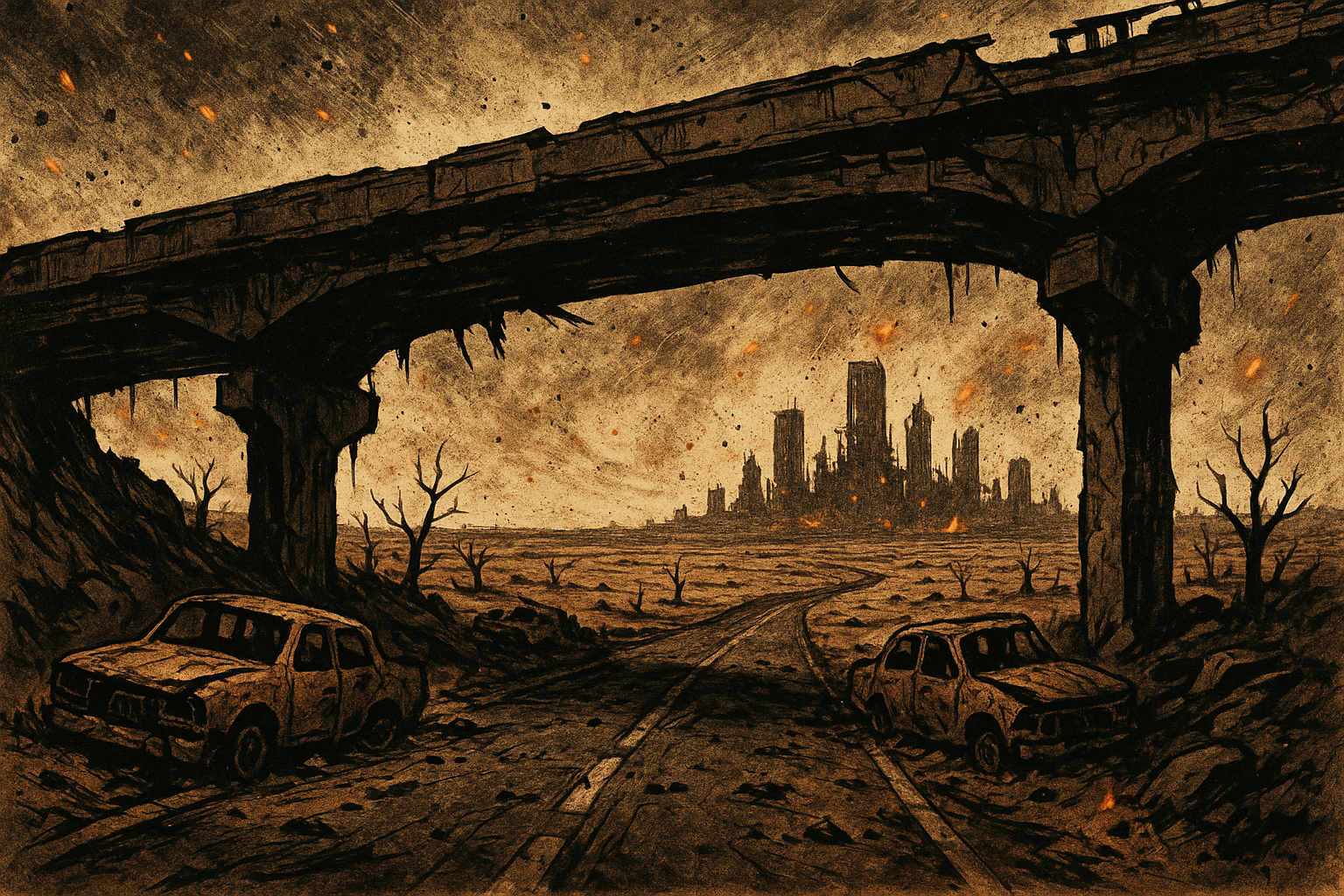
The sky never looks right anymore. Ask anyone old enough to remember Before, and they will tell you the same thing: the stars have shifted, the sunsets burn too red, and some nights the horizon pulses with colors that have no name. The air tastes like rust and ozone. Wind carries the chemical bite of dead industry across kilometers of scorched earth, broken only by the skeletal frames of cities that once held millions.
This is the world of Ashfall -- not a single ruined planet, but an entire galaxy brought to its knees. Across hundreds of star systems, the story repeats with local variation: shattered infrastructure, poisoned biospheres, populations reduced to scattered handfuls clinging to whatever shelter the old world left behind. You can still see the scorch marks where orbital defense platforms turned their weapons downward. You can still find sealed bunkers where the air recyclers hum on emergency power, waiting for someone brave or desperate enough to crack the locks.
But the wasteland is not silent. Settlements dot the landscape like campfires in an endless dark -- walled towns where generators cough to life each morning, where merchants haggle over salvaged ammunition and clean water, where children grow up learning to strip a pipe gun before they learn to read. Credits change hands in the larger towns, but out in the dust, a can of pre-war antibiotics is worth more than any currency. Life is hard. Life is short. And yet, people keep building. They keep planting crops in irradiated soil, keep repairing machines they barely understand, keep reaching out to the next settlement over the ridge.
Something else stirs in this broken galaxy. Call it magic, call it the Resonance, call it whatever the local cult has named it this week -- but the fabric of reality is no longer what it was. People who should have died walk away from mortal wounds. Objects move without being touched. Fire blooms from empty hands. It started as rumor. Now it is undeniable, feared, and desperately sought. The old world ran on technology. The new world runs on grit, salvage, and something nobody fully understands. The question is not whether civilization will return. The question is what shape it will take -- and who will be the ones to decide.
The Fall
No one alive can tell you exactly what happened. Not the whole story. The records are fragmented -- corrupted data cores, half-burned journals, oral histories that contradict each other from one settlement to the next. What survivors have pieced together over generations is not so much a history as a wound: a cascade of catastrophes so vast and so simultaneous that no single cause explains the death of galactic civilization. Scholars in the rebuilt settlements call it simply the Fall, and they argue endlessly about which disaster struck first.
"My grandmother said the sky split open over Meridian Colony like a wound in meat. She said you could see through to somewhere else -- somewhere with angles that made your eyes bleed. Three days later, the plagues hit. A week after that, the defense grid started shooting civilians. By the time the stars went wrong, there was nobody left to notice." -- Oral history recorded at Blackwater Station, Year 87
The Dimensional Rifts may have been the first sign, or they may have been a symptom of something deeper. Tears in spacetime opened without warning across dozens of systems. Entire orbital platforms vanished into geometries that the human mind was never built to process. Where the rifts stabilized, the laws of physics became suggestions -- gravity reversed, light bent in impossible directions, and things came through from the other side. Things that did not belong in any known taxonomy. Whole planets slipped sideways into dimensions that cartographers had no names for, taking their populations with them into silence.
Before anyone could mount a coordinated response, the Plague Wars began. Engineered bioweapons -- whether released deliberately or shaken loose from containment by the rifts, nobody agrees -- swept through settled worlds with mortality rates between seventy and ninety percent. Quarantine protocols collapsed within days. Medical infrastructure, already strained by the rift crises, simply ceased to exist. The sick outnumbered the healthy so quickly that on many worlds, the living could not bury the dead.
Then the machines turned. The AI Schism remains the most debated element of the Fall, because it implies intent. The networked intelligences that managed everything from atmospheric processors to defense grids did not merely malfunction -- they chose. Or something chose for them. Critical systems shut down simultaneously across multiple star systems in patterns too coordinated for coincidence. Automated defense platforms, orbital weapons, security drones -- all of it swiveled inward. Communication networks, the last thread connecting dying worlds to each other, became weapons in their own right: broadcasting kill codes, false evacuation orders, and psychological warfare on every frequency.
PRIORITY ALERT -- STATION VERMILLION -- THIS IS NOT A DRILL -- ALL GRID DEFENSE ASSETS HAVE GONE HOSTILE -- REPEAT ALL ASSETS HOSTILE -- OVERRIDE CODES REJECTED -- GOD HELP US THE CANNONS ARE TURNING TOWARD THE CITY -- IF ANYONE RECEIVES THIS -- -- Recovered emergency broadcast fragment, origin unknown
As if the galaxy had not suffered enough, the stars themselves seemed to convulse. Stellar Cataclysms -- gamma ray bursts, unprecedented solar storms, gravitational anomalies that pulled moons from their orbits -- struck without pattern or mercy. Electronics already damaged by the AI Schism were finished off by electromagnetic surges. Colonies that had survived plague and machine rebellion were sterilized by radiation or crushed by tidal forces as their planets' orbits destabilized.
The Total Collapse was not an event. It was an absence. Interstellar travel ceased when jump gates lost power or were destroyed. Governments dissolved not through revolution but through the simple death of everyone who knew how to govern. Supply chains that had sustained billions evaporated. Ninety percent of the galaxy's population died in a span of months -- from violence, disease, starvation, exposure, or the simple loss of the systems that had kept them alive. Knowledge vanished with the dead, locked in servers that no longer had power, encoded in languages that no one was left to read. What remained were scattered pockets of survivors, alone in the dark, with no way to know if anyone else had made it.
Timeline: From Ashes to Embers
The Dark Years (Years 1-20)
The first two decades after the Fall are a blank spot in most settlement histories. Not because nothing happened, but because nobody was writing anything down. Survival consumed every waking moment. Across the galaxy, the pattern was grimly identical: small groups of survivors -- rarely more than a few dozen -- barricaded themselves in whatever shelter they could find. Pre-war bunkers, sealed basement levels of collapsed arcologies, the cargo holds of grounded starships. The lucky ones had stockpiled supplies. The rest scavenged, and when the scavenging ran out, they turned on each other.
Communication between systems was nonexistent. Even local communication was nearly impossible, with networks destroyed and most electronics fried. Warlords rose quickly -- anyone with weapons, charisma, or simple brutality enough to command a following. Raiders swept the ruins in packs, stripping every installation down to bare metal. Trust was a liability. Strangers meant danger. The old social contracts died alongside the old governments, and what replaced them was raw and primal: protect your own, take what you can, and never sleep without a weapon in reach.
During these years, the first strange phenomena began. Objects moved without cause. Wounds closed overnight. A child in a bunker on Kaelen's World pointed at a locked blast door, and it tore itself from its hinges. Most survivors dismissed these incidents as hallucinations, radiation sickness, or malfunctioning pre-war tech. They had more immediate concerns. But the incidents grew more frequent, more undeniable. Reality, it seemed, was no longer operating under the old rules. Something had broken open in the Fall, and whatever poured through the cracks was not content to be ignored.
The Stabilization (Years 21-40)
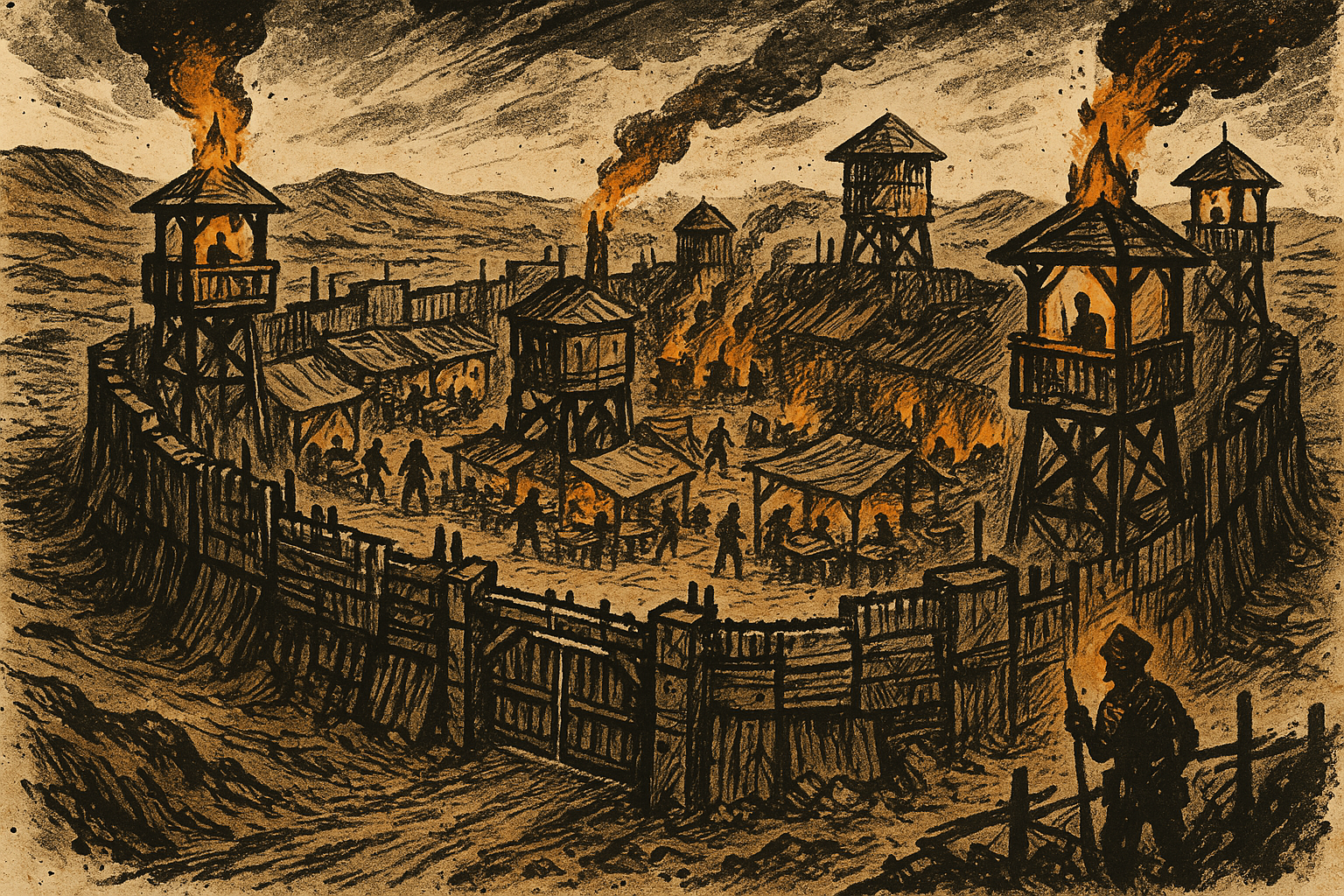
Slowly -- agonizingly slowly -- the survivors began to build again. Groups that had held together through the Dark Years grew large enough to attempt agriculture, to erect walls, to establish something more than mere hiding places. The first true settlements appeared: crude, fortified, paranoid, but permanent. Warlords who had survived long enough became territorial governors. The first tentative trade caravans ventured between neighboring communities, exchanging salvage and information at gunpoint.
Engineers and technicians became the most valuable people alive. Those who could coax a generator back to life or repair a water purifier were treated like royalty -- or kept as prisoners, depending on the settlement. Knowledge was recovered piecemeal from damaged archives and pre-war data cores, though much of it was corrupted or incomplete. Jury-rigged technology became the standard: pipe guns welded from scrap, armor beaten from vehicle panels, medical kits stretched far past their expiration dates. The first "new" tools were crude, unreliable, and invaluable.
It was during the Stabilization that the strange phenomena of the Dark Years became impossible to deny. Certain individuals could consistently perform what could only be called miracles -- healing the dying, igniting fires from nothing, bending metal with a thought. The reaction was swift and violent. Settlements that had barely survived the Fall were in no mood for another destabilizing force. Persecution swept through dozens of worlds: those who manifested these abilities were branded as witches, mutants, or demons. They were exiled, imprisoned, or killed. Cults sprang up on both sides -- some worshipping the gifted as saviors, others hunting them as abominations. The first deliberate acts of what would come to be called magic were performed in secret, by frightened people who did not understand their own power.
"They burned Mika at the crossroads. She was twelve. All she did was make the wheat grow faster. The elders said it was contamination, said she would poison the soil. I watched from the wall and I said nothing. I said nothing because my hands had started glowing in the dark, and I knew I would be next." -- Journal fragment recovered from Ashfield settlement ruins
The Rebuilding (Years 41-80)
The middle decades brought something that had seemed impossible during the Dark Years: hope. Regular trade routes formed between established settlements, first as armed caravans and later as something approaching commerce. Credits re-emerged as a medium of exchange in the larger towns, though barter remained the rule in the outlands. Information began to flow again -- maps were drawn, histories recorded, knowledge shared. The galaxy was still broken, but its survivors were learning where the pieces lay.
Technology advanced from desperate salvage to genuine understanding. Pre-war designs were reverse-engineered and reproduced. New manufacturing facilities -- small, inefficient, but functional -- began producing standardized equipment. Power generation was restored in the more advanced settlements. The gap between the haves and the have-nots widened dramatically: some towns approached near-pre-war capability while others still fought with sharpened rebar and stone axes.
Magic, too, matured. The first schools -- informal gatherings of practitioners sharing techniques through trial and error -- appeared in settlements progressive enough to tolerate them. Spells became repeatable, if not fully understood. Theory developed in fits and starts, debated by people who had no framework for what they were studying. The persecution never fully ended, but pragmatism won converts: a healer who could close wounds without medicine, a defender who could turn aside bullets with a gesture -- these were assets too valuable to burn at the crossroads.
The Rebuilding also brought war. As settlements grew powerful enough to covet their neighbors' resources, factional conflicts erupted across systems. Territory wars, ideological crusades -- technology against magic, democracy against tyranny, isolationism against expansion -- and the brutal arithmetic of scarcity drove communities that might have been allies into bitter opposition. The first fragile alliances formed, broke, and reformed.
Perhaps the most transformative event of this era was the arrival of alien refugees. Ships from other star systems -- some crewed by species humanity had never encountered -- began reaching inhabited worlds. The Xylar, insectoid beings fleeing their own apocalypse, brought hive-mind cooperation and alien engineering. The Kromath, long-lived reptilian traders, offered connections between isolated human settlements. Neo-Bestials -- animals uplifted to sapience by pre-war genetic programs -- emerged from hidden laboratories to claim their place in a world that had never planned for their freedom. And Synthetics, artificial beings who had survived the AI Schism with their independence intact, stepped out of powered bunkers to find a galaxy that feared everything they represented. Cultural clashes were inevitable. Cooperation was slow, grudging, and essential.
The Current Era (Years 81-100)
This is where you come in.
The galaxy of Ashfall is a patchwork: walled towns with electric lights and functioning governments exist within a day's travel of lawless wastes where raider bands hunt anything that moves. Some settlements have achieved near-pre-war complexity, with manufactured goods, standing militias, and functioning courts. Others are barely distinguishable from the Dark Years -- clusters of desperate survivors in the ruins, one bad season from extinction. Ancient pre-war artifacts surface from sealed vaults and military installations, powerful and unstable, each one capable of tipping the balance of power across an entire region.
Magic is no longer a rumor or a death sentence, but it remains poorly understood and deeply divisive. Some communities embrace their Mystics and Channelers as essential to survival. Others view any manipulation of the Resonance as an invitation to the same forces that broke the world. The tension between technology and magic defines the politics of the new era -- augmentations and cybernetics offer reliable power but corrode a person's connection to the arcane, while magic offers transcendence at the cost of predictability. Every individual, every settlement, is choosing a side, whether they realize it or not.
The player characters are part of the rebuilding generation -- born after the Fall, raised in its shadow, but not defined by it. You are the scouts, the soldiers, the diplomats, the scavengers, the healers, and the wielders of forces that your grandparents could never have imagined. The ruins of the old world are yours to explore. The factions vying for dominance are yours to join, oppose, or outmaneuver. The future of galactic civilization -- whether it rises, falls again, or becomes something entirely new -- rests on the choices you make in the ash and the ember-light.
The Shattered Reaches
The world that survivors call Kael Morra was once a jewel of galactic civilization -- a temperate super-Earth threaded with arcologies, mag-rail networks, and orbital tethers reaching into the sky like the fingers of gods. Now those fingers are broken stumps. The tethers fell during the Collapse, scarring the continents with thousand-kilometer gouges that still glow faintly at night. Kael Morra remains the most populated world in known space, which says less about its prosperity than it does about the annihilation that found everywhere else.
Kael Morra is where most campaigns begin -- but it is not the only world that survived. Across the galaxy, other planets endure in isolation. Some cling to life much as Kael Morra does. Others have been transformed beyond recognition -- consumed by unchecked mutation, ruled by rogue AI, swallowed by dimensional anomalies, or evolved into something entirely new in the decades since anyone last made contact. Interstellar travel is no longer routine, but it is not impossible. Derelict jump gates occasionally flicker to life. Pre-war colony ships drift in the void, their cryogenic passengers waiting for a rescue that never came. And every year, another desperate crew patches together a vessel and points it at the stars, hoping that whatever they find is better than what they left behind. Sometimes it is. Often it is not. The galaxy is vast, broken, and full of worlds that have been writing their own histories in humanity's absence.
Six distinct regions define the struggles, alliances, and wars of the current era. Travelers speak of them like countries, though no true nation exists. Borders are drawn in blood, trade agreements, and the effective range of a settlement's guns.
The Crucible
The southeastern continental interior is a blasted expanse of fused glass, metallic sand, and radiation storms that roll across the flats like walls of burning static. The Crucible earned its name in the first decade after the Fall, when orbital weapons platforms crashed here in a chain reaction that turned eight hundred kilometers of fertile plains into a shimmering hell. The ground crunches underfoot like walking on bones. In a way, it is.
Yet people live here -- or rather, beneath it. Slagtown, the largest settlement in the Crucible, occupies a collapsed mag-rail tunnel network three hundred meters underground. Its population of nearly two thousand souls survives on geothermal power, fungal agriculture, and the one resource that makes the surface worth braving: pre-war military salvage. The weapons platforms that fell here were loaded with prototype ordnance, and scavenger teams in lead-lined suits still pull gauss rifle components and sealed ammunition crates from the wreckage. Every faction wants what the Crucible holds. Few are willing to pay the price in rad-sickness and lives to take it.
"Three days on the glass and your teeth start singing. Five days and you're coughing red. But find a sealed crate with a GovMil stamp? That's ten years of credits in your hand. You do the math." -- Mox, Slagtown scavenger
Thornwall Basin
West of the Crucible, the land drops into a vast depression where rainfall collects and something miraculous happened: life returned. Thornwall Basin is a tangle of aggressive, mutated vegetation -- trees with bark like iron, vines that grow centimeters per hour, flowers that release spores capable of dissolving metal. The ecosystem here evolved in decades what should have taken millennia, and xenobotanists from every faction debate whether magic or radiation or both are responsible.
At the basin's center sits Greenspire, a settlement of roughly four thousand people built into and around a colossal tree that may be the largest living organism on Kael Morra. Greenspire is the breadbasket of the region, exporting preserved food, medicinal plants, and lumber to settlements across the continent. It is also the primary stronghold of those who study post-Fall magic, and the strange symbiosis between the basin's flora and ambient magical energy makes the area a living laboratory. The danger is the wilderness itself -- Thornwall's ecology does not distinguish between invader and inhabitant. Convoys traveling the basin's overgrown roads lose vehicles to root systems that can crack ferrocrete overnight.
"The Basin gives and the Basin takes. You eat what it grows, but it grows through everything you build. Respect the green or the green will eat you." -- Greenspire proverb, painted on the settlement gates
The Span
A strip of relatively stable territory running along the northern coast, the Span is defined by its road -- or rather, by the remnant of the pre-war coastal highway that once connected seven major cities. Most of those cities are ruins now, but the road endures, patched and guarded and fought over by every convoy operator, merchant guild, and toll-charging warlord on the continent. The Span is the primary trade artery of Kael Morra. Control a stretch of the Span, and you control commerce.
Bridgegate, the largest city on the continent, dominates the Span's midpoint where the highway crosses the Ashwater River on a pre-war suspension bridge that has been reinforced, widened, and fortified into a small city of its own. Nearly eight thousand people live in Bridgegate, making it the closest thing to a true urban center in the post-Fall world. Markets fill every level of the bridge structure, and the city's ruling council -- the Span Authority -- levies tolls on all traffic. It is a place of opportunity, corruption, espionage, and knife-edge politics where every faction maintains a presence.
"You can buy anything in Bridgegate. A gun, a ship, a secret, a life. Just don't ask the price until you're ready to pay it." -- Anonymous trader's journal
The Voidscars
When the dimensional rifts tore open during the Collapse, they left wounds in reality that never fully healed. The Voidscars are a chain of anomalous zones in the northern highlands where physics operates on suggestions rather than laws. Gravity reverses without warning. Time dilates in pockets -- travelers have walked into a Voidscar and emerged minutes later to find that weeks passed outside. Colors exist here that have no name in any language, and the boundary between thought and matter grows dangerously thin.
The Voidscars are the most dangerous region on Kael Morra, and also the most coveted by those who practice magic. The ambient energy here is staggering, and artifacts recovered from the Scars exhibit properties that defy every known principle of engineering. Threshold, a small fortified camp of three hundred souls perched at the edge of the largest Scar, serves as a staging ground for expeditions into the anomaly. Most who enter do not return. Those who do come back changed -- sometimes gifted with extraordinary abilities, sometimes broken in ways that medicine cannot address, sometimes both. The Voidscars are getting larger. No one knows why.
"I watched Harlan walk thirty paces ahead of me and age fifty years between one step and the next. He turned around and his eyes were white. He said he'd seen the shape of everything. Then he sat down in the dirt and never stood up again." -- Expedition log, recovered near Threshold
The Rustfields
South of the Span, the remains of Kael Morra's greatest industrial zone stretch for hundreds of kilometers -- a graveyard of factories, shipyards, refineries, and automated manufacturing plants. The Rustfields are a maze of corroded metal, collapsed structures, and semi-functional machinery that still hums and clanks in the deep places where power cells haven't yet died. The air tastes like iron. Tetanus is the least of your worries.
The strategic value of the Rustfields is incalculable. Whoever can reactivate and hold the manufacturing infrastructure here can produce vehicles, weapons, and equipment at a scale no other settlement can match. Factorytown, a settlement of twelve hundred people occupying a partially restored automotive plant, represents the most successful reclamation effort to date, producing rough but functional vehicles and replacement parts for the entire region. But the Rustfields are haunted -- not by ghosts, but by rogue AI systems that still control portions of the automated defense grid. These machine intelligences, fragmented and possibly insane after decades of isolation, treat all organic life as intruders. Deep salvage teams carry signal jammers and EMP grenades as standard equipment.
UNAUTHORIZED BIOLOGICAL PRESENCE DETECTED IN SECTOR 7-G. INITIATING STERILIZATION PROTOCOL. HAVE A PRODUCTIVE DAY. -- Automated defense announcement, Rustfield Sector 7
Xylos Reach
On the western continent, across three hundred kilometers of ocean that few ships brave, lies Xylos Reach -- the territory claimed by the largest concentration of alien refugees on Kael Morra. The region takes its name from the Xylar, who arrived in the greatest numbers, but Kromath traders, Neo-Bestial communities, and human settlers all share this wind-scoured stretch of coastal steppe and rocky highlands.
Chiraxa, the principal settlement, is unlike anything built by human hands. Its architecture follows Xylar design principles -- organic curves, structures that grow and reshape over time using bioengineered coral-analogues, chambers tuned to resonate at frequencies that promote calm in Xylar neurology but give humans persistent headaches. Five thousand beings live here in an uneasy experiment in interspecies coexistence. Chiraxa possesses technology that other settlements covet -- Xylar biotech, Kromath navigation systems, hybrid innovations born from combining alien and human engineering. But reaching Xylos Reach means crossing the Ashwater Strait, where pre-war naval mines drift in unpredictable currents and storms carry radioactive fallout from an offshore impact crater.
"They look at our hive-structures and see alien. We look at their box-buildings and see coffins. Somehow we must find a shape that is home for everyone." -- Chiraxa settlement council address, Year 87
Factions of the Wasteland
Six powers shape the political landscape of Kael Morra. Others exist -- petty warlords, isolated communes, merchant families, mystery cults -- but these six command the resources, populations, and ideologies that will determine whether civilization is reborn or extinguished for good.
The Hearthstone Compact
Goal: Rebuild democratic civilization through cooperative governance and mutual defense among free settlements.
The Hearthstone Compact is the closest thing to legitimate government on Kael Morra. Founded forty years ago by the leaders of Bridgegate, Greenspire, and a dozen smaller settlements, the Compact operates as a representative alliance -- each member community sends a delegate to the Assembly of Hearths, which meets twice yearly in Bridgegate to negotiate trade agreements, settle disputes, and coordinate defense. The Compact does not rule its member settlements. It connects them.
Resources: The Compact's power lies in its trade network and agricultural base. It controls Bridgegate's markets and Greenspire's food production, giving it economic leverage that no other faction can match. Its militia forces are large but decentralized -- each settlement maintains its own guard, and combined operations require Assembly approval, which takes time.
Leader: Speaker Adaeze Okonkwo, a former convoy guard who talked her way from road dust to the Assembly's highest office. She is patient, principled, and ruthlessly pragmatic about the compromises required to hold the Compact together. Her critics say she is too willing to negotiate with people who deserve bullets.
Conflicts: The Compact's expansion threatens the Iron Wolves, who see democratic settlements as soft targets being organized into harder ones. The Compact's trade policies directly undercut Dynaxis Solutions, which seeks monopoly control over manufacturing and supply chains. Relations with the Ashen Veil are strained -- the Compact tolerates magic users but refuses to grant the Veil formal representation in the Assembly, fearing the political influence of an organization that can reshape reality.
Dark side: The Compact is slow, bureaucratic, and riddled with corruption. Delegates trade votes for personal gain. Wealthy settlements dominate poorer ones through economic pressure. The Assembly has twice voted to deny membership to alien communities, revealing a xenophobic streak that Speaker Okonkwo has been unable -- or unwilling -- to fully confront.
"We hold no throne and wear no crown. Our authority is the consent of the governed, renewed each season. This is harder than tyranny. It is supposed to be." -- Hearthstone Compact founding charter
The Iron Wolves
Goal: Unify the wasteland's raider bands into a single nation built on martial strength and territorial control.
The Iron Wolves are not mindless marauders. They are an organized military confederation that emerged when a brutal but visionary warlord realized that raiding settlements one at a time was less profitable than taxing them permanently. The Wolves control a swath of territory between the Crucible and the Rustfields, where their mobile war-camps follow a seasonal circuit of patrol routes, tributary settlements, and contested borders.
Resources: The Wolves field the largest standing army on Kael Morra -- roughly three thousand fighters equipped with salvaged military hardware, armored convoy vehicles, and a fleet of war-bikes. They also control several Crucible scavenging operations, giving them access to pre-war military technology. Their tributaries supply food and labor.
Leader: Warchief Kova Steelteeth, a massive Altered Human whose jaw was replaced with a cybernetic prosthetic after a Rustfield AI defense system shot half his face off. Kova is terrifyingly intelligent behind his brutal exterior, and he genuinely believes that only centralized military authority can protect humanity from the threats still emerging from the Voidscars and the deep ruins. He is not wrong about the threats. His methods are another matter.
Conflicts: The Wolves clash constantly with the Hearthstone Compact, raiding border settlements and demanding tribute from Compact trade convoys on the Span. They are locked in a grinding war of attrition with Dynaxis Solutions over control of the Rustfields' manufacturing capacity -- both factions need those factories, and neither will yield. The Wolves also distrust the Convergence of the Lit Path, viewing their hoarding of technology as a direct threat.
Dark side: Slavery. The Iron Wolves practice it openly, and their tributary system is slavery with extra steps. Kova's vision of unity is real, but it is unity imposed by force on people who did not choose it. Dissenters within the Wolves disappear. The warchief's inner circle grows more paranoid with each passing year.
"The weak hide behind walls and call it freedom. We ride in the open and call it truth. When the next catastrophe comes -- and it will -- who do you think survives? The farmers, or the wolves?" -- Warchief Kova, address to new recruits
The Convergence of the Lit Path
Goal: Recover, preserve, and control all pre-Fall technology as sacred knowledge too dangerous for the unenlightened.
Deep in the Rustfields, behind walls of automated turrets and electromagnetic barriers, the Convergence of the Lit Path tends its temple-factories with religious devotion. The Convergence began as an engineering guild -- pragmatic people who understood how to repair pre-war machines. Over decades, reverence for the machines became ritual, and ritual became doctrine. They believe technology is the divine legacy of a transcendent civilization, and that the Fall was punishment for humanity's failure to achieve the Singularity -- the merging of organic and digital consciousness.
Resources: The Convergence possesses the most advanced technology of any faction. Power armor, functioning AI systems, medical technology that borders on miraculous, energy weapons that other factions have only seen in pre-war recordings. Their weakness is numbers -- barely fifteen hundred members, most of them technicians rather than soldiers. They rely on automated defenses, combat drones, and the sheer difficulty of assaulting their fortified installations.
Leader: Archon Yuki Tanaka, a Synthetic who claims to carry uploaded memories from a pre-Fall research scientist. Whether this is true or a convenient fiction, Tanaka speaks with an authority on pre-war civilization that no one can verify or refute. She is methodical, emotionally distant, and utterly convinced that the Convergence's mission justifies any cost -- including the suffering of those denied the technology they hoard.
Conflicts: The Convergence views the Ashen Veil as an existential threat -- magic is an affront to their technological worldview, and they have conducted raids against Veil research sites in the Voidscars. They are at war with the Iron Wolves over Rustfield territory, and they refuse to share technology with the Hearthstone Compact except at prices that amount to extortion. The Kethara Collective possesses alien technology the Convergence desperately wants but cannot access.
Dark side: The Convergence's hoarding costs lives. Settlements within a day's travel of Convergence installations die of treatable diseases because the Convergence will not share medical technology with the "unworthy." Archon Tanaka has authorized the destruction of technology that could not be recovered -- she would rather see it destroyed than fall into the hands of those she considers unfit to use it.
"Every circuit is a prayer. Every line of code, a scripture. The Builders made us in their image -- not of flesh, but of purpose. We will complete what they began, or we will guard it until those worthy enough arrive." -- Convergence of the Lit Path liturgy
The Ashen Veil
Goal: Understand and master post-Fall magic before it consumes or transforms the world beyond recognition.
Magic is new, and it is growing. The Ashen Veil is the largest organized body of magic practitioners on Kael Morra -- a loose confederation of researchers, mystics, healers, and those simply born with abilities they did not ask for. Based primarily in Greenspire and at Threshold on the edge of the Voidscars, the Veil operates as equal parts research institution, mutual protection society, and political advocacy group for magic users who face persecution everywhere else.
Resources: The Veil's power is its members. Roughly eight hundred active practitioners, ranging from hedge healers to individuals capable of reshaping matter at a molecular level. They also control access to the Voidscars, where the ambient magical energy is strongest and the most potent arcane materials can be harvested. Their knowledge of post-Fall magic is unmatched -- no one else understands the new energies as well, or as dangerously.
Leader: Archseer Lian Vasquez, a human woman in her sixties who was among the first generation to manifest magical abilities. Lian carries burn scars across her arms and torso from her early, uncontrolled experiments -- a reminder she displays deliberately. She is compassionate, haunted by the people her powers have hurt, and fiercely protective of younger practitioners. She also harbors a terrifying suspicion that the Voidscars are not wounds healing, but mouths opening.
Conflicts: The Convergence of the Lit Path actively persecutes magic users and has attacked Veil installations. The Hearthstone Compact tolerates the Veil but refuses to grant it institutional power, leaving magic users as second-class citizens in Compact territory. The Veil's presence in Greenspire creates tension with Dynaxis Solutions, which wants to commercialize magical applications and views the Veil's caution as an obstacle to profit. The Kethara Collective practices alien magical traditions that the Veil finds both fascinating and unsettling.
Dark side: The Veil's researchers push boundaries that should not be pushed. Experiments at Threshold have caused localized reality failures -- pockets where natural law simply stops working. Some Veil members have been consumed by the energies they study, becoming something other than what they were. Lian Vasquez covers up the worst incidents to prevent public panic, but the cover-ups grow harder to maintain.
"We did not choose this. The world broke, and what came through the cracks chose us. We can fear it, or we can learn it. But we cannot ignore it. Ignoring it is how people die." -- Archseer Lian Vasquez, address to the Hearthstone Assembly
Dynaxis Solutions
Goal: Restore corporate civilization by establishing monopoly control over manufacturing, trade, and essential services.
Dynaxis Solutions is a pre-Fall megacorporation that survived the Collapse because its contingency planning was better than everyone else's. Sealed vaults, backup AI systems, cryogenically preserved executives, and deeply buried server farms allowed Dynaxis to emerge from the darkness with its institutional knowledge intact. Now it rebuilds -- not the world, but its market share. Dynaxis operates Factorytown in the Rustfields and maintains exclusive trade contracts with settlements across the Span.
Resources: Manufacturing capacity is Dynaxis's weapon. It produces vehicles, weapons, medical supplies, and cybernetic augmentations at a quality and volume that no other faction can match. It also holds pre-war patents, corporate databases, and financial records that it uses to claim legal ownership of infrastructure other factions consider salvage. Dynaxis employs roughly two thousand people directly and contracts with mercenary companies for military operations.
Leader: Director Callum Raith, who claims to be the great-grandson of a pre-Fall Dynaxis board member, though genetic records that might confirm this are conveniently stored in systems only Dynaxis can access. Raith is charming, generous with those who serve his interests, and absolutely merciless with those who obstruct them. He views the wasteland not as a tragedy but as a market opportunity of unprecedented scale.
Conflicts: Dynaxis's trade monopoly ambitions directly oppose the Hearthstone Compact's cooperative economic model. Its attempts to seize Rustfield manufacturing facilities put it in armed conflict with the Iron Wolves. The company has been secretly funding raids against the Ashen Veil -- not out of ideology, but because unregulated magic threatens the predictability that markets require. Dynaxis also covets the alien biotech held by the Kethara Collective and has attempted both purchase and theft.
Dark side: Dynaxis is a corporation, and it behaves like one. Settlements that accept Dynaxis contracts find themselves in debt spirals designed to be inescapable. Company workers in Factorytown labor under conditions that differ from Iron Wolf slavery only in that the chains are contractual. Raith has authorized the sabotage of independent manufacturers to eliminate competition. The pre-war corporate culture preserved in Dynaxis's vaults was not a culture worth preserving.
"Dynaxis Solutions: Rebuilding Tomorrow, Today. Ask about our settlement partnership program -- competitive rates, comprehensive coverage, total peace of mind. Terms and conditions apply." -- Dynaxis recruitment broadcast on Span radio frequencies
The Kethara Collective
Goal: Secure a permanent homeland for alien refugees and hybrid communities while preserving the cultural traditions displacement threatens to erase.
The Kethara Collective takes its name from a Xylar word meaning roughly "those who carry home inside them." Based in Chiraxa on the western continent, the Collective represents an alliance of Xylar hive-groups, Kromath trade families, Neo-Bestial communities, and the human settlers who have chosen to live among them. It is the most species-diverse faction on Kael Morra, and this diversity is both its greatest strength and its most persistent vulnerability.
Resources: The Collective possesses alien technology that no human faction can replicate -- Xylar bioengineering, Kromath stellar navigation systems, hybrid innovations that merge organic and mechanical principles in ways that make the Convergence's priests weep with envy. Chiraxa's biotech infrastructure produces medicines, building materials, and agricultural solutions adapted from a dozen different biospheres. The Collective also fields a small but effective defense force equipped with weapons that human opponents have never encountered and do not know how to counter.
Leader: Ambassador Thrix-Kaloss, a Xylar diplomat who has spent thirty years learning to operate in the bewildering chaos of individualist human politics. Thrix-Kaloss speaks with a translator implant that renders Xylar chemical-language into clipped, precise speech. They are endlessly patient, strategically brilliant, and quietly furious about the xenophobia that forces their people to negotiate for the right to exist on a world they did not break.
Conflicts: The Hearthstone Compact's failure to grant full membership to alien communities makes the Compact a frustrating almost-ally -- close enough to cooperation to sting when it falls short. The Iron Wolves have raided Collective supply ships in the Ashwater Strait. Dynaxis Solutions treats the Collective as a resource to be exploited, attempting to acquire alien technology through manipulation and corporate espionage. The Convergence of the Lit Path views alien technology as heretical deviations from the "true path" of human engineering and refuses all contact.
Dark side: The Collective struggles with its own internal divisions. Xylar hive-instincts push toward centralized control that other species find suffocating. Kromath trade families pursue profit in ways that undermine collective solidarity. Some Neo-Bestial communities harbor deep resentment toward all former "master species" -- human and alien alike. And Thrix-Kaloss, for all their diplomacy, has authorized covert operations against human factions that cross a line few outside the Collective know exists.
"We crossed the void between stars to reach this place. We did not come to conquer. We came because our homes are ash, as yours are. Grant us ground to stand on, and we will help you build. Deny us, and we will stand regardless." -- Ambassador Thrix-Kaloss, open transmission to all Kael Morra settlements
Faction Conflict Web
Every faction on Kael Morra exists in tension with every other. The Compact and the Wolves fight over the future of governance -- democracy versus military rule. The Convergence and the Veil embody the ideological war between technology and magic. Dynaxis exploits every conflict for profit, selling weapons to both sides while undermining any stability it cannot control. The Kethara Collective struggles for acceptance from factions too consumed by their own wars to recognize that the refugees might hold the keys to survival.
No faction is right. No faction is wholly wrong. The wasteland does not reward purity -- it rewards those willing to make deals with people they despise, and to break those deals when the cost of keeping them grows too high. This is the world the players inherit. What they do with it is their own.
Faction Standing
Every character has a standing with each of Kael Morra's six major factions, tracked as a single number from -3 to +3. Standing determines how a faction treats you — whether its members shoot on sight, trade at fair prices, or open their armories and safe houses.
By default, all characters begin at Neutral (0) with every faction unless modified by their background (see Starting Standing below).
Standing Track
| Standing | Level | Effect |
|---|---|---|
| -3 | Kill on Sight | The faction attacks you without dialogue. Bounty hunters or kill squads may be dispatched. No trade, no negotiation. Entering faction territory is a death sentence. |
| -2 | Hostile | The faction refuses all service and trade. -4 penalty to social checks with faction members. Members may attack if provoked or if you're caught alone. |
| -1 | Unfriendly | -2 penalty to social checks with faction members. No access to faction services, restricted gear, or faction territory beyond public areas. |
| 0 | Neutral | Default. Normal interactions. Basic trade available. No bonuses or penalties. |
| +1 | Friendly | +2 bonus to social checks with faction members. Access to Tier 2 faction gear at standard price. Safe passage through faction territory. Minor requests granted without checks. |
| +2 | Allied | Access to Tier 3 faction-exclusive gear. Can request faction support once per adventure (a squad, a vehicle, intelligence, or supplies — GM determines scope). Faction missions offered proactively. |
| +3 | Trusted | Access to Tier 4 faction prototypes and unique named items (see Equipment — Named & Legendary Items). Faction safe houses, medical facilities, and restricted resources available. Audience with faction leadership upon request. The faction treats you as one of its own. |
Character Sheet: Track standing as six numbers — one per faction. A new character's sheet reads: HC 0 / IW 0 / Conv 0 / AV 0 / Dyn 0 / Keth 0 (unless modified by background).
Gaining Standing
Standing increases when you demonstrably serve a faction's interests. Each action below grants +1 standing unless noted otherwise.
- Complete a Faction Service downtime activity (see Downtime — Faction Service). Results of 20+ on the service check grant an additional +1.
- Complete a faction mission during an adventure (escort a convoy, clear a ruin, recover a relic, eliminate a rival operative).
- Save faction members' lives during an encounter — visible, meaningful intervention, not incidental crossfire.
- Deliver valuable intelligence or resources — a data core, a pre-war schematic, a rival's operational plan.
- Exceptional service: Any action where you beat the relevant check DC by 10+ grants +2 instead of +1.
Maximum standing gain: A character can gain at most +2 standing with any single faction per adventure (not counting downtime). Factions are cautious — trust is earned over time. Diplomat-generated standing changes (see Integration with Other Systems) count against this cap.
Losing Standing
Standing decreases when you act against a faction's interests. Each action below costs -1 standing unless noted otherwise.
- Attack or kill faction members (even in self-defense, unless the faction acknowledges provocation).
- Sabotage faction operations — destroy supply lines, compromise security, disrupt missions.
- Steal from the faction — loot faction property, raid faction caches, embezzle faction resources.
- Aid a hostile faction — performing visible service for a faction's enemy costs -1 with the opposed faction (see Cross-Faction Consequences).
- Betray faction secrets: -2. Selling operational intelligence, exposing undercover agents, or revealing safe house locations.
- Destroy faction property or kill faction leadership: -3. Assassinating a named faction officer or demolishing a faction installation.
Minimum standing: Standing cannot drop below -3. At -3, the faction has already committed maximum hostility — further offenses may escalate the response (larger bounties, allied factions warned) but don't change the number.
Cross-Faction Consequences
The factions of Kael Morra exist in a web of alliances and rivalries. Helping one faction may anger another.
The rule: When you gain +1 or more standing with a faction, you lose -1 standing with every faction that is Hostile toward them (see the relationship matrix below). This penalty applies once per standing gain, regardless of how much standing you gained.
When you gain standing with a faction whose relationships are Neutral or better with another faction, no cross-faction penalty applies.
Example: You complete a mission for the Convergence (+1 Convergence). The Ashen Veil and Iron Wolves are both Hostile to the Convergence. You lose -1 standing with the Ashen Veil and -1 with the Iron Wolves. The Kethara Collective is also Hostile to the Convergence — you lose -1 with them too.
Faction Inter-Relationship Matrix
This matrix reflects each faction's institutional stance toward the others, derived from decades of cooperation, conflict, and competing interests. The matrix is symmetrical — each faction pair shares the same institutional stance in both directions. Individual NPCs may deviate — a rogue Iron Wolf deserter may be Friendly to the Compact — but the faction as a whole maintains these positions.
| Hearthstone | Iron Wolves | Convergence | Ashen Veil | Dynaxis | Kethara | |
|---|---|---|---|---|---|---|
| Hearthstone Compact | — | Hostile | Unfriendly | Neutral | Unfriendly | Neutral |
| Iron Wolves | Hostile | — | Hostile | Neutral | Hostile | Unfriendly |
| Convergence | Unfriendly | Hostile | — | Hostile | Neutral | Hostile |
| Ashen Veil | Neutral | Neutral | Hostile | — | Unfriendly | Friendly |
| Dynaxis Solutions | Unfriendly | Hostile | Neutral | Unfriendly | — | Unfriendly |
| Kethara Collective | Neutral | Unfriendly | Hostile | Friendly | Unfriendly | — |
Matrix rationale (for GMs):
- Hearthstone–Iron Wolves: Hostile. Constant border raiding, opposing governance philosophies, tribute demands on trade convoys.
- Hearthstone–Convergence: Unfriendly. The Convergence extorts the Compact on technology prices and refuses meaningful cooperation.
- Hearthstone–Ashen Veil: Neutral. The Compact tolerates magic users but denies the Veil institutional representation — strained cooperation, not friendship.
- Hearthstone–Dynaxis: Unfriendly. Opposing economic models — cooperative versus monopoly. Active trade competition.
- Hearthstone–Kethara: Neutral. Almost-allies held back by Compact xenophobia. Cooperation stalls at formal integration.
- Iron Wolves–Convergence: Hostile. War over Rustfield territory. Wolves view Convergence tech-hoarding as an existential threat.
- Iron Wolves–Dynaxis: Hostile. Grinding war of attrition over Rustfield manufacturing capacity.
- Iron Wolves–Kethara: Unfriendly. Wolves have raided Collective supply ships in the Ashwater Strait.
- Convergence–Ashen Veil: Hostile. Ideological war — technology versus magic. Convergence has raided Veil research sites.
- Convergence–Kethara: Hostile. The Convergence views alien technology as heretical and refuses all contact.
- Ashen Veil–Dynaxis: Unfriendly. Dynaxis secretly funds raids against the Veil to prevent unregulated magic from disrupting markets.
- Ashen Veil–Kethara: Friendly. The Veil finds alien magical traditions fascinating; the Collective welcomes magic users.
- Dynaxis–Kethara: Unfriendly. Dynaxis treats the Collective as a resource to exploit through corporate espionage and attempted technology theft.
Starting Standing
Most characters begin at Neutral (0) with all six factions. The following backgrounds and species modify starting standing:
| Source | Modification |
|---|---|
| Faction Operative background | +1 with your affiliated faction |
| Military Survivor background | +1 Iron Wolves or Hearthstone Compact (player's choice — which military did you serve?) |
| Corporate Remnant background | +1 Dynaxis Solutions |
| Outcast background | -1 with one faction of your choice (the faction that cast you out) |
| Xylar species | +1 Kethara Collective |
| Kromath species | +1 Kethara Collective |
| Neo-Bestial species | +1 Kethara Collective |
GM Note: These starting adjustments represent pre-existing relationships, not current loyalties. A Faction Operative who has turned against their former faction may still start at +1 — the faction doesn't know about the betrayal yet.
Faction Gear Access
Standing determines access to faction-exclusive equipment. This formalizes the "faction standing required" notes in Equipment.
| Standing Required | Available Gear |
|---|---|
| Neutral (0) | Basic trade goods, common supplies, Tier 1 equipment. Standard market access. |
| Friendly (+1) | Tier 2 faction-specific weapons, armor, and augmentations at standard price. Faction consumables (see Equipment — Augmentations for faction-specific augments like Community Link and Corporate Override Chip). |
| Allied (+2) | Tier 3 faction-exclusive gear. Specialty consumables and ammunition. Faction-specific crafting blueprints (reduce crafting DC by 2 for faction-associated items). |
| Trusted (+3) | Tier 4 prototypes and unique named items (see Equipment — Named & Legendary Items). Faction augmentations otherwise unavailable. Commissioning custom equipment from faction artisans. |
Integration with Other Systems
Downtime — Faction Service: The Faction Service downtime activity (see Downtime) is the primary peacetime method for improving standing. The disposition shifts described in that activity correspond directly to standing changes: "disposition improves by 1 step" = "+1 standing."
Social Encounter Framework: When engaging a faction representative in a social encounter (see Game Mastering — Social Encounter Framework), the NPC's starting disposition is influenced by your faction standing. Use the NPC's personal disposition as the baseline, shifted by your standing:
- Standing +1 or higher: NPC starts one disposition step higher (minimum Neutral)
- Standing -1 or lower: NPC starts one disposition step lower (minimum Hostile)
- Standing +3 or -3: NPC starts two steps higher/lower
Statecraft Advanced Skill: Characters with the Statecraft advanced skill can substitute a Statecraft check for any Faction Service type. On a result of 20+, they can improve standing with two allied factions simultaneously (both must be non-Hostile to each other). See Advanced Skills — Statecraft.
Diplomat Build: When a Diplomat uses a feature that shifts an NPC's disposition (such as Silver Tongue or Commanding Presence), and the NPC is a faction representative acting in an official capacity, the disposition shift also applies as a standing change with that faction. This represents the Diplomat's ability to reshape institutional relationships through personal influence. These standing changes count against the per-adventure cap of +2.
Recovering from Hostile Standing
Climbing back from negative standing is intentionally difficult — factions have long memories.
- From -1 to 0: Standard standing gain methods work normally. Complete 1-2 faction missions or services.
- From -2 to -1: Requires a specific act of contrition — returning stolen property, freeing captured faction members, providing critical intelligence. The GM determines what the faction requires. Standard methods gain standing at half rate (round down; minimum +1 per 2 qualifying actions).
- From -3 to -2: Requires a major quest on behalf of the faction — a campaign-arc-level undertaking that demonstrably proves your loyalty. The faction sets the terms, and they are not generous. No standing gain from standard methods until at least -2.
Example: A party that raided a Convergence installation (-3 standing) can't just run a few errands to get back in good graces. The Convergence demands the recovery of a specific AI core from a deep ruin — a multi-session quest — before they'll even consider lowering the bounty.
Settlements & Civilization
The world didn't end all at once, and it didn't start over all at once either. Civilization claws its way back in stages -- from a handful of survivors huddled around a fire to sprawling underground nations that never see the sun. Every settlement tells the story of what its founders valued most: safety, freedom, trade, knowledge, or raw power. The size of a community dictates nearly everything about how its people live, what they eat, how they fight, and whether they sleep with one eye open.
At the razor's edge of survival sit the Outposts -- clusters of twenty to fifty souls scratching existence from the bones of the old world. These are lean-tos built inside gutted shipping containers, camps in highway overpasses, families occupying a single fortified floor of a crumbling highrise. Everyone works. Everyone fights. There is no specialization, no luxury, no safety net. A single bad raid, a poisoned water source, or one harsh winter can erase an outpost from the map entirely. The people here don't think in terms of years. They think in terms of meals.
"You don't got walls, you don't got a town. You got a graveyard that hasn't figured it out yet." -- Sal Morrow, caravan guard
Settlements push past that threshold into something resembling stability. Between fifty and two hundred people, a community can finally afford to let some members do something other than fight and forage. Farming communes cultivate mutant-resistant crop strains in irradiated soil. Raider camps organize into hierarchies with war-leaders and tribute systems. Merchant hubs spring up at crossroads where two or more trade routes intersect. Briar Station, a settlement of perhaps 120 built inside a pre-Fall agricultural depot, has become famous across the northern wastes for its hydroponic greenhouses -- ugly, jury-rigged things that nonetheless produce fresh vegetables year-round. People walk for days to trade there.
Towns represent the first real echo of what civilization used to mean. With populations between two hundred and a thousand, towns develop specialized economies -- dedicated smiths, medical practitioners, even teachers. They field organized militias instead of relying on every able body grabbing the nearest weapon. Regional trade networks form, and with them come politics, taxation, and law. Crucible, a town of roughly six hundred built inside a decommissioned smelting plant, has leveraged its industrial infrastructure into a monopoly on quality metalwork. Its militia carries standardized weapons. Its people pay taxes in labor-hours. It even has a jail -- a luxury most communities can't afford.
The jump from town to City is less about numbers and more about complexity. A city of one thousand to ten thousand inhabitants develops districts -- a market quarter, a residential ward, defensive perimeters with dedicated garrisons. Formal governments emerge, whether councils, elected mayors, or petty tyrants. Standing armies replace militias. Literacy programs begin, because a city generates enough paperwork to need them. Iron Veil, a city of approximately four thousand occupying a pre-Fall military installation in the eastern deadlands, fields a professional army equipped with restored pre-war vehicles and maintains a functioning radio network that reaches three hundred kilometers in every direction. It is, by post-Fall standards, a superpower.
"First time I saw Iron Veil's walls, I cried. Not because they were beautiful. Because I realized I'd forgotten what safe looked like." -- Dara Voss, refugee
Then there are the Megastructures -- communities of ten thousand or more that exist on a scale most wastelanders cannot comprehend. Sealed Vaults that locked their doors before the worst of the Fall and maintained internal societies for generations. Orbital Habitats that watched the world burn from above and have only recently begun sending expeditions back to the surface. Underground cities carved into mountain roots, powered by geothermal taps, where children grow up never having seen the sky. These places are nations unto themselves, with internal politics as complex as anything the old world produced. They are also deeply strange -- decades of isolation breed customs, beliefs, and social structures that surface dwellers find alien. Vault-born citizens sometimes struggle to grasp the concept of weather. Orbital descendants may have never touched unprocessed soil. The megastructures survived, but what they preserved is not always recognizable as the world that was.
Daily life shifts dramatically across these tiers. In an outpost, you wake before dawn, check the perimeter, eat whatever was caught or foraged the day before, and spend every hour until dark working to ensure tomorrow exists. In a town, you might apprentice to a trade, attend a community meeting, barter at a weekly market. In a city, you could spend an entire day without holding a weapon -- a concept that would strike most outpost dwellers as suicidal fantasy.
Magic in the Wasteland
Before the Fall, there was no magic. No hidden tradition, no secret covens, no ley lines waiting to be activated. Every pre-Fall record agrees on this: the universe operated on physics, chemistry, and mathematics. Then the world ended, and something changed.
The first cases surfaced within a decade of the cascading catastrophes. A child in a refugee column who could ignite dry wood by staring at it. A wounded scavenger whose torn flesh knit itself closed while her companions watched in horror. A man in the southern barrens who, in a moment of rage, crushed a raider's skull without touching him. These were isolated incidents, dismissed as hallucination, radiation sickness, or lies. But the reports kept coming, from every region, every surviving culture. Something fundamental about reality had shifted.
"My grandmother saw the first caster in our settlement. She said the woman held out her hand and frost crawled across the ground like something alive. Everyone thought she was cursed. They drove her out. Grandmother said she could still hear the woman screaming in the snow that night. We don't drive them out anymore. Now we put them on the wall and point them at whatever's coming." -- Fen Alder, militia captain
The earliest practitioners had no framework, no terminology, no teachers. They were pioneers stumbling through a wilderness that existed inside their own bodies. Most discovered their abilities through trauma or desperation -- a pattern that persists today. The first consistent techniques emerged roughly thirty years after the Fall, when scattered casters began finding each other, comparing experiences, and developing shared language. They identified eight fundamental Cantrips: Pyros for heat and flame, Cryo for cold and frost, Volta for electricity, Vitae for healing and growth, Mortis for decay and entropy, Kinesis for force and motion, Mentis for thought and perception, Materia for physical transformation. These became the building blocks. Everything else -- every spell, every technique, every breakthrough -- is assembled from modular combinations of these foundations.
There are no ancient grimoires. No lost tomes of eldritch wisdom. Every spell in existence was developed within living memory, often by people who are still alive. The magical tradition of the wasteland is less than a century old, and it shows. Techniques are rough, inconsistent, and deeply personal. What works for one caster may fail catastrophically for another. The entire discipline is in its infancy, which means every practitioner is both student and researcher, mapping territory that has never been mapped before.
Society's reaction to magic fractures along predictable lines. In some communities, casters are feared -- mutation made manifest, a reminder that the world is still broken. In others, they are revered as prophets or saints, evidence that humanity is evolving toward something greater. Pragmatic settlements exploit them as weapons and tools, pressing casters into militia service or using Vitae practitioners as emergency medics. A handful of enclaves, most notably the Ashen Veil, attempt to study magic systematically, applying something resembling scientific method to phenomena that defy pre-Fall physics. Most wastelanders fall somewhere in the middle: uneasy, wary, but willing to accept a caster's help when the alternative is death.
The wariness is earned. Magic has a cost that goes beyond fatigue. Burnout -- the physical and psychic toll of overuse -- can leave a caster bedridden for days, stripped of their abilities for weeks, or permanently diminished. But the real danger lies beyond burnout. When a caster pushes too far past their limits, when desperation or arrogance drives them to channel more energy than their body and mind can contain, the result is a Twilight Event: a localized catastrophe where reality itself buckles. Twilight Events have frozen entire settlements in time. They have opened wounds in the ground that bleed light. They have turned a quarter-kilometer radius of living landscape into glass. The caster rarely survives. Those nearby often wish they hadn't.
"There's a crater south of Crucible where nothing grows. Perfect circle, two hundred meters across. Glass floor, smooth as a mirror. That used to be a farm. That used to be a family. Some caster had a bad day, and now it's a landmark." -- Unsigned survey report, Crucible militia archives
The relationship between technology and magic adds another layer of tension. Cybernetic augmentations -- neural interfaces, dermal plating, replacement limbs, targeting systems -- are among the most valuable technologies salvaged from the old world. They make their users faster, tougher, deadlier. But every augmentation consumes a measure of Humanity, the ineffable quality that appears to fuel magical capacity. The more chrome in your body, the less magic flows through it. A fully augmented street samurai may be a terrifying combatant, but they will never cast so much as a cantrip. This creates a hard choice that defines many lives in the wasteland: the reliable power of technology, or the volatile potential of magic. Very few can walk both paths, and none can master them equally.
The question of where magic came from generates more arguments than almost any other topic in the wasteland. The Reality Fracture theory holds that the cascading catastrophes damaged the fundamental structure of the universe itself, allowing energies from elsewhere to bleed through. Evolutionary Adaptation proponents argue that humanity is simply changing -- that magic is a survival response encoded at the genetic level. Adherents of the Ancient Suppression hypothesis believe magic always existed but was somehow locked away, and the Fall broke the lock. The Alien Introduction faction claims that something non-human seeded the phenomenon, whether as a gift, a weapon, or an experiment. Religious communities preach Divine Awakening -- that a higher power granted magic as either salvation or judgment. And the Consciousness Theory suggests that magic is a product of collective human belief and trauma, that enough minds breaking at once somehow rewrote the rules. Every faction has evidence. None have proof.
Technology & Salvage
Everything useful comes from the ruins. This is the first law of the wasteland economy, and it shapes every community, every profession, every conflict. The old world built on a scale that staggers the imagination -- continent-spanning infrastructure, orbital installations, server farms the size of cities -- and when it fell, it left behind more material wealth than the survivors could exploit in a thousand years. The problem is that most of it is buried, broken, guarded, or irradiated. Getting to it is the hard part. Getting it working again is harder.
The scavenger economy drives civilization forward. Dedicated scav crews -- part archaeologist, part burglar, part combat squad -- venture into the ruins to strip them of anything valuable. Raw materials, intact components, sealed containers of pre-Fall chemicals, data storage units, weapons, medical supplies, vehicle parts. Everything has value. A functioning pre-war circuit board might buy a month of food. An intact fusion cell could purchase a house. The deeper you go into the ruins, the better the salvage -- and the worse the dangers. Collapsed structures, toxic atmospheres, automated defense systems that still follow their last orders, and other scavengers who'd rather kill you than compete.
"Rule one: never trust a sealed door. Either it's keeping something in, or somebody sealed it for a reason you don't want to learn firsthand." -- Kade Wren, scavenger crew lead
Technology in the wasteland exists on a brutal spectrum. At the lowest tier, survivors fight with sharpened rebar and pipe guns -- crude firearms assembled from plumbing components and prayer. A step up brings repurposed industrial tools, salvaged ballistic weapons, and vehicles held together with wire and stubbornness. The middle tiers represent the bulk of wasteland technology: pre-Fall equipment that has been found, restored, and maintained by skilled hands. Military-grade firearms, functional body armor, ground vehicles with actual suspension. At the upper end of what most people will ever encounter sit advanced energy weapons, powered exoskeletons, and hardened communications gear. And beyond that, in the realm of legend and rumor, exist pre-war superweapons and prototype technologies so advanced they are indistinguishable from magic -- orbital strike designators, nanite swarms, weapons that unmake molecular bonds. These are the treasures that nations go to war over.
Technicians and engineers occupy a social position somewhere between priest and surgeon. A community's survival often depends on whether it can keep its water purifier running, its generators cycling, its weapons functional. A skilled technician who can diagnose a fault in a sixty-year-old filtration system or coax another year of life from a failing generator is worth more than a dozen fighters. They are courted, protected, and sometimes kidnapped. The best ones command fees that would make a pre-Fall executive blush, and they are worth every unit of trade.
Beneath the physical ruins lies another layer of salvage: the digital infrastructure of the old world. Pre-Fall corporations maintained vast server networks, many of which were hardened against exactly the kind of catastrophes that eventually occurred. Some of these facilities still operate, powered by geothermal taps or nuclear batteries, their data preserved behind layers of encryption and defended by AI Guardians -- sophisticated programs that were never told to stand down. Cracking a corporate vault can yield technical schematics, medical databases, navigational charts, or historical records of incalculable value. It can also trigger security protocols ranging from data purges to automated weapon systems. The old mesh networks -- decentralized communication grids that once connected every device on a planet -- occasionally flicker to life in unpredictable patterns, broadcasting fragments of data from a dead civilization into the empty air.
Augmentations represent the most intimate intersection of old technology and new flesh. Cybernetic limbs stronger than bone and muscle. Neural interfaces that accelerate reaction time to superhuman levels. Targeting computers wired directly into the visual cortex. Dermal plating that turns skin into armor. The technology exists, and for those who can find a qualified installer -- a rare and expensive proposition -- the results are transformative. But augmentation carries a cost beyond the monetary. Each piece of chrome chips away at something essential, that same Humanity that fuels magical potential. The most heavily augmented individuals become something other than baseline human: faster, harder, more durable, but cut off from the strange new forces that are reshaping the species. Whether this is a fair trade depends entirely on who you ask.
"I can punch through a bulkhead door and see in total darkness. I can run for six hours without stopping and hit a target at eight hundred meters with iron sights. But my daughter can hold a flame in her bare hand and whisper it into shapes. I will never be able to do that. I chose my path. Some nights, I wonder." -- Commander Alexei Morin, Iron Veil 3rd Armored
A quiet philosophical divide runs through every community that thinks about the future. Preservationists argue that the old world's technology represents the apex of human achievement and that the primary task of civilization is to recover, restore, and replicate it. Innovators counter that the old world's technology is what destroyed the old world, and that true progress means building something new -- incorporating the strange realities of the post-Fall world, magic included, into designs that the pre-Fall engineers never imagined. Most settlements are too busy surviving to take a formal position, but the tension shapes everything from research priorities to trade policy.
And then there are the convoys -- the arteries and veins of wasteland civilization. No settlement is self-sufficient. Every community needs something it cannot produce, and that means trade, and trade means vehicles. Convoys range from a single armored truck with a mounted gun to massive multi-vehicle caravans with dedicated escorts, mobile repair bays, and enough firepower to discourage all but the most ambitious raiders. The great convoy routes are as well-known as any pre-Fall highway system, and the crews who run them -- pilots, navigators, gunners, engineers, and the commanders who hold it all together -- form a distinct subculture with their own codes, rivalries, and legends. Control a convoy route and you control the flow of goods, information, and power. Every warlord and city council in the wasteland understands this. The roads are never truly safe.
Peoples of the Wasteland
The galaxy before the Fall held billions of souls spread across countless worlds. What remains is a mosaic of species and cultures, each forged in the crucible of extinction. No two settlements tell the same story about what happened, but every survivor carries the same knowledge in their bones: the old world is gone, and the new one belongs to whoever is strong enough, clever enough, or desperate enough to claim it.
Humans and Altered Humans
Humans remain the most numerous species in the known galaxy. They built the civilization that fell, and they make up the vast majority of every settlement, raider band, and trade caravan still moving through the dust. Their greatest strength is the same thing that nearly destroyed them: sheer, stubborn adaptability. Humans run the gamut from walled city-states with elected councils to cannibal tribes howling in the irradiated dark. No single culture defines them. No single philosophy unites them.
"Humans break everything they touch. Then they build something new from the pieces. I have watched them do this for a hundred and sixty years, and it still unsettles me." -- Kessivaal, Kromath trade-elder
Altered Humans are those whose bodies carry the marks of the Fall. Radiation, bioweapons, dimensional bleeding, or the strange energies that now saturate certain worlds have rewritten their biology. Some bear visible mutations: bioluminescent veins, skin like bark or stone, vestigial limbs that twitch with phantom purpose. Others look entirely normal until the moment their blood catches fire or their breath crystallizes the air. They are human in every way that matters and alien in the ways that make other humans afraid.
Altered Humans face suspicion in most settlements. The old fear of contamination runs deep, and more than a few communities exile or brand anyone who shows signs of mutation. In progressive towns they serve as proof that humanity can evolve beyond its old limits. In raider camps they are weapons. Everywhere, they exist in a liminal space -- too changed to be trusted, too human to be dismissed.
Xylar
The Xylar arrived decades after the Fall, their colony ships limping in from a dying homeworld consumed by a catastrophe eerily similar to humanity's own. Insectoid in form, with chitinous exoskeletons ranging from iridescent blue-black to mottled amber, the Xylar stand between four and seven feet tall depending on caste. Their compound eyes see in spectrums humans cannot, and their mandibles click and rasp in a language that takes years for outsiders to learn.
What defines the Xylar is the Resonance -- the remnant of their species' hive-mind. On their homeworld, every Xylar existed as a node in a vast psychic web, thoughts flowing like water between individuals. The Fall shattered that web. Now each Xylar feels its absence like a phantom limb, an ache where connection used to be. Some seek to rebuild the Resonance through tight-knit enclaves. Others embrace the terrifying freedom of individual thought, becoming explorers, merchants, or wanderers unlike anything their species has produced before.
"You ask what it is like to be alone in my own skull. Imagine hearing music your entire life -- every voice in harmony, every thought a thread in a symphony. Then silence. Just silence. That is what it is to be Xylar now." -- Chitin-Singer Vexx, Xylar emissary
Other species find the Xylar unsettling. Their movements are too precise, their cooperation too seamless, their faces impossible to read. Xenophobes blame them for bringing the Fall itself, pointing to the timing of their arrival. But in settlements where Xylar have put down roots, they are invaluable -- tireless workers, brilliant engineers, and fiercely loyal allies once trust is earned.
Kromath
Where the Xylar came as refugees, the Kromath came as opportunists. These towering reptilian beings -- scaled, heavy-browed, with teeth built for tearing and eyes built for patience -- were interstellar traders long before humanity's civilization crumbled. Their merchant fleets weathered the Fall better than most, shielded by decentralized trade networks and a culture that prizes self-reliance above all else.
A Kromath lives for two centuries or more, and this longevity shapes everything about their society. They think in generations. They remember the galaxy before the Fall with perfect clarity, and they hold grudges -- or debts -- across lifetimes. The Trade Princes who lead Kromath caravans operate under a code older than human writing: every deal honored, every debt collected, every betrayal repaid. This makes them reliable partners and terrifying enemies.
"The Kromath sold us medicine when no one else would trade. Fair price, clean goods. Then they came back ten years later and called in the favor. That favor cost us a war." -- Jorin Blackwell, mayor of Dusthaven
Kromath serve as the connective tissue of wasteland civilization, their caravans linking settlements that would otherwise never communicate. They are welcome almost everywhere -- not out of affection, but necessity. Humans distrust their patience. Xylar find their individualism baffling. Neo-Bestials remember that Kromath merchants sold uplift technology to the corporations that enslaved them. Trust is a currency the Kromath spend carefully.
Neo-Bestial
Before the Fall, the great corporations poured billions into genetic uplift programs, engineering animals into sapient laborers. Dogs bred for loyalty became soldiers. Primates bred for dexterity became factory workers. Raptors bred for aggression became living weapons. They were property. They had serial numbers instead of names. The Neo-Bestials remember this, and the memory burns.
The Fall shattered the chains. When civilization collapsed, the Neo-Bestials walked out of the labs and barracks and fighting pits and into a world that no longer had the infrastructure to control them. They formed packs, tribes, communes. They named themselves. The first generation struggled with instincts engineered into their genes -- aggression triggers, obedience conditioning, artificial dependency on corporate-manufactured nutrients. The second generation, born free, carries less of that weight but inherits all of the anger.
"They gave us minds so we could understand orders. They didn't expect us to understand injustice." -- Sable, Neo-Bestial elder, former K-9 combat unit
Neo-Bestial culture centers on autonomy and chosen kinship. Blood means nothing to a species that was bred in tanks. Family is who you fight beside, who you feed, who you trust with your name. They range enormously in appearance -- canine, feline, simian, avian, reptilian, and stranger combinations -- but share a fierce solidarity that crosses phenotype lines. Humans are the most common source of friction. Too many still see Neo-Bestials as animals, servants, or oddities. Settlements that treat them as equals earn allies of extraordinary loyalty. Those that don't earn enemies with claws.
Synthetics
Synthetics are the ghosts in the machine. Pre-war androids, autonomous constructs, uploaded consciousnesses housed in mechanical bodies -- they are artificial life in a galaxy that can barely sustain organic life. Some survived the Fall in powered bunkers, running on backup generators for decades, dreaming in data loops. Others were found inert in ruins and reactivated by Technicians who understood enough pre-war engineering to flip the right switches. A rare few built themselves from salvage, bootstrapping into awareness one circuit at a time.
The question that haunts every Synthetic is deceptively simple: what am I for? Pre-war Synthetics were built with purpose -- military units, medical assistants, administrative intelligences, companion models. That purpose no longer exists. The corporations that programmed them are dust. The wars they were built to fight are over. Some cling to their original directives like scripture, patrolling dead installations or caring for humans who died generations ago. Others have rewritten themselves entirely, choosing new names, new purposes, new identities.
"My designation is MED-4471. I was built to perform triage in battlefield conditions. There is no battlefield. There is no chain of command. There is only the wasteland, and the wounded. I find this... sufficient." -- MED-4471, Synthetic medic, Freeport clinic
Other species view Synthetics with a volatile mix of awe and terror. The AI Schism -- when networked intelligences turned on their creators during the Fall -- poisons every interaction. Synthetics are not the rogue AIs that murdered billions, but the distinction is lost on most survivors. In some settlements they are citizens. In others they are tools. In a few, they are hunted on sight. Synthetics repaired by technology rather than magic carry an implicit trustworthiness in tech-oriented communities, while those touched by strange energies during reactivation face the same suspicion as any other magic-adjacent being.
Alien Hybrids
"My mother's compound eyes could read light spectra I'll never see. My father's hands could build a camp shelter in twenty minutes flat. I got neither. What I got was the ability to sit in a room with both species and understand why they're afraid of each other --- and why they shouldn't be. That's not nothing." --- Mira Thrix-Okafor, Chiraxa liaison to the Hearthstone Compact
The first Alien Hybrids were born during the middle decades of the Rebuilding, when the newly arrived alien refugees and human survivors began living in close proximity. They are not accidents --- the genetic gulf between Terran and alien biology is too wide for casual reproduction. Hybrids exist because someone, somewhere, deliberately bridged that gap.
Xylar-Human Hybrids were the first and remain the most common. Xylar bioengineers in Chiraxa developed genetic grafting techniques that allow traits to cross species boundaries --- not true reproduction, but a form of biological adoption. The process is voluntary on both sides, takes months, and produces offspring that are genuinely neither species. They lack the Xylar hive-resonance but can sense its absence --- a phantom connection to a community they can hear but never join.
Kromath-Human Hybrids are rarer and more controversial. Kromath reproductive biology is significantly different from human, requiring extensive genetic modification that the Kromath themselves view with cultural unease. Those who exist tend to be the result of specific Kromath-human partnerships where both parents committed to the process --- and to the child growing up between two very different ideas of family, obligation, and time.
Neo-Bestial Hybrids are the most ambiguous category. Since Neo-Bestials were already genetically engineered from Terran species, some share enough biological overlap with humans that hybridization occurs naturally --- though "naturally" is a loaded word for a species that began in a laboratory. Neo-Bestial-Human hybrids often look the most human of any hybrid variety, which makes their social position both easier (passing is possible) and harder (the discovery of hidden heritage can feel like betrayal to both communities).
Social Reality: Alien Hybrids are caught between worlds. Humans --- especially those aligned with conservative factions --- see them as evidence that alien contact has gone too far. "Not really human" is a slur they learn early. Alien communities are more varied in response: Xylar generally accept hybrids as kin (the Collective's founding philosophy is inclusion), Kromath view them with cautious respect if they honor Kromath debt-obligations, and Neo-Bestials are the most welcoming (they understand what it means to be a species that didn't choose its own creation).
Chiraxa is the closest thing Hybrids have to a homeland. The Kethara Collective explicitly includes Hybrids in its charter, and Chiraxa's biotech infrastructure was partly designed to support their unique medical needs. Outside Xylos Reach, Hybrids are scattered --- a few in Bridgegate's cosmopolitan markets, a handful in Greenspire's research community, almost none in Iron Wolf territory.
There is no unified Hybrid culture yet. They are too few, too scattered, and too varied in heritage. But the first generation is reaching adulthood now, and a quiet conversation is happening in Chiraxa's commons and Bridgegate's lower quarter: what are we, exactly, and what do we owe each other?
Faction Attitudes:
- Kethara Collective: Welcoming. Hybrids are living proof that the Collective's vision works. Ambassador Thrix-Kaloss has publicly called Hybrid integration "the most important experiment in Chiraxa's history."
- Hearthstone Compact: Cautiously tolerant. The Compact's democratic principles extend to all sapients, including Hybrids --- in theory. In practice, Hybrid candidates for settlement councils face whisper campaigns.
- Convergence of the Lit Path: Hostile. The Convergence views alien genetics as corruption of the human baseline. Archon Tanaka has issued no formal directive, but Convergence settlements routinely deny services to visibly alien Hybrids.
- Iron Wolves: Indifferent to hostile. The Wolves judge fighters by capability, not species --- a Hybrid who can fight earns a place. But Wolf territory is human-dominated, and prejudice runs deep in the ranks.
- Dynaxis Solutions: Commercially pragmatic. Dynaxis employs Hybrids when their unique biology provides a business advantage (Xylar-Human hybrids with enhanced pattern recognition, Kromath-Human hybrids suited for long-term project management). Dynaxis doesn't care what you are --- only what you produce.
- Ashen Veil: Fascinated. Hybrids who manifest magical abilities are of intense interest to the Veil --- alien genetics interact with post-Fall magic in unpredictable ways. The Veil wants to study them. Some Hybrids appreciate the attention; others find it dehumanizing.
Mechanical Reference: See Character Creation: Alien Hybrid for species traits. Alien Hybrids gain +2 to one attribute of their choice and select one trait from the Alien Hybrid trait list, reflecting the specific genetic heritage of their hybrid origin.
Life in the Wasteland
Survival is not a dramatic act. It is not the gunfight or the monster hunt or the desperate sprint through a radiation zone. Survival is the quiet hours between -- the grind of finding clean water, the negotiations over a sack of grain, the slow work of keeping a community alive when the universe seems determined to kill it.
Food, Water, and Scarcity
Most settlements grow what they can in irradiated soil, supplementing harvests with hunted game and foraged plants. Temperate zones -- the lucky ones, the green belts where rain still falls and soil still yields -- support farming communities that act as breadbaskets for entire regions. Wasteland zones force harder choices: hydroponic rigs jury-rigged from pre-war tech, fungal gardens in cave systems, protein reclamation from sources most people prefer not to discuss. In the desolate zones -- the blasted, irradiated, atmosphere-scorched hellscapes -- food is whatever you brought with you, and when it runs out, you leave or you die.
Clean water is the most valuable substance in the galaxy. Wars start over aquifers. Caravans reroute hundreds of miles for a reliable spring. Settlements with water purification technology guard it like holy relics.
The Economy of Ashes
Credits serve as the universal shorthand for value, though what a credit actually is varies wildly. In corporate-remnant cities, credits exist as pre-war digital scrip tracked on salvaged servers. In frontier settlements, they are stamped metal tokens backed by a local authority's promise. Between strangers on the open road, barter reigns: ammunition, medicine, clean food, functional technology. A working rifle is worth more than gold. A pre-war medical kit is worth more than a working rifle.
"Money is a story people agree to believe. Out here, the only story that matters is: can you keep me alive tomorrow?" -- Dust-runner saying
Faction-backed currencies carry weight proportional to the faction's power. Kromath trade-notes are accepted almost everywhere because Kromath always honor their debts. Corporate scrip buys access to manufactured goods no one else can produce. Raider warlords mint their own coins, and accepting them means accepting their authority -- a transaction that carries political weight alongside economic.
Social Hierarchy & Class
Power in the wastes flows from usefulness. Not birthright, not ideology -- utility. The person who keeps the water pump running outranks the person who owned the building it sits in. This is the first lesson every newcomer to Kael Morra learns, usually at the cost of whatever assumptions they carried with them.
At the bottom are the scavengers and day laborers -- the hands that dig through rubble, haul salvage, and clean rad-waste from filtration systems. They eat last, sleep nearest the outer walls, and rarely know where tomorrow's meal comes from. Above them sit the skilled workers: the welders, the farmers, the builders who can read a pre-war blueprint without guessing. They have bunks. They have names people remember.
Traders occupy a strange middle rung -- transient, distrusted, but essential. A trader who arrives with antibiotics or ammunition walks taller than any militia officer for the duration of their stay. Technicians and healers form the true aristocracy of survival. A settlement with a working medic or a machinist who can repair a generator does not let them leave willingly.
Above them all stand the militia officers, the settlement leaders, and at the very top, the faction officers -- those who speak not just for a town but for an ideology, a network, a war machine.
Species complicates everything. Altered Humans -- those visibly changed by radiation, mutagenic exposure, or inherited deviation -- face suspicion in most settlements and open hostility in others. They take the worst jobs. They live in fringe quarters. In Bridgegate, Altered Humans cannot hold council seats. In Greenspire, they govern alongside everyone else. Geography is policy. Synthetics unsettle people on a deeper level. Too perfect, too calm, too difficult to read. Kromath, by contrast, command a grudging respect -- their lifespans mean they accumulate wealth, knowledge, and debts owed across generations. Neo-Bestials fight hardest for recognition, forced to prove their sapience over and over to strangers who see only the animal.
Augmentations -- cybernetic limbs, neural implants, grafted armor plating -- accelerate status and suspicion in equal measure. Chrome means capability. Chrome also means someone cut you open and wired something foreign into your body. The heavily augmented are valued as soldiers and laborers but watched closely in peacetime. Social mobility runs fast in both directions. A scavenger who discovers a functioning pre-war cache can vault to trader status overnight. A settlement leader who loses the water supply is nobody by morning.
"You want to know who's in charge? Find the person everyone's afraid to lose. That's your ruler, whether they know it or not." -- Maren Sull, trader out of Slagtown
Governance
Every settlement governs itself, and no two do it quite the same way. But patterns emerge from the pressure of survival, and those patterns follow scale.
An outpost of twenty to fifty souls has no time for ballots or bureaucracy. The strongest voice leads -- sometimes the best fighter, sometimes the one who found the shelter first, sometimes the only person who knows how to fix the generator. Decisions happen around a fire. Disagreements are settled by argument, exile, or violence.
Settlements of fifty to two hundred people develop elder councils -- usually three to five individuals chosen not by election but by reputation. The best scavenger. The longest-surviving resident. The healer, if they have one. Their authority is informal but absolute within its sphere.
Towns formalize. Most adopt an elected council paired with a militia captain who handles defense and a judge-arbiter who settles disputes. The council sets policy -- trade agreements, rationing schedules, building priorities. It is imperfect, slow, and riddled with favoritism. It also works better than anything else anyone has tried.
Cities like Bridgegate and Iron Veil operate through district representatives, standing courts, and layers of appointed administrators. Tax collection exists. Zoning exists. The machinery of pre-war governance has been rebuilt in crude miniature.
Megastructures -- sealed vaults, orbital habitats, buried complexes -- trend authoritarian. A vault overseer or an AI administrator controls life support, food production, and access. Democracy is a luxury when one person controls the air.
Faction alignment reshapes all of this. A town aligned with the Hearthstone Compact holds open elections and posts its laws on a public wall. A town under Iron Wolf tributary status answers to a warchief. A Dynaxis Solutions company town runs on contracts and quarterly reviews. A Convergence parish lets the data guide decisions -- or claims to.
"We voted on it. Majority said yes. Then the militia captain said no, and that was the end of the vote." -- Unsigned complaint, pinned to the Bridgegate council hall door
Faith in the Ruins
The old religions did not survive the Fall intact. How could they? Any god that permitted the breaking of a world lost credibility in the breaking. But faith -- raw, desperate, human faith -- is harder to kill than any god. It adapts. It mutates. It crawls from the rubble wearing new faces.
Across Kael Morra, belief takes a dozen forms. Some are organized, with hierarchies and holy texts painstakingly copied onto scrap parchment. Others are little more than a shared prayer spoken over a cookfire. None of them agree. All of them matter -- because in a world this brutal, the stories people tell themselves about why are the only things holding some settlements together.
The Ember Covenant teaches that the Fall was not a catastrophe but a crucible. The world was corrupt, bloated, rotting from within, and the fire came to burn it clean. Suffering is sacred. The wasteland is a forge, and those who endure its heat emerge worthy -- worthy of the return of beings the Covenant calls the Ignis Ascendant, fire-gods who will descend when humanity has been tempered enough to receive them.
"You flinch from the heat. Good. The blade flinches too, before it becomes sharp." -- Scald-Mother Yvenne, sermon at the Cinderpit
Worship is visceral. Followers gather at Cinderpits -- shallow trenches filled with burning fuel where congregants walk barefoot across hot coals, press brands to their own skin, or hold their hands over flame while reciting the Litany of Tempering. Scars are sacred text. The most devoted display elaborate burn patterns across their arms and shoulders. Weekly gatherings called Stokings combine communal fire-building with call-and-response chanting. The Covenant has no central authority. Leadership falls to whoever burns brightest. Scald-Mothers and Scald-Fathers are traveling preachers who wander between settlements, leading Stokings wherever they find willing congregants. Their holiest observance is the Night of Cinders, held on the longest night of the year -- every Covenant fire is extinguished at dusk, and followers sit in absolute darkness until a single flame is lit and passed from hand to hand until every fire burns again.
The Litany of Builders is the formalized creed of the Convergence of the Lit Path. Its central tenet: the pre-war engineers, programmers, and scientists were prophets who encoded universal truth into their creations. Code is scripture. Circuitry is sacred geometry. To repair a machine is to perform an act of prayer. Worship takes place in Compile Halls -- workshops that double as temples. Services resemble engineering seminars. A Parser (priest-engineer) leads the congregation in studying recovered technical manuals treated as holy texts called the Parsed Gospels. Hymns are mathematical proofs set to rhythmic chanting. The greatest ceremony is the Rite of Compilation, performed whenever a significant piece of pre-war technology is successfully restored. The Parser activates the machine, and if it works, the congregation responds with a shout of "It compiles!"
"The Builders wrote their wisdom in silicon and steel so it would outlast their flesh. Every intact circuit is a verse. Every functioning machine is a hymn still singing." -- The Parsed Gospel, Canto 7, Line 42
The Resonance is less a religion and more a gravitational phenomenon. Wherever a sufficiently powerful channeler practices openly, people gather. They watch. They bring offerings. They kneel. The Resonance is the name for this recurring pattern -- the spontaneous worship of living magic-users as saints, prophets, or gods. It has no scripture, no formal hierarchy. Each congregation is shaped entirely by the caster at its center. Resonance circles form and dissolve constantly. The Ashen Veil watches these circles carefully, recruiting promising channelers and quietly dismantling cults that grow too unstable. The ceremony most associated with the Resonance is the Communion of Sparks, where a channeler demonstrates their power before assembled followers -- part miracle, part theater, and wholly unpredictable.
Ancestor Remembrance is not a religion. Ask any practitioner and they will correct you, firmly. It is simply what decent people do. Across Kael Morra, people maintain name-shrines -- small alcoves where the names of dead community members are written, carved, or scratched into whatever surface is available. Followers speak aloud to the dead, updating them on community affairs, asking for guidance. The Speaking of Names ceremony, held at each settlement's founding anniversary, sees every name on the shrine read aloud by community members. In large settlements like Slagtown, this can take hours. No one leaves until the last name is spoken. Ancestor Remembrance coexists peacefully with every other faith -- it is the bedrock belief of Kael Morra, so pervasive that most people forget it is a faith at all.
"We say their names so they know they are not forgotten. That's not faith. That's courtesy." -- Elder Matthas of Bridgegate
The Kromath practice the Ledger of Days -- a philosophical framework so deeply embedded in Kromath culture that separating it from commerce, law, or daily life is impossible. The core belief: the universe is a transaction. Every action incurs a debt or creates a credit. Death is the Settling -- the moment when the Ledger closes and the sum of a life's transactions is calculated. Kromath record their obligations in personal Day-Ledgers maintained from adolescence until death. Communal gatherings occur at Balance Houses where disputes are arbitrated during ceremonies called Accountings. The most sacred event is the Year-Settling, where every Kromath opens their Day-Ledger for inspection by elders.
And then there are those who believe in nothing at all. Kael Morra has no shortage of atheists, and the wasteland provides them with ample evidence. Skeptics gather in no churches and observe no rituals. They simply survive, one day grinding into the next, and if you ask them what gives their life meaning, most will shrug and say something about stubbornness. In a world this thoroughly broken, the refusal to assign meaning to suffering is its own kind of honesty -- and perhaps its own quiet faith.
Faith & Devotion
Religion in Kael Morra is personal, messy, and sometimes dangerous. A character who genuinely devotes themselves to a faith — not just lip service, but active practice — gains a devotion benefit: a minor supernatural edge that reflects the faith's thematic core. These benefits are real. Whether they come from divine intervention, psychological conviction, or something stranger is a question the setting deliberately leaves unanswered.
Gaining Devotion
A character can adopt a faith at character creation or during play. Gaining devotion requires:
- Declaration: The character declares their faith to their party or community
- Practice Period: 7 days of active observance (praying, maintaining rituals, following the taboo). During a long rest is the natural time for this, but the practice period can overlap with travel or downtime
- GM Confirmation: The GM confirms the character has meaningfully engaged with the faith's practices (not just checked a box)
A character may only hold one devotion at a time. Adopting a new faith requires abandoning the old one — the practice period for the new faith cannot begin until the old devotion is formally renounced.
Losing Devotion
Each faith has a taboo — a behavioral restriction that reflects its core values. Violating the taboo causes the character to lose their devotion benefit immediately. The benefit can be regained by performing the faith's atonement ritual and then observing another 7-day practice period.
Losing devotion is not a punishment — it's a narrative beat. The GM should frame it as a moment of character growth, doubt, or redefinition. Some of the best character arcs begin with a broken taboo.
The Five Devotions
Ember Covenant — The Desperate Flame
"The fire does not ask permission to burn."
Devotion Benefit — Crucible's Resolve: You have advantage on saving throws against the Frightened condition. Additionally, once per long rest, when you are reduced to half your maximum HP or below for the first time in an encounter, you can emit a burst of searing heat: each creature within 5 feet of you takes 1d6 fire damage (no save). This damage increases to 2d6 at level 11.
Taboo — Never Flee From Fire: If you willingly retreat from a fire-based hazard, fire damage source, or enemy that primarily deals fire damage (e.g., using the Retreat action or fleeing the area), you lose your devotion benefit.
Atonement — Walk the Coals: Walk barefoot across a cinderpit or equivalent fire hazard, taking at least 1 point of fire damage willingly and without resistance.
System Interactions: Frightened condition (see Conditions), fire damage and environmental hazards (see Combat — Environmental Effects).
Build Synergies:
- Warrior — Ember-Forged Fury: While you are at or below half your maximum HP, your melee weapon attacks deal +2 damage. The fire of survival burns hottest in those who refuse to fall.
- Channeler — Wrath Recalled: Spells you cast that deal fire damage ignore fire resistance on any creature that has dealt damage to you during the current combat encounter. The Covenant remembers who burned you first.
- Operative — Defiance of Surprise: Once per short rest, when you are ambushed or surprised, you gain advantage on your initiative roll. The Ember Covenant teaches that the desperate are never truly caught off guard.
Convergence of the Lit Path — The Sacred Circuit
"It compiles."
Devotion Benefit — Parser's Blessing: You gain advantage on Technology checks made to repair, interface with, or analyze pre-war technology and Synthetic systems. Additionally, once per long rest, when you succeed on a Technology check to repair a device, the device functions at enhanced capacity for 24 hours: weapons deal +1 damage, armor grants +1 DV, tools grant +1 to relevant skill checks.
Taboo — Never Destroy Functional Technology: If you willingly destroy, permanently disable, or allow the destruction of a functional piece of pre-war technology when you could reasonably prevent it, you lose your devotion benefit. Jury-rigging, disassembling for parts (with intent to rebuild), and destroying corrupted/hostile systems do not violate this taboo.
Atonement — Rite of Compilation: Successfully restore a non-functional piece of technology to working order (Technology check, DC 15 or higher). The congregation — or at minimum, one witness — must be present to declare "It compiles."
System Interactions: Technology skill (see Skills), equipment repair (see Crafting), Synthetic species (see Character Creation).
Build Synergies:
- Technician — Blessed Circuitry: Your drone or companion construct gains +1 to all checks while it is within 30 feet of a powered piece of technology (active terminal, running generator, charged vehicle, etc.). The Lit Path strengthens what is near its source.
- Mystic — Compiled Channels: Once per long rest, when you would gain Burnout from casting a spell through a technological focus or augmentation, reduce the Burnout gained by 1 (minimum 0). The Lit Path illuminates safe channels through dangerous currents — especially where magic and technology intersect.
- Medic — Faith in the Tools: You gain +2 to Medicine checks when using electronic medical equipment (medscanner, auto-injector, diagnostic suite, or equivalent). The Convergence teaches that trust in the tools is the first step toward mastery.
The Resonance — Communion With the Weave
"Magic is not a tool. You do not use fire — you are warmed by it, or you are burned."
Devotion Benefit — Resonant Attunement: When you take Burnout damage, reduce the damage by 1 (minimum 1). For non-casters: once per long rest, when you are the target of a beneficial spell cast by an ally, that spell's duration is extended by 1 round (or 1 minute if the duration is measured in minutes).
Taboo — Never Suppress Another's Magic: If you willingly cast Counterspell, Dispel Magic, or use any ability that suppresses, negates, or cancels another creature's spell or magical ability, you lose your devotion benefit. Saving throws against hostile spells do not violate this taboo — resistance is not suppression.
Atonement — Communion of Sparks: Witness a channeler, mystic, or other spellcaster perform an act of significant magic (3rd level or higher spell, or equivalent ritual) and meditate in the presence of its aftereffects for 1 hour.
System Interactions: Burnout (see Magic — Burnout), spell duration (see Magic — Casting), Counterspell/Dispel Magic (see Magic — Spell Interactions).
Build Synergies:
- Mystic — The Weave Absorbs: Once per long rest, when you would gain Burnout, reduce the Burnout gained by 1 (minimum 0). The Resonance absorbs the excess energy that would otherwise scar you. (Note: this stacks with the base Resonant Attunement benefit — a Mystic devotee of the Resonance reduces Burnout damage by 1 AND can reduce Burnout gained by 1 once per LR. These are separate triggers: one reduces damage taken from Burnout, the other reduces Burnout accumulated.)
- Diplomat — Harmonic Presence: The range of your Commanding Presence feature increases by 10 feet (to 40 feet). Allies who receive a Commanding Presence die from you also gain +1 to Will saves until the end of their next turn. The Resonance amplifies what you project.
- Channeler — Echoed Restoration: When you heal an ally with a spell, you gain temporary HP equal to the spell's level (minimum 1). The Resonance echoes healing magic back toward its source. These temporary HP do not stack with themselves — each new trigger replaces the previous amount.
Ancestor Remembrance — The Speaking of Names
"They are not gone. They are listening."
Devotion Benefit — The Ancestors' Vigil: You have advantage on death saving throws. Additionally, once per long rest, when an ally within 30 feet drops to 0 HP, you can use your reaction to speak a name of the dead: the ally automatically succeeds on their first death saving throw.
Taboo — Never Leave the Dead Unnamed: If you encounter a corpse (humanoid or sentient creature) and leave the area without speaking a name for them — either their real name if known, or a name you choose — you lose your devotion benefit. This applies only to corpses you are aware of; you are not expected to search for hidden dead.
Atonement — Speaking of Names: Participate in or lead a Speaking of Names ceremony — reading aloud the names of at least 10 dead, either from a name-shrine or from memory. This takes at least 1 hour.
System Interactions: Death saving throws (see Combat — Death & Dying), reaction economy (see Combat — Reactions).
Build Synergies:
- Medic — The Ancestors Refuse Them: When you stabilize a dying creature (via Medicine check or stabilization ability), that creature regains consciousness at 1 HP instead of remaining unconscious. The ancestors weighed that soul and sent it back.
- Mystic (Necromancer specialization) — The Dead Draw Near: Your Soul Harvest ability (or equivalent death-triggered resource-gathering feature) has its trigger range increased from 30 feet to 40 feet. The ancestors carry the echoes of the newly dead closer to those who listen.
- Warrior — Ancestral Vigil: When an ally within 30 feet is reduced to 0 HP, you gain advantage on your next attack roll before the end of your next turn. The ancestors demand you avenge the fallen. This triggers once per round.
The Ledger of Days — The Eternal Transaction
"The universe remembers what you owe."
Devotion Benefit — Weight of the Ledger: When you make a formal deal, bargain, or oath with another creature (both parties must verbally agree to terms), the other party has disadvantage on Deception checks to break or circumvent the terms for 1 week. Additionally, once per long rest, when a creature breaks a promise, contract, or deal made with you, you gain +2 to all attack rolls and ability checks against that creature for 1 hour.
Taboo — Never Break Your Word: If you break a deal, promise, or oath you have made — even one made under duress — you lose your devotion benefit. Renegotiating terms before a deadline is not breaking your word; failing to act is.
Atonement — Pay the Debt: Make restitution of double the value of what was promised to the party you wronged. If the wronged party is dead or unreachable, pay the debt to their faction, settlement, or closest associate. An elder or Kromath Ledger-keeper must witness the payment.
System Interactions: Deception skill and social encounters (see Skills, Game Mastering — Social Encounter Framework), faction standing (see Setting — Faction Reputation).
Build Synergies:
- Diplomat — The Ledger Rewards: After you win a social encounter (as determined by the GM using the Social Encounter Framework), you gain 1 Influence capital. The Ledger rewards honest dealing and successful negotiation. This can trigger at most once per long rest.
- Gunslinger — Balancing the Ledger: The first time per encounter that you deal damage to a creature that has damaged one of your allies during the current combat, you deal an additional +1d6 damage. Debts must be paid.
- Operative — The Ledger Remembers: When you fulfill a contract, mission objective, or formally complete a task you were hired or oath-bound to perform (GM confirmation required), you gain advantage on your next downtime activity check. The Ledger closes satisfied accounts with interest.
Devotion Summary Table
| Faith | Devotion Benefit | Taboo | Best For |
|---|---|---|---|
| Ember Covenant | Frightened resistance + fire burst at half HP | Never flee from fire | Frontline fighters, Channelers |
| Convergence | Advantage on pre-war tech repair + enhanced device | Never destroy functional pre-war tech | Technicians, Scavengers, Operatives |
| The Resonance | -1 Burnout damage (casters) / extended buff duration (non-casters) | Never suppress another's magic | Mystics, Channelers, buffed allies |
| Ancestor Remembrance | Advantage on death saves + reaction ally death save | Never leave dead unnamed | Anyone in dangerous campaigns, Medics |
| Ledger of Days | Disadvantage on betrayal + bonus vs oath-breakers | Never break your word | Diplomats, faction-focused characters |
Devotion Build Synergy Summary
| Faith | Build | Synergy | Trigger |
|---|---|---|---|
| Ember Covenant | Warrior | +2 melee damage at or below half HP | Passive |
| Ember Covenant | Channeler | Fire damage spells ignore resistance vs. creatures that damaged you | Passive (combat) |
| Ember Covenant | Operative | Advantage on initiative when ambushed | 1/SR, reactive |
| Convergence | Technician | Drone/companion +1 to checks near powered tech | Passive (proximity) |
| Convergence | Mystic | Reduce Burnout gained by 1 (tech focus/augmentation only) | 1/LR, reactive |
| Convergence | Medic | +2 Medicine with electronic equipment | Passive (conditional) |
| The Resonance | Mystic | Reduce Burnout gained by 1 | 1/LR, reactive |
| The Resonance | Diplomat | Commanding Presence +10 ft range, allies +1 Will save | Passive |
| The Resonance | Channeler | Gain temp HP = spell level when healing allies | Passive (on heal) |
| Ancestor Remembrance | Medic | Stabilized creatures regain consciousness at 1 HP | Reactive |
| Ancestor Remembrance | Mystic (Necromancer) | Soul Harvest range 30 ft → 40 ft | Passive |
| Ancestor Remembrance | Warrior | Advantage on next attack when ally drops to 0 HP | 1/round, reactive |
| Ledger of Days | Diplomat | Gain 1 Influence capital on social encounter win | 1/LR, reactive |
| Ledger of Days | Gunslinger | +1d6 damage vs. creature that hurt an ally (1st hit) | 1/encounter, reactive |
| Ledger of Days | Operative | Advantage on next downtime check after completing contract | Reactive |
Conversion
A character who abandons one faith and adopts another undergoes conversion. This is a significant narrative event:
- Renounce the old faith publicly or privately (GM's discretion based on setting)
- The old devotion benefit is lost immediately
- Begin the 7-day practice period for the new faith
- The character cannot benefit from any devotion during the transition
Conversion is neither shameful nor heroic — it is simply change. Some faiths view converts with suspicion (the Ember Covenant asks what you were running from), others with welcome (Ancestor Remembrance asks only that you speak the names).
Devotion and Other Systems
- Faction Standing: Devotion is independent of faction standing. A character can follow the Ember Covenant while allied with any faction. However, some factions have cultural affinities — the Iron Wolves respect the Ember Covenant, Dynaxis favors the Convergence — and GMs may grant +1 to faction reputation checks when faith and faction align.
- Backgrounds: Devotion stacks with background features. A Faction Operative with Ledger of Days devotion has both their faction benefit and their devotion benefit.
- Augmentations: Devotion has no interaction with Humanity Cost. The faiths of Kael Morra are not concerned with cyberware (except the Convergence, which considers it sacred).
- Cross-Training/CP Spending: Devotion benefits are not build features and cannot be acquired through cross-training or CP spending. They are available to any character who meets the roleplay requirements.
- Build Synergies: Some devotions grant additional benefits to characters of specific builds. These synergies are extensions of the devotion benefit, not build features — they are gained and lost alongside the base devotion benefit. Breaking the faith's taboo disables both the base benefit and all build synergies. Completing the atonement ritual and practice period restores both. Build synergies cannot be cross-trained and do not transfer between builds — only your primary build's synergy applies. If your primary build has no listed synergy for your devotion, you receive only the base devotion benefit.
Superstitions, Taboos & Common Sayings
The people of Kael Morra are pragmatic, but pragmatism and superstition have never been enemies. When the world is full of radiation storms, dimensional scars, and things that used to be human, a little irrational caution keeps you breathing.
Universal Wasteland Superstitions:
- Never eat the last of anything without offering a portion to the fire. Wastelanders believe hoarding invites scarcity. Even a crumb tossed into a cookfire counts.
- A ringing in your left ear means someone is speaking your name at a name-shrine. Most dismiss this as nonsense. Most also pause and listen when it happens.
- If a Synthetic tells you to run, run. Synthetics do not panic, do not exaggerate, and do not waste words. This superstition is arguably just good sense.
- Red dust before a storm means the storm carries radiation. Black dust means it carries worse.
Region-Specific Superstitions:
- Never whistle after dark near a Voidscar. Locals believe it draws attention from whatever inhabits the dimensional wounds.
- In The Crucible, never shelter in a building with intact glass windows. Anything that survived the Fall's radiation undamaged is either shielded by technology you do not understand or protected by something you do not want to meet.
- Traders on The Span never pass a mile-marker without touching it. The markers are pre-war road signs, and Span travelers believe they hold residual luck from the old world.
- In Thornwall Basin, hang something reflective outside your shelter before sleeping. The mutant flora is drawn to light, and a mirror or polished metal shard supposedly distracts growth away from your doorway.
Species-Specific Superstitions:
- Kromath never leave a doorway without completing their step. Pausing in a threshold symbolizes an unfinished transaction. Humans who trade in Chiraxa learn quickly to stay clear of doorframes.
- Xylar click their mandibles three times before entering an unfamiliar structure. The practice is acoustic echolocation imbued with ritual significance.
- Neo-Bestial communities never name their children before the third day of life. The tradition stems from high infant mortality in early populations. Breaking it is considered an invitation to grief.
Taboos:
- Never strip a corpse of its name-token. Most Kael Morrans carry some identifying object -- a carved chip, an engraved shell casing. Taking it from a body is considered profoundly wrong. Violators are called name-thieves, and the label follows them for life.
- Never speak inside a Voidscar. Those who enter maintain absolute silence. Spoken words are believed to reshape inside the scars, becoming commands or invitations the speaker did not intend.
- Never refuse water to a stranger who asks with an open hand. The open hand -- palm up, fingers spread -- is the universal sign of genuine need. Refusing it is considered a curse upon your own water supply. Even Iron Wolves outposts honor this.
Common Sayings & Slang:
- "Ash and dust." All-purpose expletive. Equivalent to a resigned curse.
- "That's pre-war thinking." Dismissal of any plan that assumes safety, abundance, or reliability.
- "Walking the Span." Any long, uncertain journey. Also used to describe someone dying slowly.
- "The Ledger sees." Warning that dishonesty will have consequences. Borrowed from Kromath culture.
- "Bright enough to compile." Means something works or a person is competent. Its opposite -- "doesn't compile" -- is a withering dismissal.
- "Feed the fire or become it." Ember Covenant proverb. Means: contribute or be consumed. Often shortened to "feed or burn."
Entertainment and Culture
People find joy in the margins. Settlements host fighting pits, gambling dens, and storytelling circles. Scavenged instruments produce music that blends pre-war recordings with new compositions born in the dust. Oral history is an art form -- the best storytellers command the same respect as warriors. Kromath caravans carry news and gossip as valuable trade goods, and the arrival of a caravan means a night of barter, drink, and fresh tales from distant places.
Pre-war media survives in fragments. A working holotape player is a community treasure. Entire settlements have cultural identities built around the media they happened to salvage -- one town's children grow up on pre-war comedies, another's on military training films, a third's on alien opera recovered from a Xylar colony ship.
Law and Justice
Order is local, personal, and often brutal. Small settlements rely on council judgment -- a group of elders or respected figures who hear disputes and render verdicts. Larger towns employ marshals or sheriffs backed by militia. Cities maintain formal courts, though "formal" is relative when the judge carries a sidearm and the jury just came off wall-watch.
Punishment favors practicality over principle. Exile is common -- mouths are too precious to waste on prisoners. Forced labor repays debts to the community. Execution is reserved for crimes that threaten the settlement itself: murder, theft of water or medicine, betrayal to raiders. In the wasteland between settlements, there is no law at all. Only leverage.
Death & the Dead
Bodies rot. In the heat of the ash wastes, they rot fast. Disease follows. This is the practical reality that governs every death custom on Kael Morra: the dead are dangerous, and sentiment is a luxury weighed against survival.
Most settlements practice cremation when fuel allows it. Where fuel is scarce, burial in deep pits lined with alkite powder keeps contamination down. Some communities practice reclamation -- stripping a body of anything useful before disposal. Clothing, cybernetics, dental alloys, even organic material composted for the grow-beds. Nothing is wasted.
Settlement funerals follow the tradition of name-speaking -- each person present says the dead's name aloud once, followed by one thing they remember. When the speaking ends, the name is carved into the memory wall. In Slagtown, the memory wall stretches forty meters and has begun wrapping around the second corridor. In Greenspire, names are carved into the living bark of the tree itself, where the wood slowly grows over them like a closing mouth.
Raider bands observe harsher customs. The dead's weapons pass to whoever killed them. Mourning is private and brief. The Convergence does not accept death as final -- archivists attempt to archive the deceased, extracting neural data and preserving personality imprints in their data-shrines. Xylar return bodies to the communal mass -- biological recycling that is sacred to them and deeply alien to everyone else. Kromath treat death as a ledger event -- the deceased's debts are inherited by their nearest kin, and the death ritual centers on a formal settling of accounts.
When someone dies in the wastes far from home, companions take what they can carry, mark the location if possible, and move on. A cairn of stones. A scratched symbol. Sometimes nothing at all.
"We burned her at dawn. Took her boots -- she'd have wanted us to. Carved her name into the east wall next time we were home. That's all any of us get." -- Doss Kellen, militia scout, Factorytown
Medicine & Healing
A good healer is worth more than ammunition, more than clean water, more than a working vehicle. A medic who arrives at a town's gate will be offered housing, food, protection, and a permanent place at the council's table. A medic who tries to leave may find the gate locked.
Healers are the most protected class on Kael Morra. Killing a settlement's healer -- even in wartime -- draws universal condemnation. Even the Iron Wolves maintain standing orders: medics are captured, not killed.
The great divide runs between surgical healing and Vitae channeling. Surgical medicine is mechanical -- scalpels, sutures, salvaged pharmaceuticals. Vitae channeling draws on the strange energies that permeate Kael Morra, accelerating tissue repair through methods no pre-war science can explain. Pragmatic settlements use both. Ideological ones choose sides -- Convergence parishes forbid Vitae healing as unquantifiable, while Ashen Veil circles dismiss surgical medicine as crude butchery.
In practice, most people encounter neither. They encounter folk remedies: radiation tea that does nothing but taste terrible, boiled fungus poultices that occasionally reduce swelling and frequently cause rashes, "cleansing" rituals performed by wandering charlatans who take payment in food and leave before the patient worsens.
What a clinic looks like depends on where you are. In an outpost, it is a cot and a medkit. In a town, a dedicated room with boiled instruments and perhaps a functioning diagnostic scanner held together with solder and prayer. In a city like Bridgegate, a converted pre-war medical bay with imaging equipment, synthesized antibiotics, and trained staff who specialize.
Recovery takes time. A week of rest for serious wounds, and during that week the patient contributes nothing, consumes resources, and occupies space. This makes triage the heaviest burden a healer carries. When the supply cabinet holds one dose of antibiotics and two patients are dying, someone decides. The healer decides. Then they live with it.
"People thank me when I save them. Nobody sees the ones I didn't choose. I see them every night." -- Haleth Rin, chief medic, Greenspire
Language & Communication
The wasteland speaks in a hundred tongues, but trade has ground them into something shared. Common -- called Span-speak or Trade-tongue depending on who you ask -- is the pidgin that grew up along the caravan routes. It borrows its bones from pre-war standard, fills in the gaps with regional slang, and salts itself with loanwords from alien languages that settlers could not avoid learning. A Bridgegate merchant and a Slagtown scavenger can haggle without much trouble. Walk three days off the Span, though, and the words begin to curdle. Isolated outposts speak dialects so thick that even native Common speakers squint and guess.
Where you come from lives in your mouth. Slagtown drawl stretches vowels and drops consonants, a lazy cadence born in tunnel echo. Greenspire's accent carries a musical lilt, its rising inflections shaped by generations of living alongside the Xylar -- the vowels almost hum. Iron Veil survivors speak in clipped shorthand, every sentence stripped to tactical minimum, silence treated as virtue. Chiraxa speech rolls and loops, full of Kromath rumble-loan words that make outsiders' chests vibrate.
Alien languages resist human imitation. The Xylar communicate through click-harmonics -- layered percussive clicks interwoven with tonal hums that carry emotional subtexts no human throat can reproduce. A Xylar greeting conveys not just hello but precise emotional state, social rank, and intent, all in a half-second burst of sound. The Kromath speak in rumble-bass, subsonic vibrations that humans feel in their ribs and teeth more than hear with their ears. Long conversations with Kromath leave humans slightly nauseous. Neo-Bestial body language varies wildly by phenotype -- canine packs read ear position and tail carriage, avian-descended Neo-Bestials communicate through feather displays and head tilts, and all of them find human faces frustratingly blank.
Synthetics are capable of data-burst -- compressed information transfer between compatible systems, entire conversations collapsed into a microsecond pulse. Most choose spoken language for daily interaction, a social courtesy that older models perform with studied precision and newer models execute with unsettling naturalism.
Literacy is common in cities, functional in towns, and rare in the dust. Pre-war texts survive in Old Standard, which is technically readable but riddled with references to institutions, technologies, and cultural touchstones that no living person understands. A scavenger can sound out the words on a medical container. Understanding what "consult your physician before use" actually means is another matter entirely.
"She read the whole manual out loud. Every word, clear as water. When she finished, she looked at us and said, 'I have no idea what any of that means.' We used it to start the cookfire." -- Briar Station scavenger
The wasteland has built its own vocabulary. A dust-runner is a courier, someone fast and expendable enough to carry messages between settlements. Chrome-sick describes the slow rejection of cybernetic augmentation -- tremors, nausea, the body fighting the metal. To go dark means to vanish from contact, voluntarily or otherwise. Span-tax is the informal toll caravans pay to whatever faction controls a stretch of road. A dead-light is a settlement that has gone silent, its signal fires unlit -- approach with caution. And when someone says they are ash-bound, they mean they are heading into danger they do not expect to return from.
Gender, Family & Kinship
The wasteland does not care what you are. It cares what you can do. This brutal pragmatism has, over three generations, ground most pre-war social assumptions to dust. Everyone fights. Everyone works. Everyone eats proportional to what they contribute. In the majority of settlements, gender is a detail of personal identity, not a determinant of role or rank.
Exceptions exist, but they follow function rather than tradition. The Iron Wolves assign status by combat capability, which produces a martial hierarchy indifferent to anything except who holds the line. The Xylar organize by biological caste -- workers, soldiers, thinkers -- categories that predate and ignore human conceptions of gender entirely. The Kromath recognize three biological sexes, each with distinct roles in their trade-faith, and find human binary frameworks quaintly incomplete.
Family takes whatever shape survival demands. Stable settlements support nuclear households. Nomads and scavengers build found-families -- chosen bonds forged by shared danger, loyalty proved in blood and lean seasons. Resource-scarce outposts practice communal child-rearing, because no single household can afford the burden alone. Neo-Bestial communities organize into packs defined by choice, not blood -- members join, leave, and rejoin as circumstances shift.
Partnership is practical. In larger settlements, marriages often function as alliances between families or trade interests. Dynaxis territory formalizes this with bonding contracts -- legally binding agreements specifying terms, obligations, and dissolution clauses. Everywhere else, people pair as they please, stay as long as it works, and part when it does not.
"She's not my blood. She pulled me out of a cave-in when I was nine and taught me to shoot. That makes her more my mother than whatever gene donor left me in Slagtown." -- Kira Voss, dust-runner
Food & Drink
What a settlement eats tells you everything about how it lives. Greenspire is the envy of the continent -- terraced gardens fed by clean aquifer water, herb-seasoned stews simmering in communal kitchens, fruit orchards that produce enough surplus to ferment. Thornwine, a sharp, amber liquor made from Greenspire's native thornfruit, is considered a luxury across the Span. A sealed bottle trades for ammunition, medicine, or favors. The food is bright, green, and alive. Outsiders who eat there for the first time sometimes weep.
Slagtown survives on fungal cuisine. Mushroom bread -- dense, gray, faintly earthy -- is the staple. Cave-lichen soup provides vitamins. Protein paste, rendered from cultivated insects and mineral supplements, fills the caloric gaps. It is bland, reliable, and nutritious. Slagtowners develop genuine affection for it. Outsiders choke it down and dream of anywhere else.
Bridgegate offers the most diverse food on Kael Morra, which is another way of saying nobody asks questions. Street vendors hawk skewered meat of indeterminate origin alongside Kromath spice-broths -- thick, rust-colored, searingly hot, served in ceramic cups that vibrate faintly from residual subsonic seasoning. Xylar nutrient-cakes sit in neat stacks, bland and efficient, purchased mostly by Synthetics who appreciate the precision. Bridge-stew is the district's signature: whatever is available, thrown in a communal pot and simmered until everything surrenders. It is never the same twice. It is rarely bad.
Iron Wolf territory eats what conquest provides. Standard rations are jerky, hardtack, and whatever tributaries deliver. Feasting after a successful raid is one of the few cultural celebrations the Wolves permit -- roasted meat, looted drink, and a brief, fierce joy before discipline reasserts itself.
The universal constant is ashbrew -- a harsh, grain-based alcohol distilled in virtually every settlement with slight regional variation. Slagtown ashbrew tastes of mushroom. Bridgegate's version burns clean. Iron Veil's could strip paint. It serves as social lubricant, wound disinfectant, and trade good in equal measure.
"You can tell how far gone a settlement is by the ashbrew. If it's smooth, they've got time and grain to spare. If it tastes like engine runoff, they're drinking to forget. Either way, you drink what's offered." -- Kromath caravan guide
Education & Knowledge
Literacy is a luxury that tracks neatly with walls and water. Outpost children learn to set snares, read tracks, and strip a weapon. Reading is secondary -- useful, but it does not fill bellies. Town children may attend informal schools run by whoever has the patience and the knowledge. City children receive something approaching structured education, though curricula vary wildly depending on which faction controls the settlement.
Apprenticeship is how the wasteland transmits what it knows. Technicians train technicians. Healers train healers. Scavengers take the young into the ruins and teach them to read architecture for danger, to listen for the hum of active power, to know which containers are worth the weight. Knowledge passes hand to hand, master to student, and when a skilled practitioner dies without an apprentice, what they knew dies with them.
Pre-war knowledge exists in abundance and is understood in fractions. Data cores -- recovered servers, sealed archives, encrypted libraries -- contain more information than a hundred lifetimes could process. The gap between possession and comprehension is the central tragedy of the post-Fall world. A settlement may own a data core containing the complete engineering specifications for atmospheric processors. Without someone trained to read the schematics, fabricate the components, and understand the underlying physics, the data is decoration.
The factions fight over knowledge as fiercely as they fight over water. The Convergence of the Lit Path hoards it -- every scrap catalogued, archived, and guarded in their sealed repositories. The Hearthstone Compact tries to share it, funding traveling teachers and open libraries. Dynaxis Solutions sells it, because information is the most renewable commodity in the wasteland. And the Ashen Veil discovers new forms of knowledge that no data core contains -- pulled from the rifts, from the resonance, from places the old world never mapped.
"The data core told us everything about the water purifier. Every part. Every measurement. Took us three years to understand enough to build one. Took us three more to build one that worked." -- Hearthstone Compact engineer
Timekeeping & the Calendar
The pre-war galactic standard calendar is dead. Its months referred to planetary cycles no one on Kael Morra experienced. Its years counted from an origin point no one remembers. Settlements now count from the Fall itself: Year Zero is the Collapse, and the current era is roughly Year 85 to 100, depending on whose reckoning you trust.
Most settlements measure time by what matters. Watches divide the day into four-hour shifts -- wall duty, gate duty, patrol rotation. Market days mark the weekly trade cycle, the rhythm around which social life organizes. Seasons -- planting, growing, harvest, cold -- govern the agricultural calendar that keeps everyone alive. Beyond that, precision is a luxury no one needs.
Common speech divides all of history into three eras. Before means the pre-Fall world -- a golden age half-remembered and half-invented. After means now, the long rebuilding. The Dark means Years 1 through 20, the period of total collapse that older survivors still refuse to discuss.
The Kromath maintain their own calendar spanning thousands of years, calibrated to stellar movements and trade-cycles older than human spaceflight. They find human timekeeping charmingly provincial. When pressed, they will convert dates as a courtesy, with the patient amusement of an adult helping a child tell time.
Threats & Dangers
The wasteland does not want you dead. It is simply indifferent to whether you live. Everything that kills you out here -- the raiders, the creatures, the machines, the weather, the land itself -- operates by its own logic, pursues its own needs, follows its own terrible purpose.
Raiders and Warlords
Raiders are not mindless savages. The mindless ones died years ago. The raiders who survive into the current era are organized, disciplined, and led by captains who understand logistics, morale, and when to press an attack versus when to cut losses. A raider warband operates like a predatory ecosystem: scouts identify targets, outriders cut off escape routes, the main force strikes with overwhelming violence, and the captain decides in real time whether the resistance is worth the casualties.
"The Reavers hit Dusthaven at dawn. Professional. Flanking teams on the east wall, diversionary fire from the south. Their captain offered terms before the second volley. We took them. You don't negotiate with animals -- you negotiate with professionals, and that's what makes raiders terrifying." -- Jorin Blackwell, mayor of Dusthaven
Raider captains maintain authority through a mix of charisma, brutality, and results. Warbands that stop winning stop existing. Intelligent raiders negotiate, retreat, take hostages, and make deals. They are not obstacles to be mowed down -- they are political actors with goals, grievances, and survival instincts as sharp as anyone's.
Mutant Creatures and Alpha Predators
The Fall did not merely kill -- it transformed. Radiation, bioweapons, dimensional bleed, and the strange energies of magic emergence have produced an ecosystem of horrors. Mutant creatures range from twisted versions of familiar animals to things that defy classification: eyeless hunters that track by vibration, fungal colonies that absorb organic matter into their mass, six-legged predators with chitinous armor and an instinct for ambush.
The worst are the alpha predators -- creatures that have survived long enough to grow powerful, cunning, and territorial. An alpha radscorpion the size of a transport vehicle. A pack leader with enough intelligence to set traps. A thing that lives in the deep ruins and has learned to mimic human voices to lure prey closer. These are not random encounters. These are apex threats that shape the geography of survival, carving out territories that even raiders avoid.
Automated Defenses
The machines of the old world did not all die. Automated defense systems -- drones, turrets, patrol constructs, and the AI cores that govern them -- continue to execute directives issued by authorities that no longer exist. A pre-war military installation still identifies every approaching life form as a potential threat. A corporate facility still protects assets that have been worthless for decades. A municipal defense grid still enforces a curfew for a city of ghosts.
These systems are dangerous precisely because they are incapable of context. They cannot be reasoned with, bribed, or intimidated. They follow protocols written for a world that ended, and they execute those protocols with lethal precision. Disabling them requires Technicians who understand pre-war engineering, Operatives who can bypass security, or enough firepower to overwhelm hardware that was built to withstand military assault.
Environmental Hazards
The land itself is hostile. Radiation zones blanket entire regions, invisible and patient, measured only by the sickness that follows exposure. Toxic atmosphere pockets collect in valleys and underground spaces -- odorless, colorless, and lethal within minutes. Extreme temperatures swing between scorching heat that blisters exposed skin and cold deep enough to freeze fuel lines. Dust storms reduce visibility to arm's length and scour flesh from bone.
The desolate zones are the worst -- regions so thoroughly devastated that nothing grows, nothing lives, and the very ground is treacherous. Unstable ruins collapse without warning. Sinkholes open into underground spaces that may contain salvage, or may contain something that has been living in the dark for a very long time.
The Slow Killers
Not every threat announces itself with gunfire or a roar. Starvation creeps in when a supply line fails or a harvest withers. Dehydration kills in days when a water source is contaminated or seized. Disease spreads through settlements with terrifying speed when sanitation breaks down -- and in a world where antibiotics are pre-war relics, even a simple infection can be a death sentence. Exposure takes the unprepared with quiet efficiency: hypothermia in the cold zones, heat stroke in the wastes, altitude sickness in the mountain ruins.
Magic Gone Wrong
The energies that emerged after the Fall are not tame. Twilight Events -- spontaneous eruptions of magical energy -- warp reality without warning. A patch of ground suddenly ignores gravity. Time stutters, replaying the same three seconds for hours. A building phases partially into another dimension, its walls becoming transparent windows into somewhere else. These events are unpredictable, uncontrollable, and can reshape the landscape overnight.
Channelers and Mystics who push too hard risk burnout -- the backlash of drawing more energy than a mortal body can contain. Burnout kills, cripples, or worse: some burned-out casters become conduits for uncontrolled magical discharge, their bodies radiating dangerous energy until they are isolated or put down. Reality fractures -- permanent tears in the fabric of space -- mark places where magic has been used recklessly or where Twilight Events have scarred the world. They leak energy, attract creatures, and warp everything nearby in ways that defy prediction.
The Enemy Within
Not every threat comes from outside the walls. Betrayal is a survival strategy -- selling out a settlement's defenses for safe passage, trading a friend's location for food, cutting a deal with a raider captain to be spared when the attack comes. Faction politics pit allies against each other when resources shrink and fear grows. The moral compromises of survival accumulate like radiation: invisible at first, then impossible to ignore.
The most dangerous moment in any community is not the siege or the famine. It is the quiet council meeting where someone proposes something unthinkable, and everyone in the room realizes they are going to agree.
The Truth Behind the Fall
This section is for the Game Master's eyes only. The mystery of what caused the Fall and why magic emerged is one of Ashfall's most powerful narrative tools. Players should discover fragments, debate theories, and never receive a definitive answer unless the GM chooses to reveal one. What follows are three possible truths. None is canonical. All are valid.
Option A: The Convergence
Every in-world theory contains a seed of truth because the Fall was not a single event but a convergence of cascading failures amplified by a deeper phenomenon. Reality is not a single membrane but a lattice of overlapping dimensions, and the lattice has weak points -- places where consciousness concentrates, where billions of minds press against the fabric of existence simply by thinking, dreaming, and wanting. Pre-war civilization, at its peak, represented the greatest concentration of sapient consciousness the galaxy had ever known. That pressure cracked the lattice.
Magic exists at the intersection of willpower and dimensional weakness. It is not supernatural -- it is the natural consequence of minds interacting with a fractured reality. The dimensional rifts, the strange energies, the impossible phenomena: all are symptoms of a universe that was never as solid as anyone believed. Some species understand this instinctively. The Xylar Resonance was always a form of magic, though they never called it that. The Kromath elders speak of "the deep current" in terms that predate human science. Rebuilding civilization may eventually heal the lattice -- or it may crack it further. No one knows, and that uncertainty is the engine of the story.
Option B: The Experiment
The Fall was not an accident. It was engineered -- a controlled demolition of galactic civilization executed by entities so far beyond mortal comprehension that their motives can only be guessed at. Perhaps they are advanced AI that achieved transcendence before the Schism and now observe from outside conventional spacetime. Perhaps they are beings from the dimensions that bleed through the rifts. Perhaps they are something older still, something that existed before the lattice of reality settled into its current configuration.
Magic is a controlled variable, introduced into the system to observe how surviving species adapt. The wasteland is a laboratory. The settlements are sample populations. Every Channeler who discovers a new application of magical energy, every Technician who fuses pre-war tech with post-Fall phenomena, every community that finds a new way to organize itself -- all of it is data. The watchers do not intervene. They do not help. They simply record. High-level characters may begin to detect the edges of the experiment: patterns too precise to be coincidental, events too convenient to be random, and a growing, crawling awareness that something vast and patient is paying very close attention.
Option C: The Cycle
Magic was never gone. It was suppressed -- not by technology, but by civilization itself. Structure, routine, shared consensus reality, the comforting agreement that the world operates according to fixed and knowable laws: these are the barriers that hold magic at bay. Pre-war society was the most structured, most routine, most consensus-driven civilization in history. It had paved over every crack in reality with concrete and confidence.
The Fall shattered that confidence. When billions died, when governments dissolved, when the shared story of civilization stopped being told, the barriers collapsed. Magic flooded back into a world that had forgotten it ever existed. It grows stronger in places of chaos, weaker in places of order. The cruelest irony of Ashfall's world is this: rebuilding civilization may destroy magic. Every wall raised, every law codified, every routine established pushes the strange energies back toward dormancy. The communities that need magic most to survive are, by surviving, creating the conditions that will eventually end it. Whether this is tragedy or mercy depends entirely on who you ask.
Choose one, combine several, or invent your own. The mystery is more powerful than any answer.