
Introduction
A Post-Apocalyptic Sci-Fantasy TTRPG System
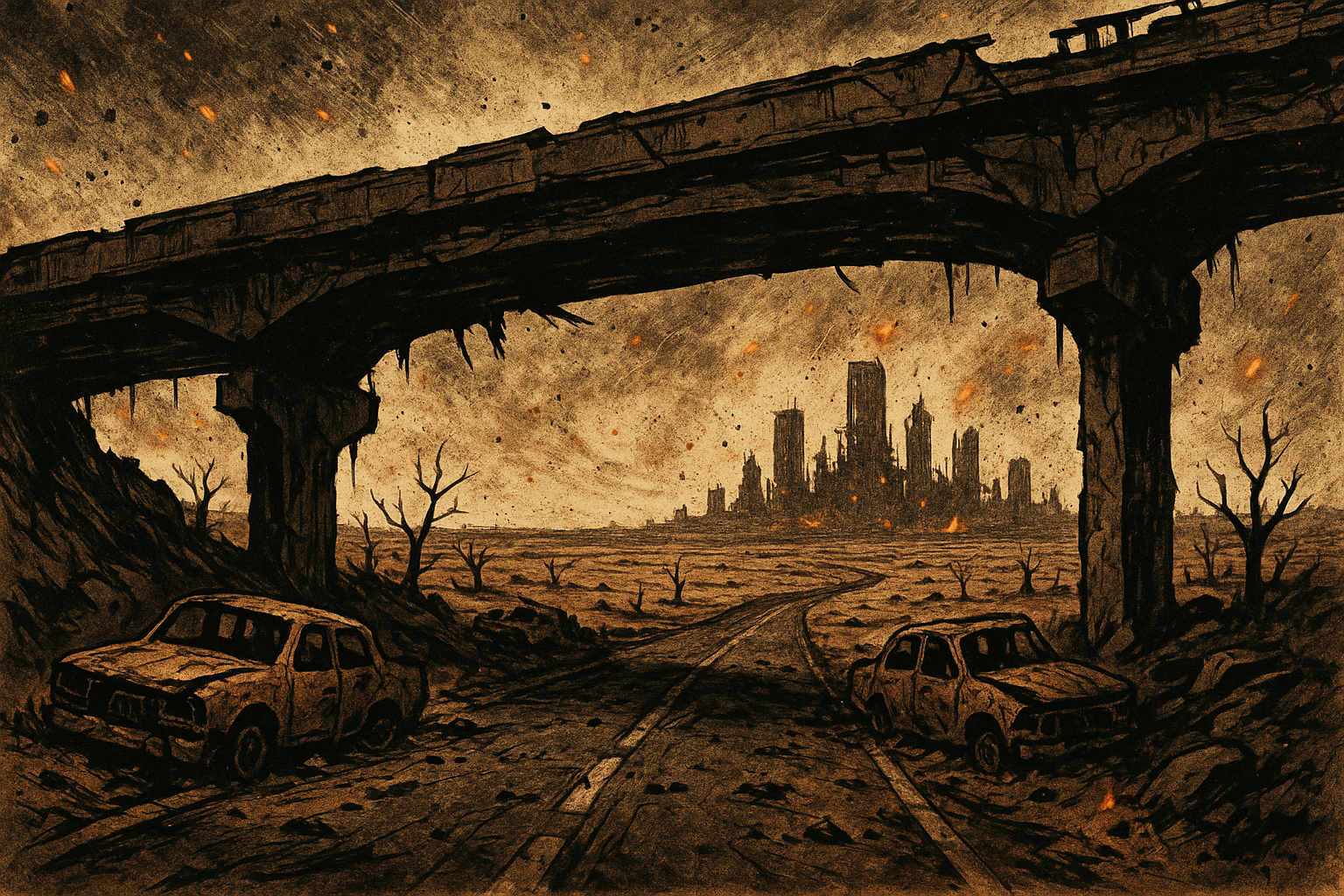
What Is Ashfall?
Ashfall is a gritty, dark, and grounded tabletop roleplaying game set 50-100 years after a series of cascading catastrophes destroyed galactic civilization. This system emphasizes:
- Tactical depth with adjustable lethality - GMs can dial encounters from cinematic to brutally realistic
- Meaningful progression - Characters grow from desperate survivors to legendary figures over 20 levels (with optional mythic tier content beyond level 20)
- Resource management - Equipment, augmentations, magic, and humanity are all finite resources
- Hybrid flexibility - Mix tech and magic, combine builds, but always at a cost
- Systematic balance - Clear rules for GMs to build encounters, distribute loot, and maintain challenge
Design Philosophy
Core Pillars
- Survival - Every resource matters in the wasteland
- Choice & Consequence - Power comes with trade-offs
- Emergence - Magic is new, alien, and unpredictable
- Rebuilding - Characters shape the future of scattered civilizations
- Grit - Healing is slow, death is real, victory is earned
Dice Mechanics
Primary Resolution Mechanic: d20 Roll
d20 + Attribute Modifier + Proficiency Bonus + Situational Modifiers
Target Numbers:
- Skill Checks: Roll vs. Difficulty Class (DC 5-30)
- Attacks: Roll vs. Target's Defense Value (DV)
- Saving Throws: Roll vs. Effect DC
Advantage and Disadvantage
- Advantage: Roll 2d20, take higher result
- Disadvantage: Roll 2d20, take lower result
- Multiple sources of advantage/disadvantage don't stack - you either have it or you don't
Critical Success and Failure
- Natural 20: Critical success - double damage on attacks, automatic success on checks (GM discretion for impossible tasks)
- Natural 1: Critical failure - automatic miss on attacks, automatic failure on checks with potential complication
Bounded Accuracy Framework
To maintain meaningful challenges across all levels, bonuses are intentionally limited:
Maximum Bonuses:
- Attribute Modifier: +5 (20 attribute score)
- Proficiency Bonus: +6 at level 20 (scales slowly)
- Equipment Bonus: +3 (legendary gear only)
- Total Maximum Bonus: +14 (core); +18 with mythic tier (requires Mythic Boon; see Mythic Tier below)
This keeps level 1 characters relevant in certain scenarios while allowing high-level characters to perform legendary feats without breaking the math.
Proficiency Bonus by Level:
Levels 1-4:   +2
Levels 5-8:   +3
Levels 9-12:  +4
Levels 13-16: +5
Levels 17-20: +6
Mythic Tier (Optional, Beyond Level 20):
Levels 21-24: +7
Levels 25-28: +8
Levels 29-30: +9
Mythic Tier Bonus Ceiling: The mythic proficiency cap of +9 (at Levels 29-30) produces a typical mythic maximum of +17 (Attribute +5, Proficiency +9, Equipment +3). The absolute ceiling of +18 requires a Mythic Boon — an exceptional power gain available to mythic-tier characters who complete specific legendary achievements. Without a Mythic Boon, +17 is the practical mythic ceiling.
Mythic Boons are GM-granted narrative rewards, not purchasable with Character Points (CP). A character can benefit from at most one Mythic Boon, and each Boon grants +1 to a single bonus category (attribute, proficiency, or equipment), pushing the total to +18. Examples include:
- Slaying a World-Shaping Entity: Defeating a being of world-shaping mythic power — not a powerful beast, but a creature whose existence reshapes the world around it. The character absorbs a fragment of its essence, granting +1 to their primary attribute.
- Completing a Mythic Ritual: Performing a civilization-scale working — sealing a permanent rift, rewriting the laws of magic for a region, or binding a god's aspect — that fundamentally alters the world. The sustained channel of power leaves the character permanently attuned, granting +1 to proficiency.
- Earning a Deity's Favor: Receiving direct investment of divine or cosmic will from an active god, primordial, or world-shaping intelligence — not mere blessing, but a permanent marking that elevates the character's potential. This grants +1 to equipment bonuses as the character's gear responds to their elevated status.
Reaching +18 is a story milestone, not a mechanical transaction. The GM determines whether an achievement qualifies — the examples above are guidance, not an exhaustive list.
Difficulty Classes
Standard DC Scale:
DC 5:   Trivial (nearly automatic)
DC 10:  Easy (trained individuals succeed regularly)
DC 15:  Moderate (requires focus and skill)
DC 20:  Hard (experts succeed more often than not)
DC 25:  Very Hard (only masters succeed reliably)
DC 30:  Near-Impossible (legendary difficulty)
DC 35+: Impossible for mortals (demigod+ only)
Contested Checks: When two characters oppose each other, both roll and highest total wins. Ties go to the defender/passive party.
Game Modes
Combat Mode
- Structured turn order (initiative)
- 6-second rounds
- 3 actions + 1 reaction per turn
- Precise positioning matters
Exploration Mode
- Fluid time (minutes to hours)
- Abstract movement
- Group checks common
- Environmental interaction focus
Downtime Mode
- Measured in days/weeks
- Training, crafting, research
- Recovery and base-building
- Narrative advancement