
Downtime
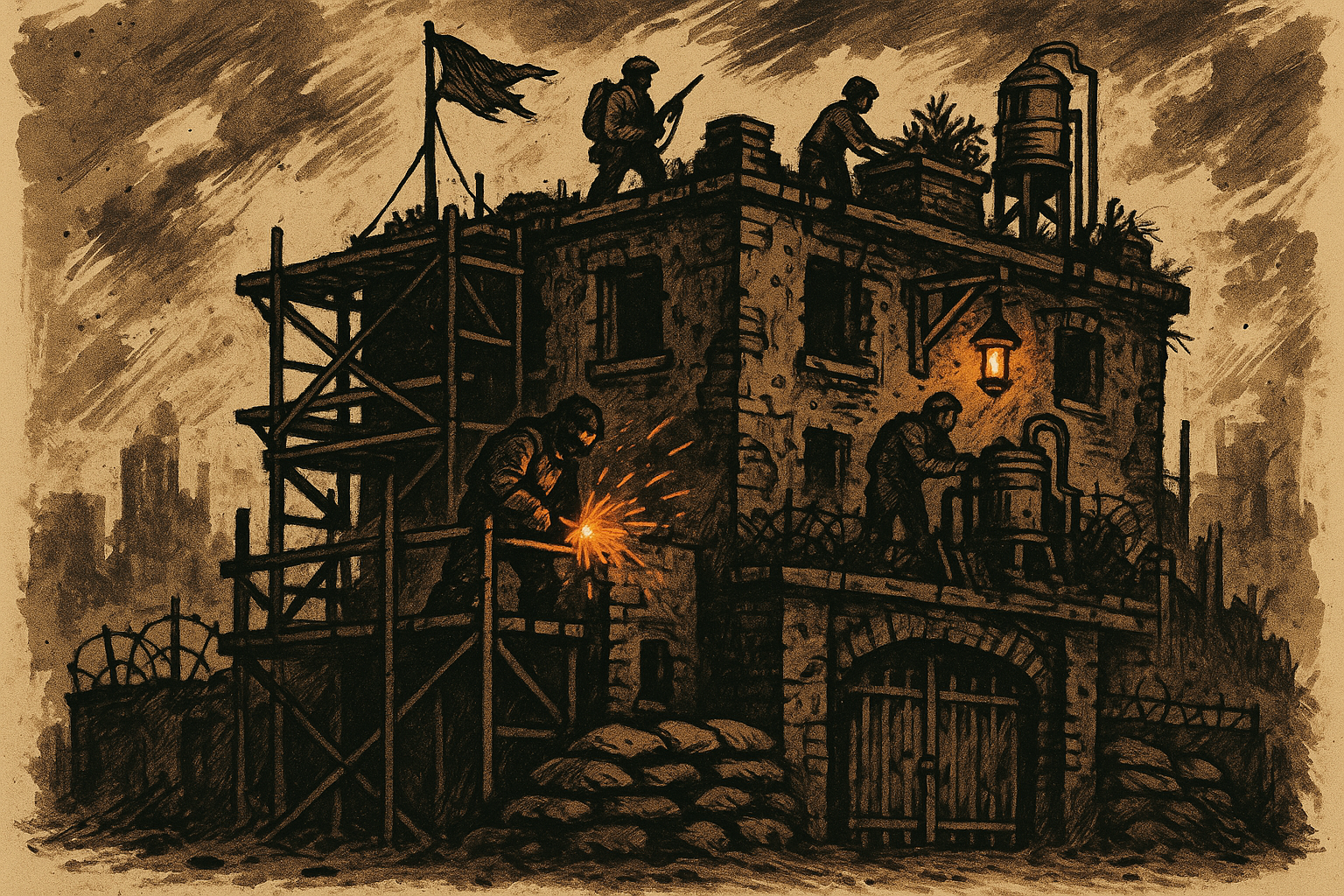
Why Downtime Matters
In the wasteland, the time between missions is just as important as the missions themselves. Long rests take a full week in a safe settlement — that's seven days of potential. Characters who spend that time wisely craft weapons, build alliances, fortify shelters, and gather intelligence. Characters who don't fall behind.
The downtime system gives every character meaningful choices during rest periods. It turns "I wait a week" into "I spend three days upgrading the workshop and two days gathering intel on the raider camp."
Downtime Phases
Each long rest week follows four phases in order:
- Upkeep — Pay maintenance costs for your base (if any)
- Activity — Spend your 5 downtime days on activities
- Income — Base upgrades generate passive resources
- Event — Roll for a random downtime event (if your party has a base)
You get 5 downtime days per long rest week. The remaining 2 days are consumed by actual rest, recovery, and basic survival needs. Each downtime activity lists how many days it costs. You can split days between multiple activities.
No Long Rest Required: The GM may also grant downtime days outside of long rests — a 3-day layover waiting for a caravan, a week of travel with nothing to do, etc. These "free" downtime days follow the same rules but don't include rest recovery benefits.
Capital
Capital represents abstract resources you accumulate and spend during downtime. There are four types:
| Capital | Purchase Cost | Represents | Primary Skills |
|---|---|---|---|
| Salvage | 20 cr per point | Scrap metal, raw materials, components, fuel | Survival, Technology |
| Influence | 30 cr per point | Favors, reputation, social connections, debts owed | Persuasion, Deception, Streetwise |
| Tech | 50 cr per point | Pre-Fall schematics, rare electronics, precision parts | Technology, Science, Engineering |
| Essence | 50 cr per point | Magical reagents, ley-line energy, ritual components | Arcana, Mysticism |
Earning Capital
You can acquire capital in three ways:
Purchase: Buy capital outright at the listed credit cost. This represents hiring laborers, buying materials from merchants, calling in favors, or purchasing rare components.
Earn (Downtime Activity): Spend 1 downtime day and make a skill check to earn capital. See the Earn Capital activity below.
Loot: The GM may award capital as mission rewards — a cache of salvageable parts (Salvage), a faction's gratitude (Influence), a recovered hard drive full of blueprints (Tech), or a vial of crystallized ley-energy (Essence).
Spending Capital
Capital can be spent in three ways:
- On downtime activities that list a capital cost (crafting, building, recruiting)
- As credits at the listed purchase cost (1 Salvage = 20 cr, 1 Influence = 30 cr, etc.)
- To boost skill checks during downtime activities (see Activity Boosts below)
Activity Boosts
When performing a downtime activity, you can spend capital to improve your chances:
- Spend 1 Salvage for +1 to Technology or Science checks (max +5)
- Spend 1 Influence for +2 to Persuasion, Deception, or Streetwise checks (max +6)
- Spend 1 Tech for +2 to Technology, Science, or Engineering checks (max +6)
- Spend 1 Essence for +2 to Arcana checks (max +6)
These bonuses represent using better materials, leveraging connections, referencing schematics, or channeling additional magical energy.
Tracking Capital
Record capital on your character sheet as a simple tally (e.g., Salvage: 3, Influence: 1, Tech: 0, Essence: 2). Capital doesn't expire and carries between rest periods. There's no maximum — hoard as much as you can get.
Downtime Activities
Each activity lists its time cost (in downtime days), skill check (if any), capital cost (if any), and effect. Unless stated otherwise, a character can only perform one instance of the same activity per downtime week.
Earning
Earn Capital
- Time: 1 day
- Skill: Any applicable skill (see Capital table)
- Effect: Make a skill check. The result determines how much capital you earn:
| Check Result | Capital Earned |
|---|---|
| 9 or lower | 0 (wasted day) |
| 10-14 | 1 point of chosen type |
| 15-19 | 2 points of chosen type |
| 20-24 | 3 points of chosen type |
| 25+ | 4 points of chosen type |
You choose the capital type before rolling. The skill used must match the capital type (Survival or Technology for Salvage, Persuasion or Streetwise for Influence, etc.). The GM may allow creative skill pairings — an Operative using Stealth to "earn" Salvage by stealing scrap, for instance.
Level Scaling: At level 6+, multiply capital earned by 2. At level 11+, multiply by 3. At level 16+, multiply by 4. This keeps capital earning competitive with Work for Credits at higher levels.
Work for Credits
- Time: 1 day
- Skill: Any Profession-adjacent skill
- Effect: Earn credits directly. Base pay is 10 credits per day for unskilled labor. With a relevant skill check:
| Check Result | Daily Pay |
|---|---|
| 9 or lower | 10 cr (unskilled rate) |
| 10-14 | 20 cr |
| 15-19 | 40 cr |
| 20-24 | 75 cr |
| 25+ | 125 cr |
Scaling: At level 6+, multiply daily pay by 2. At level 11+, multiply by 4. At level 16+, multiply by 8. Higher-level characters command premium rates.
Run a Business
- Time: 1 day
- Skill: Persuasion, Streetwise, or relevant craft skill
- Prerequisite: You must own a base with at least one income-generating upgrade
- Effect: Make a skill check with a +5 bonus. Use the Earn Capital table above. The capital type depends on the business (a workshop earns Salvage or Tech; a bar earns credits or Influence).
Crafting
For the full crafting system — including detailed DCs, modification lists, enchanting rules, formulas, and magical item crafting — see the Crafting chapter.
Craft Items
- Time: Varies by tier (see Crafting)
- Skill: Technology (mechanical/electronic) or Science (chemical/pharmaceutical)
- Capital Cost: Crafting materials can be paid in credits OR capital:
| Item Tier | Credit Cost | Or Capital Cost | Time | DC |
|---|---|---|---|---|
| Tier 1 | 5 cr | 1 Salvage | 1 hour | DC 10 |
| Tier 2 | 25 cr | 2 Salvage | 4 hours | DC 13 |
| Tier 3 | 100 cr | 5 Salvage + 1 Tech | 1 day | DC 16 |
| Tier 4 | 500 cr | 10 Salvage + 3 Tech | 3 days | DC 19 |
| Tier 5+ | 2,000+ cr | 20 Salvage + 8 Tech | 5+ days | DC 22+ |
Magical items require Essence instead of (or in addition to) Tech. See the Crafting chapter for the complete magical item crafting table with specific Essence costs by category (consumable, charged, permanent).
Formulas: Having a formula reduces the crafting DC (Tier 1-2: -1, Tier 3: -2). Tier 4+ items and all enchanted items require a formula. Formulas can be found as loot, purchased from merchants (see the Formula Purchase Cost table in Crafting), or created with the Research activity. See Crafting for full formula rules.
Outcomes: See Crafting for the expanded outcome table including Setback, Masterwork quality, and the Mishap table.
Craft Ammunition
- Time: 30 minutes per magazine (does not consume a full downtime day)
- Skill: Technology DC varies by type
- Cost: Half purchase price in credits, or 1 Salvage per 3 standard magazines
- Effect: See Special Ammunition in the Equipment chapter
Brew Stims
- Time: 1 hour per stim (does not consume a full downtime day)
- Skill: Science DC 12 (Tier 1), DC 15 (Tier 2), DC 18 (Tier 3)
- Cost: Half purchase price in credits, or 1 Salvage per Tier 1 stim, 2 Salvage per Tier 2, 1 Salvage + 1 Essence per Tier 3
- Effect: Produce one stim of the listed tier
Research
- Time: 1-3 days
- Skill: Science, Technology, or Arcana (DC varies)
- Capital Cost: 1 Tech (for schematics) or 1 Essence (for spell research)
- Effect: Create a blueprint for a specific item (reduces future crafting DC by 2), or research a new spell effect (see Magic for spell research rules). The DC equals the item's crafting DC + 2.
Networking
Gather Intelligence
- Time: 1 day
- Skill: Streetwise, Persuasion, or Investigation
- Capital Cost: Optional — spend 1 Influence for +2 to check (max +6)
- Effect: Learn information about a specific topic. The GM determines what you discover based on your check result:
| Check Result | Information Quality |
|---|---|
| 9 or lower | Rumors only (may be false) |
| 10-14 | General information (publicly known) |
| 15-19 | Specific details (requires digging) |
| 20-24 | Sensitive information (guarded secrets) |
| 25+ | Critical intelligence (faction plans, hidden locations, etc.) |
Recruit
- Time: 2 days
- Skill: Persuasion or Intimidation
- Capital Cost: 2 Influence + ongoing cost (see Base Upgrades)
- Effect: Recruit an NPC to work at your base or join your organization. The NPC's quality depends on your check:
| Check Result | Recruit Quality |
|---|---|
| 9 or lower | Nobody willing |
| 10-14 | Unskilled laborer (no proficiency bonus) |
| 15-19 | Skilled worker (+2 proficiency, one skill) |
| 20-24 | Specialist (+3 proficiency, two skills) |
| 25+ | Expert (+4 proficiency, three skills, may have build levels) |
Recruited NPCs can staff base upgrades, accompany you on missions (GM discretion), or perform downtime activities on your behalf (using their own skill modifiers, one activity per week).
Trade Favors
- Time: 1 day
- Skill: Persuasion or Deception
- Effect: Convert between capital types at a loss. Spend 3 points of one capital type to gain 2 points of another. A successful DC 15 check improves the rate to 2-for-2.
Cultivate Contact
- Time: 1 day (meet, share a meal, do a small favor, exchange information)
- Skill: Persuasion, Streetwise, or Deception (your choice, based on the contact's personality)
- Effect: Choose one contact in your Contact Network (see Contact Networks). Roll the chosen skill against a DC based on what you're trying to accomplish:
| Goal | DC | Outcome |
|---|---|---|
| Establish a new contact (Reliability 1) | 12 | Contact is willing to work with you — record them as Reliability 1, Neutral disposition |
| Improve contact from Neutral to Friendly | 14 | Contact's disposition improves; next request is treated as if Reliability is 1 higher |
| Increase an existing contact's Reliability (+1) | 16 | Reliability increases by 1 (max 5; only once per contact per downtime week) |
| Repair a damaged relationship (Wary → Neutral) | 18 | Contact's disposition improves; you must also have addressed whatever caused the damage |
Prerequisite for new contacts: You must have a narrative reason to meet this person — a faction connection, an introduction from another contact, or a setting-appropriate circumstance (your GM decides). You cannot cold-cultivate a contact with no narrative basis.
Capital bonus: Spending 1 Influence capital on this activity grants +2 to the check (representing gifts, favors, or social leverage — max +4 from 2 Influence).
Settlement Born background characters have advantage on this activity check when the contact lives or operates in a settlement (their natural environment for building relationships).
Promote
- Time: 1 day
- Skill: Persuasion or Streetwise DC 15
- Capital Cost: 1 Influence
- Prerequisite: You must own a base with income-generating upgrades
- Effect: On success, your base's passive income is doubled for the next downtime week. On failure, the Influence is still spent but you gain no benefit.
Personal Recovery
Activities focused on the character's mental and emotional health rather than their external network.
Seeking Counsel
You reach out for help with wounds that medicine can't treat.
Spend one week in a settlement with access to a counselor, spiritual leader, trusted companion, or community elder who is willing to listen — truly listen, not just offer platitudes.
Activity: Describe the conversation (briefly, at whatever level of detail feels right for your table). You do not need to justify every detail of your character's inner life — a few sentences about what your character is carrying is enough.
Effect:
- Remove the Traumatized condition (if you have it)
- Reduce your Stress to 3 (if you were at SP 5) or by 1 (if you were at SP 3–4)
- This activity counts as one downtime activity for the week. You may take other downtime activities as normal.
Requirements: Access to a settlement (not a field camp). Presence of an NPC or PC willing to spend time with your character — this is a social connection, not a clinical service. In many wastelands, it's a fellow survivor, a bartender who's heard everything, or a Channeler who understands the weight of carrying spiritual burden. If the GM establishes a settlement's people as cold or indifferent, this activity may not be available there — the wasteland isn't generous with connection.
Note on Medics: A Medic performing Psychological First Aid during a Long Rest camp is a different activity — shorter, more tactical, available in the field. Seeking Counsel is the longer-form civilian equivalent. Both remove Traumatized, but Seeking Counsel doesn't require a Medicine check — only time and trust.
Training
Train Skill
- Time: 5 days (full downtime week)
- Skill: None (training check at end)
- Capital Cost: 2 Influence (finding a teacher) OR 1 Tech (self-study materials)
- Effect: At the end of the training period, make an INT or WIS check (your choice) DC 15. On success, you gain proficiency in one skill you are not already proficient in. On failure, you can try again next downtime week (capital must be spent again).
Prerequisite: You can only train skills that are narratively accessible — you can't learn Piloting without access to a vehicle, or Arcana without a magic user to teach you.
Magical Research
Magic came back broken. Half-understood. The old formulas don't work because the world they were written for doesn't exist anymore. Every spell you craft is an experiment. Every experiment is a risk. But the wasteland rewards those who push the boundary --- and punishes those who push too hard.
Magical research covers the deliberate, focused study of arcane or divine forces during downtime. Unlike the spell creation process described in Magic (which covers the mechanical steps of designing a new spell), these activities represent the broader work of advancing your understanding of how magic functions in the post-Fall world.
Prerequisite: You must be able to cast spells (Mystic, Channeler, Medic, or multiclass with spellcasting access). Characters without spellcasting cannot perform these activities.
Primary Skill: Arcana (INT). All Magical Research activities use Arcana as the primary skill.
Capital Cost: All Magical Research activities consume Essence capital --- the magical reagents, ley-line energy, and ritual components that fuel experimental magic.
Research Clocks: Some activities take longer than a single downtime session to complete. These use a Research Clock --- a progress tracker divided into segments. Each downtime week spent on the activity fills segments based on your Arcana check result. When all segments are filled, the research is complete. Progress is persistent: if you stop researching to do something else, your filled segments remain. You can resume later.
Failure and Twilight Events: Magical research is dangerous. When an Arcana check for a research activity fails by 5 or more, a Twilight Event occurs (see Magic --- Twilight Events). The researcher gains 1d4 Burnout Points. This threshold (fail by 5+) matches the spell creation Twilight Event trigger in Magic and is lower than the overcasting trigger (fail by 10+), reflecting the experimental nature of the work.
Relationship to Existing Research Activity: The existing Research downtime activity (1-3 days, 1 Essence) covers quick magical inquiries --- identifying an unknown magical effect, answering a specific arcane question, or studying a single magical item. It is a general-purpose knowledge tool. The activities below are specialized, longer-term projects. Develop Spell replaces the existing Research activity for the specific purpose of spell creation. For all other magical questions and identification tasks, the existing Research activity remains the correct choice.
Develop Spell
You're not copying someone else's work. You're inventing. The formula doesn't exist yet --- you're writing it, one failed experiment at a time.
- Time: Variable (Research Clock)
- Skill: Arcana (INT)
- Capital Cost: 1 Essence per spell level per session (spent each week of research, whether or not the clock fills)
- Prerequisite: Must be able to cast spells of the desired level
- Effect: Advance your progress toward creating a new spell, using the Research Clock system.
Research Clock: The clock has segments equal to the spell level x 2 (a 1st-level spell = 2 segments; a 3rd-level spell = 6 segments; a 7th-level spell = 14 segments).
Each downtime week spent on this activity, make an Arcana check (DC = 15 + spell level):
| Result | Segments Filled |
|---|---|
| Success by 10+ | 3 segments |
| Success by 5+ | 2 segments |
| Success | 1 segment |
| Failure (by less than 5) | 0 segments (wasted week, Essence still consumed) |
| Failure by 5+ | 0 segments + Twilight Event + 1d4 Burnout Points |
When all segments are filled, the spell is complete --- you learn the spell and can prepare/cast it normally.
Relationship to Magic Chapter: This activity supplements the spell creation rules in Magic. The magic chapter describes the credit cost (1,000 cr x spell level squared) and the design process. This activity handles the time investment and provides a structured progress system for multi-session research. The credit cost is paid when the clock completes, not per session.
Interruption: If research is interrupted (combat, travel, emergency), filled segments are preserved. However, if more than 3 months pass without resuming, all progress is lost --- the notes decay, the reagent states collapse, the insights slip away. Start over.
Collaboration: Two spellcasters can research the same spell together. Each makes their own Arcana check per session. Both fill segments on the same clock. Both pay Essence. Both learn the spell when the clock completes.
Example: Fen (Mystic, L7) wants to develop a 4th-level spell. The Research Clock has 8 segments. She spends 2 Essence per week (4th level x 1) researching. Week 1: Arcana check 23 vs DC 19 --- success by 4, fills 1 segment. Week 2: Arcana check 26 --- success by 7, fills 2 segments. Week 3: Arcana check 14 --- failure by 5, Twilight Event + rolls 1d4 and gains 2 Burnout Points. No segments filled. She has 3 of 8 segments. She'll need at least 3 more successful weeks.
Study Phenomenon
Something happened here. The air tastes like copper and ozone. The compass spins. The local wildlife has three too many eyes. You don't know what it is yet, but you're going to find out.
- Time: 3 days
- Skill: Arcana (INT)
- Capital Cost: 1 Essence
- Prerequisite: Must be at or near a magical phenomenon (ley line, Twilight scar, magical creature territory, anomalous zone, ruin with magical residue)
- Effect: Study a magical phenomenon to understand it and potentially extract useful knowledge. Make an Arcana check (DC varies by phenomenon):
| Phenomenon Type | DC | Example |
|---|---|---|
| Minor (residual energy, faint ley line) | 13 | Old ritual site, weak Twilight echo |
| Moderate (active magical effect, strong ley line) | 16 | Twilight scar, magical creature lair |
| Major (reality distortion, Voidscar proximity) | 20 | Active rift, alien technology, ancient ward |
On success:
- Learn the phenomenon's nature (what it is, what caused it, what it does)
- Learn any hazards or benefits associated with the phenomenon (radiation-like effects, healing properties, defensive wards, etc.)
- Gain 1 Essence (extracted from the phenomenon --- net zero cost if successful)
- The GM may reveal a research lead: a hint about a spell, cantrip modification, or magical technique that could be developed using this phenomenon as a basis. This lead grants advantage on your next Develop Spell Arcana check if the spell is thematically related.
On success by 5+:
- All of the above, plus gain 2 Essence (net +1) and the research lead grants advantage on the next 2 Develop Spell checks (related spell).
On failure:
- Partial understanding --- the GM reveals the phenomenon's nature but not its hazards or benefits. No Essence extracted. Essence cost is still consumed.
On failure by 5+:
- The phenomenon reacts to your probing. Twilight Event occurs. Gain 1d4 Burnout Points. The phenomenon may also shift, intensify, or attract attention (GM discretion).
This activity rewards exploration and curiosity. A party that finds a Twilight scar during a ruin delve and marks the location can return during downtime to study it --- turning a hazard into an opportunity.
Example: Voss (Mystic, L6) spends 3 days studying a Twilight scar in an abandoned hospital (Moderate phenomenon, DC 16). Arcana check: 19 --- success by 3. The GM reveals the scar was caused by a failed pre-Fall containment ritual; the residual energy is necrotic in nature and could serve as a foundation for developing a necrotic-themed spell. Voss gains 1 Essence (net zero cost) and a research lead: advantage on his next Develop Spell check if the spell involves necrotic energy.
Cantrip Refinement
You've cast this cantrip ten thousand times. You know its shape better than your own name. You think you can make it do something it wasn't designed to do.
- Time: 5 days (full downtime week)
- Skill: Arcana (INT)
- Capital Cost: 2 Essence
- Prerequisite: Must know the cantrip being refined. Can only refine a specific cantrip once (each cantrip gets one refinement).
- Effect: Modify one of your known cantrips with a minor enhancement. Make an Arcana check (DC 16):
On success, choose one refinement:
| Refinement | Effect |
|---|---|
| Extended Range | The cantrip's range increases by 30 feet (or from touch to 30 feet) |
| Widened Area | If the cantrip affects an area, increase the radius or cone by 5 feet |
| Lingering Effect | If the cantrip deals damage, the target takes 1d4 additional damage of the same type at the start of its next turn (no save) |
| Subtle Cast | The cantrip can be cast without visible or audible components. Observers don't realize a spell was cast unless they succeed on an Arcana DC 15 check |
| Quick Recovery | If the cantrip costs an action, once per short rest you can cast it as a bonus action instead |
On failure:
- The refinement doesn't take. The Essence is consumed. You can retry during your next downtime period.
On failure by 5+:
- The cantrip destabilizes. Twilight Event occurs. Gain 1d4 Burnout Points. Additionally, the cantrip is unreliable for 1 week: each time you cast it, roll 1d20. On a 1-3, the cantrip fizzles (action wasted, no effect). The instability resolves after a long rest.
Limitation: Each cantrip can only be refined once. You cannot stack refinements. Choosing a refinement is permanent --- you cannot swap it later unless you unlearn the cantrip and re-learn it (losing the refinement in the process).
Forward Compatibility: Cantrip Refinement is separate from any inherent cantrip scaling (damage die increases at L5/L11/L17) or future utility scaling enhancements. A refined cantrip retains its refinement alongside all normal scaling. The two systems stack without conflict.
Example: Keth (Mystic, L5) refines his CRYO cantrip with Lingering Effect. Now when CRYO deals damage, the target takes an additional 1d4 cold damage at the start of its next turn. This doesn't change the cantrip's level or slot cost --- it's a permanent minor upgrade from weeks of practice and experimentation.
Attune to Sacred Ground
The ley line runs beneath the floor. You can feel it --- a slow pulse, like the heartbeat of the earth. You've been here three days, listening. It's starting to listen back.
- Time: 5 days (full downtime week)
- Skill: Arcana (INT) or Insight (WIS) --- caster's choice
- Capital Cost: 3 Essence
- Prerequisite: Must be at a location with significant magical energy (ley line, temple, Twilight scar, natural power site). The GM confirms whether a location qualifies.
- Effect: Attune yourself to the magical resonance of a specific location. Make an Arcana or Insight check (DC 15):
On success:
- You are attuned to this location. While within 1 mile of the attunement point, you gain:
- +1 to spell attack rolls and +1 to spell save DCs
- Essence recovery: When you complete a short rest at the attuned location, recover 1 Essence capital (once per long rest)
- Sense disturbance: You can feel when something disrupts the location's magical energy (intruders casting spells, Twilight Events, excavation) from up to 1 mile away
On success by 5+:
- All of the above, plus the attuned radius extends to 5 miles and you can cast one spell per long rest at the attuned location without consuming a spell slot (the location's energy fuels the casting). The spell must be 3rd level or lower.
On failure:
- The attunement doesn't take. The Essence is consumed. The location is too chaotic, too faint, or too alien for your current understanding. You can retry after gaining a level or after a significant magical event changes the location's energy.
On failure by 5+:
- The location's energy rejects you. Twilight Event occurs. Gain 1d4 Burnout Points. Additionally, you are magically suppressed at this location for 1 month: all spell attacks have disadvantage and spell save DCs are reduced by 2 while within 1 mile. The location remembers your failed intrusion.
Limitations:
- You can be attuned to one location at a time. Attuning to a new location ends the previous attunement.
- Attunement is personal --- you cannot share it or transfer it to another character.
- If the location is destroyed or its magical energy is depleted, the attunement ends.
Channeler Affinity: Channelers make this check with advantage. Their divine/spiritual connection to places of power is deeper than the Mystic's intellectual approach. This is the Channeler's signature research activity --- while Mystics excel at Develop Spell and Cantrip Refinement, Channelers are the masters of sacred ground.
This activity turns locations into resources. A party that discovers a ley line intersection during a Wasteland Survey (see Field Activities) can return during downtime to attune --- giving their caster a permanent home-field advantage. It also creates a narrative hook: the caster has a reason to defend this location, return to it, and build near it.
Example: Sera (Channeler, L7) spends a week attuning to a ruined temple her party discovered during a Wasteland Survey. The temple sits on a ley line convergence (qualifies as Sacred Ground). She chooses Insight (WIS) for her check --- advantage because she's a Channeler. Insight check: 18 --- success by 3. Sera is now attuned: within 1 mile of the temple, she gains +1 to spell attacks and spell save DCs, recovers 1 Essence per short rest at the site, and can sense magical disturbances nearby. The party decides to build their base here.
Retrain Feature
- Time: 5 days (full downtime week)
- Capital Cost: 2 of any single capital type
- Effect: Swap one of the following for a different option of the same type:
- One skill proficiency for another
- One talent for another you qualify for
- One class feature choice (e.g., swap a Warrior's combat style)
You cannot retrain core class features, attribute scores, or species traits.
Prepare for Adventure
- Time: 1 day
- Skill: Any relevant skill
- Capital Cost: 1 of any capital type per +1 bonus (max 3)
- Effect: Gain a bonus to one specific skill check during your next adventure. You must declare the skill and the anticipated situation (e.g., "I'm studying the compound's security — Technology check to bypass their locks"). The bonus equals the capital spent (max +3) and expires at the end of the next adventure or after one use, whichever comes first.
Building
See the Base System section below for full rules on constructing and upgrading a base of operations.
Construct Upgrade
- Time: Varies by upgrade (2-10 days)
- Skill: Technology (mechanical upgrades), Survival (structural), or relevant skill
- Capital Cost: Varies by upgrade
- Effect: Add a new upgrade to your base. See the Base Upgrades table.
Repair Base
- Time: 1 day per 10 points of damage
- Skill: Technology or Survival DC 13
- Capital Cost: 1 Salvage per 10 points of damage repaired
- Effect: Restore your base's Hit Points after an attack or disaster. On a failed check, the day is spent but no HP are restored (materials are not consumed on failure).
Recovery
These activities represent medical procedures, augmentation work, and personal recovery that go beyond standard long rest healing.
Install Augmentation
- Time: 1 day per augmentation
- Skill: Technology DC 15 (or Medicine DC 15 for biological augments)
- Capital Cost: 1 Tech per augmentation tier (Tier 1 = 1 Tech, Tier 2 = 2 Tech, etc.) in addition to the augmentation's credit cost
- Prerequisite: Medical facility or base with Clinic upgrade
- Effect: Install a cybernetic augmentation per the rules in Equipment. On a failed check, the augmentation is damaged (50% cost to repair) and the patient takes 2d6 damage.
Intensive Care
- Time: 5 days (full downtime week, concurrent with long rest)
- Skill: Medicine (DC varies by injury)
- Effect: Treat a lingering injury with full medical attention. This is the same as Long-Term Care in the Exploration chapter but with additional benefits if you have a Clinic upgrade at your base:
- Without Clinic: Standard long-term care rules
- With Clinic: +2 to Medicine checks, can treat two patients simultaneously, access to Tier 3 medical supplies
Therapy
- Time: 3 days
- Skill: Medicine (WIS) or Insight (WIS) DC 15
- Effect: Help a character recover from psychological trauma. On success, remove one mental condition (frightened, charmed effects that persist, stress-related penalties imposed by the GM). On failure, no effect but no harm done.
Faction & Field
Faction Service
- Time: 2 days
- Skill: Varies by service type (see table)
- Capital Cost: 1 Influence (representing favors called in to secure the assignment)
- Effect: Perform a service for a named faction to improve your standing. Choose a service type and make the corresponding skill check:
| Service Type | Skill | Example |
|---|---|---|
| Combat Mission | Athletics or Intimidation | Clear a raider camp threatening faction territory |
| Intelligence | Investigation or Hacking | Infiltrate a rival faction's communication network |
| Diplomatic | Persuasion or Deception | Negotiate a trade agreement with a neutral settlement |
| Logistics | Survival or Technology | Repair a supply route or maintain faction equipment |
| Check Result | Outcome |
|---|---|
| 9 or lower | Service failed. Faction standing unchanged. Capital spent. |
| 10-14 | Service completed adequately. Faction disposition improves by 1 step (see Social Encounters — NPC Disposition). |
| 15-19 | Service completed well. Disposition improves by 1 step + earn 1 Influence (net zero cost). |
| 20-24 | Impressive service. Disposition improves by 1 step + earn 2 Influence (net +1). Faction may offer a follow-up assignment. |
| 25+ | Exceptional service. Disposition improves by 2 steps + earn 2 Influence. The faction owes you a significant favor (GM determines). |
Background Synergy: Characters with the Faction Operative background have advantage on Faction Service checks for their affiliated faction. Characters with the Military Survivor background can use their military contacts — treat Combat Mission and Logistics service types as having a +2 bonus.
Restrictions: You can only perform Faction Service for one faction per downtime week. Performing service for a faction that is hostile to another faction you have positive standing with may reduce your standing with the opposing faction by 1 step (GM discretion).
Statecraft Interaction: Characters with the Statecraft advanced skill can substitute a Statecraft check for any service type. Additionally, a successful Statecraft check of 20+ allows them to improve standing with two allied factions simultaneously (both must be non-hostile to each other).
Fence Goods
- Time: 1 day
- Skill: Streetwise or Deception
- Capital Cost: None (you are selling, not buying)
- Effect: Sell stolen, illegal, faction-restricted, or otherwise hard-to-move goods through underground channels. Declare the goods and their legitimate market value, then make a skill check:
| Check Result | Outcome |
|---|---|
| 9 or lower | Burned. No sale. The buyer is an informant, undercover agent, or rival. You draw Heat (see below). |
| 10-14 | Sold at 50% value (same as open market for restricted items — no benefit over legal sale). |
| 15-19 | Sold at 75% value. Clean transaction. |
| 20-24 | Sold at 100% value. The buyer is impressed — you gain a Black Market Contact (1 Influence worth of underground connections). |
| 25+ | Sold at 100% value + bonus. Gain 1 Influence and the buyer offers you a job lead — a lucrative but dangerous opportunity (GM determines). |
Heat: When you draw Heat, the GM chooses one consequence:
- A faction you've wronged learns of your location (disposition drops 1 step)
- Local law enforcement or settlement militia begins investigating you (disadvantage on Persuasion checks in this settlement for 1 week)
- A criminal rival takes notice (potential ambush encounter within the next adventure)
Background Synergy: Characters with the Outcast background have advantage on Fence Goods checks. Characters with the Ruin Delver background can identify the most valuable components of salvage before selling — add +1 to the check result tier when fencing Pre-Fall technology.
Outcast Economy Note: Outcast's Margin Walker feature (1:1 Salvage↔Influence conversion) applies to legitimate capital trades, not to Fence Goods. Fence Goods deals in credits and physical merchandise, not abstract capital. The two systems are complementary, not redundant.
Mentor Recruit
- Time: 3 days
- Skill: Persuasion, Intimidation, or a skill you are teaching (see below)
- Capital Cost: 1 Influence (your time and reputation invested in the recruit)
- Prerequisite: Target NPC must be stationed at your base (recruited via the Recruit activity)
- Effect: Invest time improving an existing base NPC. Choose one of the following:
Option A — Improve Proficiency: The NPC's proficiency bonus increases by +1 (maximum +3 above their starting value). Make a check using the skill you are teaching — the DC equals 10 + the NPC's current proficiency bonus. On success, the improvement takes effect. On failure, the NPC needs more time — you can try again next downtime week.
Option B — Grant Skill Proficiency: The NPC gains proficiency in one skill you are proficient in. Make a Persuasion or Intimidation check (DC 14). On success, the NPC gains the new skill proficiency permanently. On failure, the training didn't take — try again next week.
Option C — Teach Specialty: The NPC learns a specific practical capability: basic first aid (can stabilize dying creatures), basic crafting (can craft Tier 1 items), sentry duty (gains +2 to Perception while on watch), or basic combat (gains +1 to attack rolls). Make a check using the relevant skill (Medicine, Technology, Perception, or Athletics) against DC 16. On success, the NPC gains the specialty. On failure, try again next week.
Background Synergy: Characters with the Military Survivor background reduce the time to 2 days (military training efficiency). Characters with the Scholar background reduce the DC of all Mentor Recruit checks by 2 (academic teaching methods).
Limits: An NPC can only be mentored once per downtime week. There is no limit to how many different NPCs you can mentor in a single week (if you have the days available).
Ruin Survey
- Time: 3-5 days (3 for Tier 1, 4 for Tier 2, 5 for Tier 3)
- Skill: Investigation (primary), Survival or Perception (secondary)
- Capital Cost: 1 Salvage (supplies for the expedition) + 1 additional Salvage per tier above 1
- Effect: Explore pre-Fall ruins in the area around your base or current location. Choose a ruin tier and make an Investigation check:
| Ruin Tier | DC | Time | Cost | Success Reward | Failure Reward |
|---|---|---|---|---|---|
| Tier 1 (scavenged outskirts) | DC 12 | 3 days | 1 Salvage | 2d4 Salvage + 1 Tech | 1d4 Salvage |
| Tier 2 (sealed interior) | DC 15 | 4 days | 2 Salvage | 3d4 Salvage + 2 Tech | 1d4 Salvage + 1 Tech |
| Tier 3 (deep vault / reactor) | DC 18 | 5 days | 3 Salvage | 4d4 Salvage + 3 Tech + 1 special item | 2d4 Salvage + 1 Tech |
Critical Failure (miss DC by 5+): You encounter a serious hazard. Roll 1d4:
- Structural collapse: Take 3d6 bludgeoning damage
- Radiation pocket: Gain Irradiated Level 1 (sealed environment breached by the collapse — standard radiation protection applies to ambient exposure during the rest of the survey)
- Hostile encounter: Ambushed by 1d4+1 creatures (GM determines type appropriate to the ruin)
- Trapped: Gain 1 level of Exhaustion escaping a sealed chamber, gas pocket, or flooding section
Critical Success (beat DC by 10+): In addition to normal rewards, you discover a map fragment — your next Ruin Survey at this location has advantage on the Investigation check and takes 1 fewer day.
Special Items (Tier 3): The GM determines the special item from the following categories:
- A Tier 3 weapon or armor in salvageable condition (needs 1 day repair)
- A crafting formula for a Tier 4+ item
- A pre-Fall data core (quest hook or 3 Tech when decoded)
- A unique named item (see Equipment — Named & Legendary Items)
Background Synergy: Characters with the Ruin Delver background have +2 to Ruin Survey Investigation checks and reduce the time by 1 day (minimum 2 days). Characters with the Vault Dweller background add +2 to Investigation checks when surveying pre-Fall military or government installations (they recognize the layout).
Radiation Risk: Tier 2 and Tier 3 ruins may include radiation zones. At the GM's discretion, a Tier 2 ruin survey exposes you to Mild radiation (1 save), and Tier 3 exposes you to Moderate radiation (2 saves during the expedition). Hazmat Suits and RadBlock apply as normal.
Scavenger Synergy: The Scavenger's Salvage Network activity finds supply caches already marked and mapped. Ruin Survey is the act of mapping new ruins — they are complementary. A Scavenger who Ruin Surveys and finds a map fragment can later use Salvage Network to establish a permanent supply route to the mapped location (GM discretion).
Field Activities (Nomadic Downtime)
Most downtime activities assume your party has a base — a place to store equipment, run a workshop, and collect on investments made last week. Not every party has that. Caravans keep moving. Faction scouts can't afford a fixed address. Mercenaries go where the work is.
These activities require no base, no permanent infrastructure, and no prior setup. They work anywhere you stop long enough to sleep: a settlement, a road-camp, an empty stretch of wasteland, the cargo hold of a grounded transport.
The tradeoff is deliberate. Field activities give immediate, one-time returns. They don't compound. A week spent caching supplies in the wastes doesn't build toward anything — next week, you do it again or you don't. Base activities reward parties who put down roots. Field activities reward parties who keep moving and use what they find.
Caravan Contact
Every settlement has someone who knows what's moving, who's buying, and who owes a favor. Find them before you leave.
Time: 1 day
Skill: Streetwise or Persuasion
DC: 13
Requirements: None. Must be performed in or adjacent to a settlement, trading post, or faction waystation.
Effect: Work the local network — the market stalls, the watering holes, the loading docks. On success, you establish a named trade contact at this location and gain 1 Influence. You also learn what uncommon items the settlement currently stocks (GM reveals one tier-appropriate item the party wouldn't find at a standard vendor roll).
- Success by 5+: The contact trusts you enough to talk. You also learn a rumor or hook about the region — a disputed location, a faction movement, an opportunity, or a threat. The GM provides a concrete lead, not a vague hint.
- Failure: You make no useful connections this visit. The Influence is not gained. You can try again next downtime period at a different settlement (or same settlement after circumstances change — reputation works slowly in both directions).
Contact Network: Contacts established through Caravan Contact are persistent. The GM tracks them as named NPCs. When you return to the same settlement, your contact may have new information, new stock, or new problems. The more settlements you've visited, the wider your network — and the more places you have ears.
Wilderness Cache
You can't carry everything. But you can make sure it's waiting for you when you need it.
- Time: 2 days
- Skill: Survival or Navigation
- DC: 12
- Requirements: None. Can be performed in any outdoor location (wilderness, wasteland, ruins outskirts). Cannot be performed inside active settlements or heavily trafficked areas.
- Effect: Scout a concealed location and prepare a hidden supply cache. You can store up to 50 lbs of equipment, capital, or supplies in the cache. The cache is weatherproofed as well as conditions allow. The concealment DC for anyone searching the area equals your Survival or Navigation check result (minimum 15, even on a low roll — a cache you can't hide isn't worth making).
- Retrieval: Anyone who knows the exact location can retrieve the cache without a check. You can share the location freely. The cache has no expiration — it stays hidden until found or retrieved.
- Success by 5+: The location is exceptionally well-concealed. The concealment DC increases by +3 beyond your check result, and the cache is also protected against one type of environmental hazard (flooding, radiation, extreme heat — your choice).
- Failure: The location isn't secure enough. You spent the time scouting but found nowhere suitable. No cache is established. No materials are lost.
- Cache Compromised: There is a 15% chance per month the cache is discovered and looted in your absence (GM rolls secretly when the party returns). Raiders, scavengers, and wildlife are facts of life in the wasteland.
Vehicle Maintenance
The wasteland doesn't care about your engine. You have to care for it yourself.
- Time: 1 day
- Skill: Technology
- DC: 13
- Requirements: You must have access to the vehicle being maintained. Requires basic tools (a standard toolkit counts; improvised tools impose disadvantage on the check).
- Effect: Perform preventive maintenance and opportunistic repairs on one vehicle — fluid checks, worn component replacement, hull patching, weapon system calibration. On success:
- Restore 2d6 Vehicle HP (cannot exceed the vehicle's maximum HP)
- Improve the vehicle's system damage status by one step (e.g., from Damaged to Stressed, or from Stressed to Operational — see Vehicles chapter for system damage states)
- The vehicle grants +1 to the next vehicle chase check, combat check, or extended travel roll made with it (expires after use or until your next long rest, whichever comes first)
- Success by 5+: Restore 3d6 Vehicle HP instead of 2d6, and the +1 bonus extends to the next three vehicle checks instead of one.
- Failure: The maintenance attempt turns up a problem you can't fix with what you have. The vehicle develops a vehicle quirk (GM's choice — a rattling panel, sluggish steering, fuel inefficiency). Quirks are cosmetic or minor mechanical; they don't impose penalties but create narrative texture and may escalate if ignored.
- Failure by 5+: While attempting the repair, you inadvertently damage a secondary system. The vehicle loses 1d6 HP and gains the quirk.
Wasteland Survey
Most people see empty wasteland. A trained eye sees a water source three miles northeast, a raider patrol route, and something half-buried that nobody's touched since The Fall.
Time: 2 days (3 days for a more thorough survey — see below)
Skill: Survival (primary) and Navigation (secondary — both required)
DC: 15 (primary Survival check); Navigation DC 12 (secondary — must pass both)
Requirements: None. Performed in wilderness, wasteland, or the outskirts of settled areas. Cannot be performed entirely within an established settlement.
Effect: Systematically survey a 10-mile radius around your current position — high ground observation, trail reading, water source location, sign tracking, and mapping. Both the Survival and Navigation checks must succeed. On success:
- Identify 1d3 points of interest in the surveyed area (GM determines significance: ruins, resource nodes, natural hazards, faction activity, unusual terrain)
- Learn the current creature activity level in the region (light, moderate, heavy, or hostile — and what type of creatures)
- Locate the nearest reliable water source (and whether it's clean, contaminated, or contested)
- Create a rough map of the surveyed area that the party can reference
- Success by 5+ on the primary check: Identify one hidden location the GM has placed in the area but not yet revealed — a concealed entrance, an unmarked cache, a ruin that doesn't appear on Pre-Fall maps. The GM determines what it is and whether it's immediately actionable or a future hook.
- Failure on either check: You covered the ground but came back with incomplete or unreliable data. The GM provides one point of interest (your choice: creatures, water, or a landmark) but the rest of the information is vague or incorrect.
Extended Survey (3 days): Spending an extra day allows you to survey the same radius with greater depth. Gain advantage on both the Survival and Navigation checks, and on a success, you identify 2d3 points of interest instead of 1d3.
Salvage Repairs
A proper workshop would take an hour and leave it better than new. You have a roadside camp, whatever's in your toolkit, and forty minutes before sunrise. Good enough.
Time: 1 day
Skill: Technology or Survival
DC: 13
Requirements: The items being repaired must be present. Requires a basic toolkit (standard kit or improvised tools — improvised tools impose disadvantage but don't prevent the activity).
Effect: Perform makeshift repairs on up to 3 items using scavenged materials found at your current location. On success, restore 1d4 DP per item repaired. Repaired items gain the Jury-Rigged tag: they break again on a natural 1 attack roll or usage check until properly repaired at a workshop. The Jury-Rigged tag is removed by visiting any settlement workshop or using the base Workshop upgrade.
- Additionally, you can craft 1 Tier 1 consumable (standard ammunition magazine, Basic Stim, patch kit charge, flare, or similar) from scavenged materials. No capital cost — you're improvising from what's available. The consumable functions normally but has the Jury-Rigged tag (fails on a natural 1).
- Success by 5+: Restore 2d4 DP per item instead of 1d4. The Jury-Rigged tag is still applied, but items won't break again until a natural 1 is rolled twice on the same item (track separately — it's sturdy improvisation, not a miracle).
- Failure: You make partial progress but can't stabilize the repairs. Items are unchanged. Scavenged materials are consumed (the day is spent, the parts are wasted), but no items are damaged further.
- Failure by 5+: An attempt to repair a complex item goes wrong. One of the items loses 1 additional DP from the botched attempt.
Jury-Rigged Tag: An item with the Jury-Rigged tag that rolls a natural 1 on an attack roll, skill check, or relevant usage roll immediately breaks and becomes non-functional until repaired properly. The item is not destroyed — it's just broken again. A second Salvage Repairs attempt clears the previous Jury-Rigged break but reapplies the tag.
Spiritual Practice
The wasteland has its own gods now. Some of them are older than The Fall. Some were born from it. Either way, the ritual helps.
Time: 1 day
Skill: Insight (WIS)
DC: 12
Requirements: None. Can be performed anywhere. Does not require ritual materials, a temple, or other infrastructure — only time and intent.
Effect: Spend a day in meditation, prayer, cultural ritual, or philosophical reflection appropriate to your character's background, faith, or personal practice. On success, choose one of the following:
- Remove 1 level of Exhaustion — Your body and mind need this. The wasteland runs everyone ragged, and a week of sleep isn't always enough. Spiritual recovery fills the gaps that rest doesn't. (Note: Exhaustion levels 1-2 are removed automatically by a Short Rest (8 hours). Spiritual Practice is most valuable for Exhaustion level 3 or higher, which requires a Long Rest (1 week) to remove. For nomadic parties without access to a safe long rest environment, this activity provides the only field method to address severe exhaustion.)
- Gain advantage on your next Wisdom saving throw — Something has settled in you. The next WIS save you make before your next long rest benefits from this clarity.
- Failure: The ritual is interrupted, the focus won't come, or the practice feels hollow today. No effect, but no harm done. The day wasn't wasted — it just didn't work.
Channeler and Religious Background: Channelers, and characters whose background has explicit religious or spiritual expression, gain both benefits on a success, not just one. Their connection is more practiced, their practice more grounded.
Build-Specific Activities
The following downtime activities are available only to characters with the listed build. They extend each build's fantasy into the downtime phase, creating meaningful choices about how to spend your limited downtime days.
Salvage Network (Scavenger)
- Time: 1 day
- Skill: Survival or Streetwise
- Capital Cost: None (you're building connections, not spending resources)
- Prerequisite: Scavenger build
- Effect: Establish or maintain a network of scrap contacts, dead drops, and salvage claims. Make a skill check to arrange a Salvage Cache — a pre-positioned supply drop at a location along your next route.
| Check Result | Cache Contents |
|---|---|
| 9 or lower | No cache established (contacts flake, location compromised) |
| 10-14 | 1d4 Salvage (capital) worth of common materials at a GM-determined location |
| 15-19 | 1d4+1 Salvage (capital) worth of materials, including 1 specific component you request |
| 20-24 | 2d4 Salvage (capital) worth of materials, including up to 2 specific components |
| 25+ | 2d4+2 Salvage, specific components, plus one Tier 2 item (tool, stim, or ammo) |
The GM places the cache at a reasonable location along the party's likely route. Finding the cache during an adventure requires no check — you know where it is. However, there is a 10% chance the cache has been discovered and looted by scavengers, animals, or raiders (GM rolls secretly when the party arrives).
At level 6+, you can maintain 2 active caches simultaneously. At level 11+, you can maintain 3.
Jury-Rig Base Upgrade (Scavenger)
- Time: 2 days
- Skill: Technology DC 16
- Capital Cost: 2 Salvage
- Prerequisite: Scavenger build; party must have an established base
- Effect: Temporarily enhance one base upgrade using scrap and improvisation. Choose one upgrade at your base. For the next downtime week (one long rest period), that upgrade functions as if it were one tier higher:
- Workshop → Forge capability (craft Tier 4 items)
- Clinic → Surgery Suite capability (treat severe injuries, install Tier 3+ augments)
- Lookout Post → Watchtower capability (extended detection range)
- Basic Defenses → Reinforced Defenses (+10 Base HP, +1 DV)
The improvement is crude and temporary — jury-rigged systems, repurposed components, and improvised solutions that hold together for a week before requiring proper materials to maintain. After one long rest period, the upgrade reverts to its original tier.
Failure: The upgrade is undamaged, but the time and Salvage are spent. You can try again with another 2 days and 2 Salvage.
Failure by 5+: The jury-rigging goes wrong. The upgrade is undamaged, but you cause a minor mishap at the base (1d6 damage to the base, or a small fire that must be dealt with before the upgrade functions normally again).
Build Cover Identity (Infiltrator)
- Time: 2 days
- Skill: Deception
- Capital Cost: 1 Influence (for planting references, forging documents, bribing contacts)
- Prerequisite: Infiltrator build
- Effect: Create a false identity with documentation, backstory, and planted references. The depth of the cover depends on your check result:
| Check Result | Cover Depth | Details |
|---|---|---|
| 9 or lower | Botched — cover is flawed. Anyone investigating automatically succeeds. Time and Influence wasted. | |
| 10-14 | Shallow — new name and basic appearance change. Holds up to casual scrutiny only. | |
| 15-19 | Standard — faction affiliation, employment records, personal history. Withstands routine checks. | |
| 20-24 | Deep — established presence in a specific settlement, known to NPCs, verifiable background. | |
| 25+ | Embedded — long-standing identity with reputation, allies, and history. Nearly indistinguishable from a real person. |
Using the Cover: When you assume a cover identity during an adventure, you use the identity's persona for social interactions. If someone investigates your cover, they make an Investigation check opposed by your original Deception check result (the number you rolled when creating the cover). If the investigation succeeds, the questioner becomes suspicious. If the investigation succeeds by 5 or more, the cover is burned — permanently destroyed and unusable.
Maintaining Covers: You can maintain a number of cover identities equal to your proficiency bonus. Creating a new cover beyond your limit requires retiring an existing one. Cover identities do not expire on their own but may become stale if you haven't used them in a location for several months (GM discretion — an NPC might say "I haven't seen you at the market in a while").
Infiltrator Synergy: The Infiltrator's Cover Identity feature grants advantage on the initial Deception check to create the cover.
Focus Meditation (Psion)
- Time: 1 day
- Skill: None (this is internal psychic work, not a skill check)
- Capital Cost: None
- Prerequisite: Psion build
- Effect: Spend a day in deep psychic meditation to stabilize, explore, or attune your psionic abilities. Choose one of the following:
Stabilize Actively calm your psionic signature. If you currently have any lingering psionic effects from the previous adventure (GM-imposed psychic conditions, residual Backlash effects, or psionic "noise" from overuse), this meditation removes them. Additionally, your Backlash Threshold increases by +1 for the next adventure (stacks with other bonuses, but resets after the next long rest). You are entering the field with a more controlled mind.
Explore Turn your focus inward and discover latent psionic potential. You can change one Discipline Surge technique you know for a different one from your available list Free . This represents your meditation uncovering a psionic pathway you hadn't consciously developed. Available once per long rest. This is faster and cheaper than the generic Retrain Feature activity because it applies only to Discipline Surge techniques — a narrow subset of class features that represent your psionic focus shifting, not a fundamental retraining.
Attune Choose one creature or location you've encountered this downtime week (met, visited, or been briefed on). You form a faint psychic impression. For the next adventure, you gain the following benefits:
- Creature: Advantage on Perception checks to detect that creature within 60 feet, even through barriers. You sense their psychic presence.
- Location: When within 1 mile of the attuned location, you know the direction and approximate distance. Useful for navigating to hidden or hard-to-find places.
This attunement fades after the next long rest.
Psionic Research (Psion)
- Time: 3 days
- Skill: INT check DC 16
- Capital Cost: 1 Essence (optional, grants +2 to the check)
- Prerequisite: Psion build
- Effect: Push the boundaries of your psionic understanding. Through focused experimentation and mental exploration, attempt to learn a new application of your disciplines.
Success: Learn one Discipline Surge technique you don't already know. The available techniques are Kinetic Wave (Telekinesis), Psychic Lance (Telepathy), and Force Eruption (Psychokinesis) — each tied to its corresponding Psionic Discipline (see Psion, Level 2: Centering & Discipline Surge for full mechanical descriptions). The GM may offer a choice of 2–3 options appropriate to your current Discipline specialization.
Failure: Gain 1 Backlash. The mental exertion leaves psychic scarring, but you learn what doesn't work --- your next Psionic Research check during this downtime period gains +2.
Critical Failure (fail by 5+): Gain 2 Backlash and suffer a vivid psychic episode. The GM introduces a narrative complication --- involuntary telepathic broadcast (nearby minds hear your thoughts for 24 hours), prophetic visions (compelling but cryptic), or attracting attention from a psionic entity in the Voidscars.
"The mind is an organ. You can overtrain it the same way you can overtrain a muscle. The difference is that when a muscle tears, it doesn't show you what's behind the sky." --- Instructor Kaelen, Threshold Psion Academy
Mental Fortification (Psion)
- Time: 2 days
- Skill: WIS check DC 14
- Capital Cost: None
- Prerequisite: Psion build
- Effect: Strengthen your psychic defenses through disciplined meditative conditioning. This is the Psion's equivalent of a Warrior's training drill --- grinding mental resilience through repetition.
Success: Increase your Backlash Threshold by +1 until your next long rest. This bonus stacks with your natural threshold and with bonuses from other sources (such as Focus Meditation's Stabilize option) but not with itself (multiple Mental Fortifications do not stack).
Critical Success (exceed DC by 5+): The threshold bonus lasts until your next long rest AND you remove 1 existing Backlash immediately. The meditation purges residual psychic strain.
Failure: No effect. The meditation was unfocused but not harmful.
"You're not building a wall. You're learning to be the wall. There's a difference."
Psychic Imprint (Psion)
- Time: 1 day
- Skill: PRE check DC 13
- Capital Cost: None
- Prerequisite: Psion build
- Effect: Forge a temporary psychic bond with a willing creature. The bond creates a low-level telepathic link that enhances coordination and situational awareness.
Success: Until your next long rest, you and the bonded creature gain:
- Telepathic communication within 1 mile (simple concepts and emotions; complex ideas require concentration)
- +1 to Initiative when within 60 feet of each other (you sense each other's readiness)
Only one Psychic Imprint can be active at a time. Forging a new one ends the previous bond.
Failure: The bond fails to form. You can retry with the same creature, but the DC increases to 15 (the psychic "static" from the failed attempt must dissipate).
Narrative hook: The GM can have the bond transmit emotions or memory fragments unexpectedly --- the Psion feels the bonded creature's fear during a nightmare, or catches a flash of a memory they weren't meant to see.
Controlled Evolution (Mutant)
- Time: 3 days
- Skill: Endurance (END) DC 16
- Capital Cost: 1 Salvage (mutagenic stimuli, controlled exposure materials, medical monitoring supplies)
- Prerequisite: Mutant build
- Effect: Spend three days deliberately stressing your mutations under controlled conditions — mutagenic exposure, extreme physical training, or medically supervised mutation activation cycles. On success, choose one:
Adaptation Train your body to handle the strain of transformation. The next time you would gain a level of exhaustion from Feral Evolution, you don't. This benefit is consumed on use and must be re-earned through another Controlled Evolution session. Represents training your body to endure the physical cost of unleashing your full power.
Mutation Refinement Choose one of your known mutations. Its Mutation Surge save DC increases by +1 (maximum +2 from this activity, cumulative across sessions). This bonus is permanent — your mutation is becoming more potent through deliberate development. If you change which mutations are active, the refinement stays with the mutation, not the slot.
New Growth If you know fewer mutations than your maximum allowed, discover and develop an additional mutation from the Mutant mutation list (see Classes — Mutant: Mutation Options). This represents dormant mutagenic potential activating under controlled stress. You must still obey the limit of 2 active mutations at a time — the new mutation starts dormant and can be activated via Adapt.
Failure (missed DC by less than 5): Gain 1 level of exhaustion. Your body wasn't ready for the stress. The days and Salvage are spent.
Failure by 5+ (rolled 10 or lower): Gain 1 level of exhaustion AND one of your active mutations temporarily goes dormant for 24 hours (your system destabilized — choose which mutation deactivates, or the GM chooses randomly). You cannot activate a replacement mutation during this dormancy period.
Mutation Experimentation (Mutant)
- Time: 3 days
- Skill: END check DC 16
- Capital Cost: 1 Salvage (biological materials for the experimentation)
- Prerequisite: Mutant build
- Effect: Push your body's adaptive limits in a controlled environment. Deliberately stress your mutations to trigger secondary adaptations.
Success: Choose one of your existing mutations and unlock a permanent secondary benefit. The secondary benefit is determined by the mutation type:
- Physical mutations (claws, scales, enhanced senses): Gain a minor passive enhancement (e.g., claws gain +1 damage, scales grant +1 DV in a specific environment, enhanced senses extend range by 10 ft).
- Metabolic mutations (regeneration, toxin production, thermal adaptation): Gain a usage expansion (e.g., regeneration activates 1 additional time per rest, toxin DC increases by +1, thermal range widens).
- Cognitive mutations (tremorsense, empathic sense): Gain an information bonus (e.g., tremorsense reveals creature size, empathic sense detects deception).
The GM selects the specific secondary benefit based on the mutation and the character's experimentation approach. Each mutation can only gain one secondary benefit.
Failure: Gain 1 level of Exhaustion as your body rejects the change. The mutation remains unchanged.
Critical Failure (fail by 5+): Gain 1 Exhaustion and the targeted mutation becomes Unstable --- it manifests a random negative side effect at the GM's discretion (involuntary activation, cosmetic deformity, pain when used) until stabilized via Genetic Stabilization or Controlled Evolution.
Genetic Stabilization (Mutant)
- Time: 2 days
- Skill: Medicine check DC 15
- Capital Cost: None
- Prerequisite: Mutant build. Requires a Medic ally or access to medical facilities. The Mutant or a Medic ally on the Mutant's behalf makes the Medicine check.
- Effect: Stabilize your mutations with medical assistance. This is the maintenance activity --- managing the ongoing tension between power and physical stability.
Success: Choose one:
- Remove one Unstable tag from a mutation (clearing the negative side effect)
- Gain advantage on your next END save against mutation-related effects (Feral Evolution control, involuntary transformation, mutation rejection)
Failure: No effect. The procedure is safe --- failure means the stabilization didn't take hold, not that it made things worse.
Party synergy: This activity requires a Medic or medical facility, creating natural interdependence. A Mutant who experiments aggressively needs a Medic to stabilize them afterward.
Feral Communion (Mutant)
- Time: 1 day
- Skill: None (automatic success)
- Capital Cost: None
- Prerequisite: Mutant build. Requires wilderness access (cannot be performed in settlements).
- Effect: Spend time in the wilderness letting your mutations express freely, without the social pressure of civilized spaces. Run. Hunt. Let the instincts your mutations gave you have free rein for a day.
Remove 1 level of Exhaustion (if any) and gain advantage on Survival and Perception checks for the next 24 hours. If you have the Beast Form mutation, you can spend the communion in beast form, extending the advantage duration to 48 hours.
"People ask why I disappear into the waste for days at a time. I tell them I'm scouting. The truth is simpler: out there, I don't have to pretend to be something I'm not." --- Grex, Mutant scout
The Base System
A base is a persistent location your party controls — an abandoned factory turned fortress, a reclaimed bunker, a derelict ship grounded in the wastes. It's collaborative: the whole party invests in one base, and everyone benefits.
Establishing a Base
To claim a base, you need:
- A location — Found during play (an abandoned building, cave system, ruined settlement, etc.)
- Initial investment — 10 Salvage + 5 Influence to secure and make habitable
- Time — 5 downtime days of work to establish basic operations
Once established, a base starts with 50 Hit Points, DV 10, and enough space for the party plus a handful of NPCs. It provides the minimum requirements for a long rest (shelter, safety, basic resources).
Base Hit Points and Defense
Your base can be attacked by raiders, monsters, rival factions, or natural disasters.
| Base Level | Hit Points | DV |
|---|---|---|
| Basic (0-2 upgrades) | 50 | 10 |
| Established (3-5 upgrades) | 100 | 12 |
| Fortified (6-9 upgrades) | 150 | 14 |
| Stronghold (10+ upgrades) | 200 | 16 |
Defenses: Certain upgrades (Watchtower, Perimeter Wall, Armory) increase DV or add defensive capabilities. Staffed defenses (guards, automated turrets) can fight back during attacks.
Upkeep
During Phase 1 of each downtime week, you pay maintenance costs for your base:
- Basic (0-2 upgrades): 10 cr/week or 1 Salvage
- Established (3-5 upgrades): 25 cr/week or 2 Salvage
- Fortified (6-9 upgrades): 50 cr/week or 3 Salvage
- Stronghold (10+ upgrades): 100 cr/week or 5 Salvage
If you can't pay upkeep, one random upgrade becomes inactive until maintenance is paid. Inactive upgrades provide no benefits and generate no income.
Passive Income (Phase 3)
During Phase 3, each income-generating upgrade rolls automatically:
Income Roll: d20 + upgrade's income modifier
| Roll Result | Income Generated |
|---|---|
| 9 or lower | Nothing this week |
| 10-14 | 1 point of the upgrade's capital type |
| 15-19 | 2 points or 30 cr |
| 20-24 | 3 points or 50 cr |
| 25+ | 4 points or 75 cr |
A character who uses the Run a Business activity adds their skill modifier to one upgrade's income roll.
Base Upgrades
Each upgrade has a cost (in capital), construction time (in downtime days), effect, and income (if any). Upgrades also list any staff that come included — NPCs who operate the facility.
Shelter & Structure
| Upgrade | Cost | Time | Effect |
|---|---|---|---|
| Bunkhouse | 5 Salvage, 1 Influence | 3 days | Houses up to 12 people. Meets long rest shelter requirements. |
| Perimeter Wall | 8 Salvage | 5 days | Base DV +2. Enemies must breach wall (HP 30) before attacking base interior. |
| Watchtower | 4 Salvage, 1 Tech | 3 days | +5 to Perception checks to detect approaching threats. Staff: 1 lookout. |
| Hidden Entrance | 3 Salvage, 2 Tech | 2 days | Base is harder to find. DC 20 Perception/Investigation to locate from outside. |
| Reinforced Structure | 10 Salvage, 2 Tech | 5 days | Base HP +50. Resistant to fire and explosive damage. |
Production & Crafting
| Upgrade | Cost | Time | Effect | Income |
|---|---|---|---|---|
| Workshop | 6 Salvage, 2 Tech | 4 days | Craft Tier 1-3 items. +2 to Technology checks for crafting. Staff: 1 apprentice. | Salvage +3 |
| Forge | 8 Salvage, 3 Tech | 5 days | Craft Tier 1-4 melee weapons and armor. Requires Workshop. | Salvage +5 |
| Laboratory | 5 Salvage, 4 Tech, 1 Essence | 5 days | Craft Tier 1-4 chemicals, stims, and explosives. +2 to Science checks. Staff: 1 lab assistant. | Tech +3 |
| Arcane Sanctum | 3 Salvage, 2 Influence, 4 Essence | 5 days | Craft magical items. Ritual casting takes half time. +2 to Arcana checks. | Essence +3 |
| Armory | 6 Salvage, 2 Tech | 3 days | Store weapons/armor safely. Quick-equip: change loadout as a free action when leaving base. Base DV +1 (armed defenders). | — |
Services & Social
| Upgrade | Cost | Time | Effect | Income |
|---|---|---|---|---|
| Clinic | 4 Salvage, 3 Tech | 4 days | +2 to Medicine checks at base. Install Tier 1-2 augmentations. Treat two patients simultaneously. Staff: 1 medic. | — |
| Surgery Suite | 6 Salvage, 5 Tech | 5 days | Install Tier 1-4 augmentations. Requires Clinic. +2 to augmentation installation checks (stacks with Clinic bonus). | Tech +2 |
| Comms Array | 3 Salvage, 3 Tech | 3 days | Long-range communication (50-mile radius). +2 to Gather Intelligence checks. Can contact allied settlements. | Influence +2 |
| Bar / Common Room | 5 Salvage, 2 Influence | 3 days | Attract visitors and traders. +2 to Persuasion and Streetwise checks at base. Staff: 1 bartender. | Influence +4 |
| Market Stall | 4 Salvage, 3 Influence | 2 days | Buy and sell goods at base. Reduces purchase costs by 10%. Attracts traders weekly. | Credits: +20 cr/week (flat) |
| Barracks | 6 Salvage, 3 Influence | 4 days | House up to 8 armed guards. Guards defend base during attacks (use Guard stat block). Staff: 4 guards. | — |
Specialized
| Upgrade | Cost | Time | Effect | Income |
|---|---|---|---|---|
| Training Ground | 5 Salvage, 2 Influence | 3 days | Train Skill activity takes 3 days instead of 5. Sparring partner: +2 to Train Skill checks. | — |
| Stable / Garage | 6 Salvage, 1 Tech | 3 days | House mounts or vehicles. Maintain up to 4 vehicles. Repair vehicles at half cost. | — |
| Archive | 2 Salvage, 3 Tech, 1 Essence | 4 days | +2 to Research activities. Store blueprints and schematics. Recovered data can be studied here. | Tech +2 |
| Generator | 5 Salvage, 4 Tech | 3 days | Power other upgrades. Required for Surgery Suite, Comms Array, and Laboratory to function at full capacity. Without a Generator, those upgrades operate at -2 to all checks. | — |
| Greenhouse | 4 Salvage, 1 Tech | 3 days | Grow food. Reduces upkeep cost by 1 Salvage (minimum 0). Party gains advantage on Fortitude saves vs starvation/dehydration while at base. | Salvage +2 |
Upgrade Dependencies
Some upgrades require others to function:
- Forge requires Workshop
- Surgery Suite requires Clinic
- Generator is required for Surgery Suite, Comms Array, and Laboratory to operate at full capacity (they function at -2 without it)
Losing a Base
If your base is destroyed (reduced to 0 HP) or overrun, you lose access to all upgrades. Upgrades are not destroyed — they're damaged. If you reclaim the base, you can repair it (see Repair Base activity). If the base is permanently lost, you salvage what you can: recover capital equal to 25% of the total invested.
Downtime Events
During Phase 4, if your party has a base, roll d20 on the event table. On a 1-4, an event occurs. Roll d12 to determine which:
| d12 | Event | Effect |
|---|---|---|
| 1 | Raider Scout | A raider band has spotted your base. If not dealt with (Stealth DC 15 to hide, Intimidation DC 15 to scare off, or combat), raiders attack next downtime week with a force equal to the party's level. |
| 2 | Trader Caravan | A merchant caravan passes nearby. You can buy or sell goods at standard prices. They carry 1d4 items of Tier equal to your base level (Basic=1, Established=2, Fortified=3, Stronghold=4). |
| 3 | Refugee Arrival | 1d6 refugees seek shelter. If accepted: gain 1 Influence and 1 unskilled laborer for your base. If turned away: lose 1 Influence (word spreads). Refugees consume 5 cr/week in supplies. |
| 4 | Equipment Failure | One random upgrade malfunctions. It becomes inactive until repaired (Technology DC 13, 1 day, 1 Salvage). |
| 5 | Resource Discovery | A party member stumbles onto a cache. Gain 1d4 points of a random capital type (roll d4: 1=Salvage, 2=Influence, 3=Tech, 4=Essence). |
| 6 | Faction Attention | A local faction takes notice of your base. The GM chooses which faction. They send an envoy to discuss terms: trade agreement, protection racket, alliance offer, or territorial demand. |
| 7 | Infestation | Vermin, mutant creatures, or hostile flora infest the base. One upgrade is inactive until the infestation is cleared (Survival DC 15, 1 day). If ignored, it spreads: another upgrade goes inactive each week. |
| 8 | Storm / Natural Disaster | Severe weather or geological event. Base takes 2d10 damage (ignores DV). Exposed upgrades (Watchtower, Greenhouse, Market Stall) take double damage. |
| 9 | Mysterious Stranger | A skilled individual offers their services. They'll work for free for 1 week in exchange for shelter. They have +4 in one random skill. After the week, they leave unless recruited (Persuasion DC 18, no Influence cost). |
| 10 | Salvage Opportunity | A pre-Fall ruin, crashed vehicle, or abandoned camp is discovered nearby. Send a party to investigate: 1 day expedition, potential loot (GM determines), possible danger (50% chance of encounter). |
| 11 | Reputation Spreads | Word of your base reaches a wider audience. Gain 1 Influence. If your base has a Bar/Common Room, gain 2 Influence instead. Future Recruit checks at this base gain +1 (cumulative, max +3). |
| 12 | Quiet Week | Nothing happens. The peace is almost unsettling. All characters gain advantage on their first downtime activity check next week. |
Event Frequency: The GM can adjust event frequency. For a more eventful campaign, events occur on 1-6 instead of 1-4. For a quieter game, events occur only on a natural 1.
Collaborative Downtime
Downtime works best when the whole party participates simultaneously. Here's how to run it efficiently at the table:
Quick Resolution (Recommended)
- Declare: Each player states what their character does for the week (e.g., "I spend 3 days crafting and 2 days earning Salvage")
- Roll: Everyone rolls their checks at once
- Resolve: The GM resolves outcomes, describes events, and moves on
A full downtime week should take 10-15 minutes of real time. If it's taking longer, simplify: skip the event roll, use average income, or let players resolve activities between sessions.
Helping
Characters can assist each other during downtime:
- Aid Another: Spend 1 downtime day to give an ally advantage on one downtime skill check. You must be proficient in the relevant skill.
- Group Projects: Multiple characters can contribute downtime days toward the same construction project. Each character beyond the first reduces construction time by 1 day (minimum 1 day).
Downtime at Different Levels
The system scales with character progression:
Levels 1-5 (Survival): Capital is scarce. Characters focus on earning basic resources, crafting Tier 1-2 gear, and establishing a base. Every point of Salvage matters.
Levels 6-10 (Establishment): The base grows. Characters have enough capital flow to maintain upgrades, recruit staff, and craft Tier 3 gear. Passive income begins to matter. Work for Credits pays double.
Levels 11-15 (Influence): The party's base becomes a regional landmark. Faction events dominate. Characters craft Tier 4 gear, install advanced augmentations, and their reputation precedes them. Work for Credits pays quadruple.
Levels 16+ (Legacy): The base is a stronghold. Characters shape the political landscape through downtime — brokering alliances, funding expeditions, and developing experimental technology. Work for Credits pays eight times base rate.
Quick Reference
Capital Costs at a Glance
| Capital | Buy | Sell | Boost |
|---|---|---|---|
| Salvage | 20 cr | 20 cr | +1 per point to Tech/Science checks (max +5) |
| Influence | 30 cr | 30 cr | +2 per point to Social checks (max +6) |
| Tech | 50 cr | 50 cr | +2 per point to Tech/Science/Engineering checks (max +6) |
| Essence | 50 cr | 50 cr | +2 per point to Arcana checks (max +6) |
Activity Summary
| Activity | Time | Key Skill | Cost |
|---|---|---|---|
| Earn Capital | 1 day | Varies | — |
| Work for Credits | 1 day | Varies | — |
| Run a Business | 1 day | Persuasion/Streetwise | Requires base |
| Craft Items | Varies | Technology/Science | Materials (see tier) |
| Craft Ammunition | 30 min | Technology | Half purchase price |
| Brew Stims | 1 hr | Science | Half purchase price |
| Research | 1-3 days | Science/Technology/Arcana | 1 Tech or 1 Essence |
| Gather Intelligence | 1 day | Streetwise/Persuasion | Optional Influence |
| Recruit | 2 days | Persuasion/Intimidation | 2 Influence |
| Trade Favors | 1 day | Persuasion/Deception | 3 capital → 2 capital |
| Promote | 1 day | Persuasion/Streetwise | 1 Influence |
| Train Skill | 5 days | INT/WIS check | 2 Influence or 1 Tech |
| Retrain Feature | 5 days | — | 2 of any capital |
| Prepare for Adventure | 1 day | Relevant skill | 1-3 of any capital |
| Construct Upgrade | 2-10 days | Technology/Survival | Varies |
| Repair Base | 1 day/10 HP | Technology/Survival | 1 Salvage per 10 HP |
| Install Augmentation | 1 day | Technology/Medicine | 1 Tech per tier |
| Intensive Care | 5 days | Medicine | — |
| Therapy | 3 days | Medicine/Insight | — |
| Faction Service | 2 days | Varies by service | 1 Influence |
| Fence Goods | 1 day | Streetwise/Deception | — (selling) |
| Mentor Recruit | 3 days | Varies | 1 Influence |
| Ruin Survey | 3-5 days | Investigation | 1-3 Salvage |
| Salvage Network | 1 day | Survival/Streetwise | — |
| Jury-Rig Base Upgrade | 2 days | Technology DC 16 | 2 Salvage |
| Build Cover Identity | 2 days | Deception | 1 Influence |
| Focus Meditation | 1 day | None | — |
| Psionic Research | 3 days | INT DC 16 | 1 Essence (optional) |
| Mental Fortification | 2 days | WIS DC 14 | — |
| Psychic Imprint | 1 day | PRE DC 13 | — |
| Controlled Evolution | 3 days | Endurance DC 16 | 1 Salvage |
| Mutation Experimentation | 3 days | END DC 16 | 1 Salvage |
| Genetic Stabilization | 2 days | Medicine DC 15 | — |
| Feral Communion | 1 day | None | — |
Hire (Temporary Help)
Not every job needs a permanent recruit. You can hire temporary specialists:
- Time: 1 day to find and negotiate
- Cost: 2 Influence + daily rate in credits (10 cr/day unskilled, 30 cr/day skilled, 75 cr/day specialist, 150 cr/day expert)
- Duration: Hired help stays for one specific job or mission, then leaves
- Effect: The hired NPC performs a specific task using their skills. Common hires: a guide through dangerous territory, a demolitions expert for a specific breach, a translator for alien negotiations, a courier for sensitive messages
The GM determines availability based on location. A remote outpost won't have expert hackers for hire.