
Medic
Recommended Build Guide — Classless System This file describes the Medic recommended build: a curated path through Ashfall's shared skill trees designed for this build's core fantasy. Under the current rules, you are not locked to this build. Choose a chassis for your starting stats and proficiencies, then spend Character Points (CP) in any skill trees that match your character concept.
- Chassis selection and starting stats: see Chassis
- CP economy, spending rules, and milestones: see Character Points
- Full skill tree catalog: see Skill Trees
The ability descriptions, skill tree layouts, and feature details in this file remain the authoritative rules reference for those abilities. The CP values listed in the skill trees are the costs for purchasing abilities.
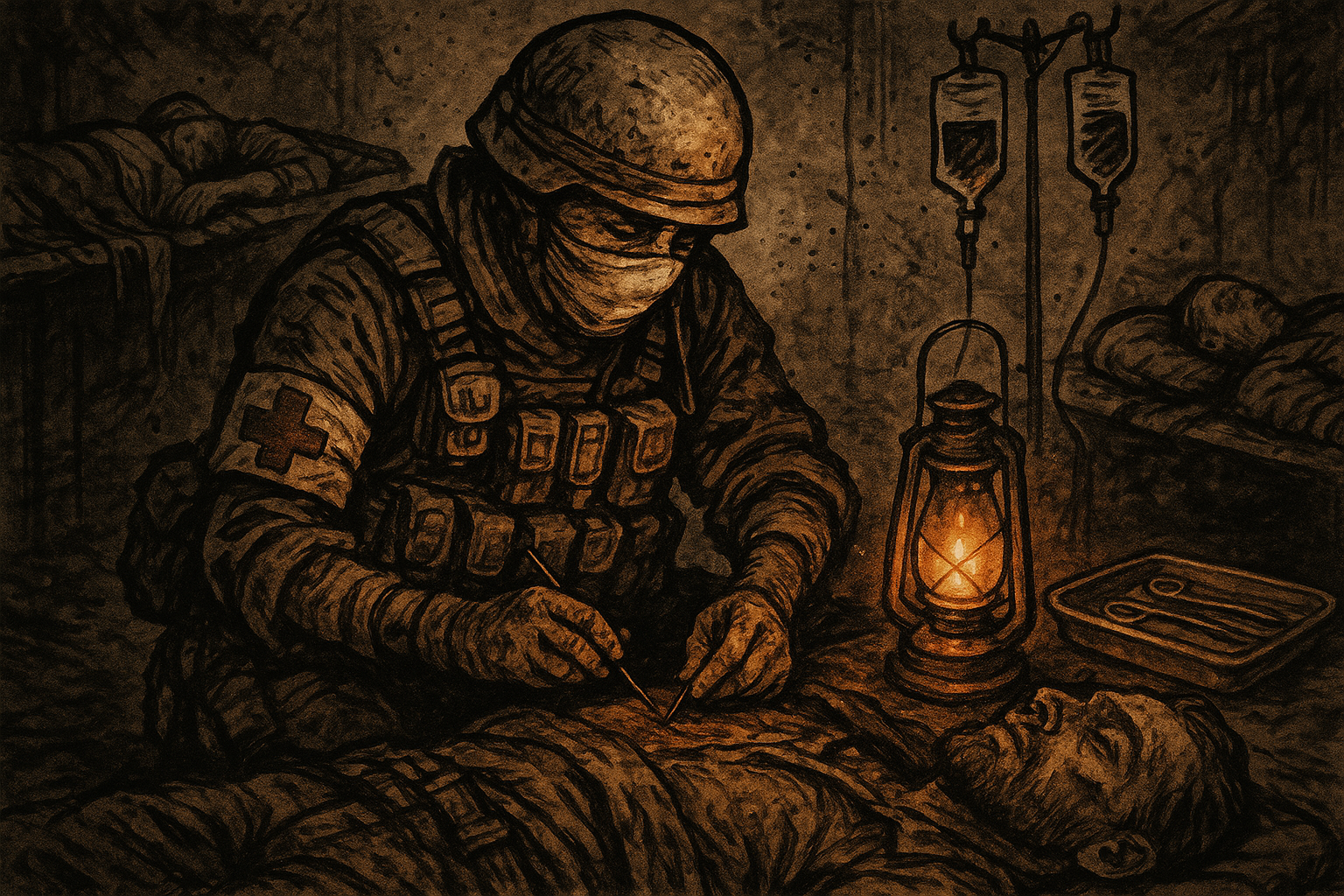
In the Wasteland, death comes quick and mercy comes quicker. The medics are those rare souls who learned to stitch flesh, set bone, and brew remedies from the scraps of Old World medicine and post-Fall herbalism. They walk the razor's edge between healer and butcher, performing surgeries in blood-soaked tents with rusted instruments and homemade antiseptics. Most started as field medics for warbands, caravan surgeons, or plague-town doctors—people who saw so much suffering they either broke or became something harder.
A Medic's pack is a treasure trove: stims scavenged from military caches, bandages torn from pre-war linens, syringes filled with cocktails that blur the line between medicine and poison. They know which mushrooms stop bleeding, which Old World pills still work, and how to keep someone breathing when all hope is lost. In the gritty rest economy where a full recovery takes a week, a good Medic is worth their weight in clean water.
But healing in the Wasteland has a cost. Every saved life is a moral calculation—who gets the last stimpack? Who's worth the risk of infection? Medics carry the weight of every patient they couldn't save, every amputation they performed without anesthetic, every mercy killing. Some maintain their Humanity through rigid ethical codes. Others become cold, efficient triage machines. All of them know: in this world, keeping people alive is the hardest job there is.
Core Statistics
| Attribute | Value |
|---|---|
| Primary Stats | WIS/INT |
| Secondary Stat | END |
| Hit Die | d8 |
| Starting HP | 8 + END modifier |
| Starting Humanity | 10 |
| Starting CP | 15 |
Proficiencies
Weapons: Simple weapons, sidearms Armor: Light armor, medium armor Saving Throws: Will, Fortitude Skills: Medicine +2, Science +2, plus 2 of your choice
Starting Equipment
- Medical kit (20 uses, DC 10 Medicine check to stabilize)
- Medium armor (reinforced surgical gear + scavenged plates, DV 13 + AGI mod, max +2)
- Simple weapon of choice (scalpel, baton, or sidearm)
- Field bag containing: 3 stims (Tier 1, heal 1d8+2 HP each), 10 bandages, 1 vial of antiseptic
- Surgical tools (improvised, grants advantage on Medicine checks for surgery)
Level Progression Features (Levels 1-5)
Level 1: Field Medic
Field Medic (Class Feature, not a spell): 1 Action, touch a creature and restore 1d6 + WIS modifier HP. Uses per short rest: WIS modifier (minimum 2). This does not require a spell slot.
Special: This ability can be used during combat without provoking opportunity attacks from enemies adjacent to you (you've learned to work under fire). At Level 5, healing increases to 2d6 + WIS modifier. At Level 10, it increases to 3d6 + WIS modifier.
Level 1: Triage
Action Cost: Free action / Passive Range: 60 feet Effect: Your trained eye instantly assesses battlefield injuries. You learn the exact current HP of all visible allies within range. Additionally, you can identify which visible creatures are poisoned, diseased, or suffering from ongoing conditions.
Stabilization Expertise: When you stabilize a dying creature (0 HP), they regain 1 HP immediately instead of remaining unconscious. You have advantage on Medicine checks to stabilize. Note: This applies only when you (the Medic) perform the stabilization. If an ally stabilizes you while you are dying, your Triage does not trigger — another creature must use your expertise, not benefit from it passively. However, if you stabilize yourself (e.g., via death saves reaching 3 successes), Triage does trigger and you regain 1 HP upon stabilizing.
Special: HP assessment is always active — you don't need to declare it. Your GM simply tells you ally HP totals when you ask. Note: When an ability triggers "when you heal a creature at 0 HP" (such as Adrenaline Spike), it still triggers even if Triage would bring them to 1 HP — resolve the healing ability first, then apply Triage's +1 HP if the creature would still be at 0 HP after healing.
Level 1: Preventive Care
Action Cost: 1 action Range: Touch (5 feet) Frequency: WIS modifier times per short rest (minimum 1) Effect: You administer preventive treatment to an ally — wrapping joints, applying salves, or injecting a mild stimulant. The target gains damage reduction 2 against the next source of damage they take within the next 10 minutes. At Level 5, this increases to DR 3; at Level 10, DR 4. You can have Preventive Care active on a number of creatures equal to your WIS modifier at once (each on a different creature — you cannot stack multiple applications on the same target).
Special: This ability gives you something to do proactively before combat starts. It does not require a spell slot and is separate from Field Medic.
Level 1: Adrenaline Surge
Action Cost: Reaction (when you take damage) Frequency: WIS modifier times per short rest Effect: When you take damage, you can use your reaction to reduce the damage by your Wisdom (WIS) modifier (minimum reduction of 1). This represents a burst of combat instinct and adrenaline-fueled toughness that lets you shrug off part of an incoming blow.
Special: This stacks with Preventive Care's damage reduction if both are active. Adrenaline Surge applies after all other damage reductions and resistances. Combined with medium armor proficiency, this makes the Medic significantly more durable in the field — essential for a class that must stay alive to keep others alive.
Level 2: Emergency Stabilization
Action Cost: 1 action Range: Touch (5 feet) Effect: You can instantly stabilize a dying creature (0 HP and making death saves). The creature regains 1 hit point and is conscious but prone.
Special: This doesn't count against your Field Medic uses. You can do this even if you've exhausted other healing abilities. The creature gains 1 level of exhaustion (you shocked their system back to function—there are consequences).
Level 3: Combat Medic
Passive Feature Effect: You've trained to heal under fire. You gain the following benefits:
- Healing an ally with Field Medic or any healing spell doesn't provoke opportunity attacks from any enemies
- You can move up to half your speed while administering Field Medic (you work as you move)
- You have advantage on Medicine checks made during combat
- Allies you heal can immediately use their reaction to move 5 feet without provoking opportunity attacks (you pull them to cover)
Level 4: Attribute Improvement
Increase one attribute by +2 or two attributes by +1 each (maximum 20).
Level 5: Miracle Worker (Capstone)
Action Cost: 1 action Range: Touch Frequency: 1/long rest Effect: You perform one of the following medical miracles:
Option 1 - Resurrection: Touch a creature that died within the last 1 minute. That creature returns to life with 1 hit point and 1 level of exhaustion. You cannot revive creatures that died of old age or are missing vital organs. The creature's soul must be willing to return.
Option 2 - Cure All: Touch one living creature. You immediately end ALL of the following conditions affecting them: diseased, poisoned, blinded, deafened, paralyzed, stunned. You can also neutralize one curse, remove one level of exhaustion, or cure one chronic condition (GM's discretion on what qualifies).
Special: This represents the peak of field medicine—part skill, part desperation, part miracle. Even in a world of magic, bringing someone back from death or curing the incurable is legendary.
Skill Trees
Trauma Surgery (Healing Power)
This tree focuses on raw healing capability and surgical intervention.
Tier 1 Abilities (5 CP each):
- Rapid Suture: Field Medic healing +1d6
- Pressure Points: Spend 1 action to grant one ally temporary HP = your WIS modifier + your level (lasts until next short rest)
- Painkiller Injection: When you heal an ally with Field Medic, they gain +2 to their next attack roll or saving throw
Tier 2 Abilities (10 CP each, requires one Tier 1):
- Mass Triage: Field Medic can now target up to 3 allies within 10 feet (roll healing once, each receives that amount)
- Precision Surgery: 1/short rest, perform a 10-minute surgery on a willing creature. Restore 2d8 + WIS modifier HP and remove one lingering wound or chronic condition
- Adrenaline Spike: When you use Field Medic on an ally at 0 HP, they gain +10 feet movement and advantage on their next attack (you flooded them with combat drugs)
Tier 3 Abilities (15 CP each, requires Level 5+ and one Tier 2):
- Battlefield Surgeon: Once per turn, you can use Field Medic as a free action (0 action cost). All other aspects of Field Medic (range, targets, healing roll) remain the same. When healing under fire, your technique is precise enough that it leaves all three of your actions free for combat, movement, or additional abilities.
Pharmacology (Crafting & Chemistry)
Master the creation of drugs, poisons, and chemical enhancements.
Tier 1 Abilities (5 CP each):
Tier 2 Abilities (10 CP each, requires one Tier 1):
- Poison Crafter: Craft poisons during downtime (1 hour, DC 14 Medicine check). Basic poison: 2d6 damage, DC 13 Fortitude save for half. Can coat one weapon or 3 ammo.
- Biochemical Analysis: Spend 10 minutes examining a substance. Learn its exact properties, effects, and any antidotes. You can reverse-engineer drugs you encounter.
- Enhanced Stimpacks: Your crafted stims now heal 2d8+4 HP, and you can craft them during short rest without a check (automatic success)
Tier 3 Abilities (15 CP each, requires Level 5+ and one Tier 2):
- Antidote Specialist: 1 action, touch an ally—immediately end one poisoned or diseased condition. Additionally, you can craft universal antidotes (1 hour, 50cr materials, works on any toxin)
- Performance Enhancers: Craft military-grade combat drugs. During rest, create doses that grant: +4 MIG/AGI/END for 10 minutes (pick one per dose). After effect ends, 2 levels of exhaustion. Dangerous but effective.
Field Support (Buffs & Condition Removal)
Keep your team fighting through protection and condition removal.
Tier 1 Abilities (5 CP each):
- Protective Injection: 1 action, touch ally—grant resistance to poison damage and advantage on Fortitude saves for 1 hour
- Cleansing Touch: When you use Field Medic, you can also remove one minor condition (prone, grappled, or 1 level of exhaustion)
- Shield of Vitality: 1 action, 2/short rest—target ally within 30 ft gains temporary HP = 2 x your WIS modifier (lasts 10 minutes)
Tier 2 Abilities (10 CP each, requires one Tier 1):
- Greater Restoration: 1/short rest, spend 1 action to touch an ally and remove one major condition: blinded, deafened, paralyzed, poisoned, or diseased
- Combat Awareness Protocol: All allies within 30 ft of you gain +1 to DV (you're shouting warnings and tactical advice)
- Second Wind Injection: 1/short rest, touch an ally—they immediately regain HP = half their hit die + your WIS modifier, and can reroll their next failed saving throw
Tier 3 Abilities (15 CP each, requires Level 5+ and one Tier 2):
- Prevent Death: 1/long rest, when an ally within 30 ft would drop to 0 HP, you can use your reaction to have them drop to 1 HP instead (you inject a last-resort stimpack from range)
- Mass Cure: 1/long rest, 1 action—all allies within 30 ft regain 2d8 HP and end one condition of their choice affecting them
Magic: Half-Caster Progression
Medics are half-casters with access to healing and support magic. They learn the modular spell-crafting system but are restricted to cantrips with healing, protective, or support themes.
Spell Slot Progression
| Level | 1st | 2nd | 3rd | 4th | 5th |
|---|---|---|---|---|---|
| 1 | 1 | — | — | — | — |
| 2 | 2 | — | — | — | — |
| 3 | 2 | 1 | — | — | — |
| 4 | 3 | 2 | — | — | — |
| 5 | 3 | 2 | 1 | — | — |
| 6 | 3 | 3 | 1 | — | — |
| 7 | 3 | 3 | 2 | — | — |
| 8 | 3 | 3 | 2 | 1 | — |
| 9 | 3 | 3 | 2 | 1 | — |
| 10 | 3 | 3 | 2 | 2 | 1 |
Spell Slot Recovery: Regain all expended spell slots on a long rest (1 week). During a short rest (8 hours), you can regain spell slots totaling up to half your Medic level (rounded down, minimum 1).
Cantrip Access
Medics start with 2 cantrips known. They can learn additional cantrips by spending 10 CP per cantrip.
Allowed Cantrip Themes:
- Healing (restore HP, stabilize, regeneration)
- Protection (shields, resistance, barriers)
- Support (buffs, condition removal, temporary HP)
- Diagnosis (detect disease, sense injuries, identify poisons)
Restricted: Medics cannot learn damage cantrips or offensive spells through their half-caster progression. If they want offensive magic, they must buy it separately with CP (same as non-casters: 15 CP per cantrip).
Spell Crafting
Medics use the modular spell-crafting system:
- Base Cantrip (Minor Heal, Ward, Cure, etc.)
- Delivery Shape (Touch, Ranged, Area, etc.)
- Effect Modifier (Increased healing, extra duration, condition removal, etc.)
The combination determines the final spell level and slot cost.
Example Crafted Spells:
- Minor Heal (cantrip) + Touch + Amplify (×2 effect) = 1st-level spell: Cure Wounds (2d8 healing, touch)
- Ward (cantrip) + Target Ally + Extended Duration = 1st-level spell: Shield of Faith (+2 DV, 10 minutes)
- Cure (cantrip) + Area (15 ft radius) = 2nd-level spell: Mass Cure Minor Wounds (1d6 healing to all allies in area)
Sample CP Expenditures
Here's how a typical Medic might spend CP from Level 1-5:
Level 1 (15 CP total):
- Rapid Suture (Trauma Surgery Tier 1): 5 CP
- Remaining: 10 CP
Level 2 (25 CP total):
- Stimpack Crafter (Pharmacology Tier 1): 5 CP
- Protective Injection (Field Support Tier 1): 5 CP
- Remaining: 10 CP (saved)
Level 3 (35 CP total):
- Mass Triage (Trauma Surgery Tier 2): 10 CP
- Cleansing Touch (Field Support Tier 1): 5 CP
- Remaining: 5 CP
Level 4 (45 CP total):
- Greater Restoration (Field Support Tier 2): 10 CP
- Remaining: 5 CP
Level 5 (55 CP total):
- Battlefield Surgeon (Trauma Surgery Tier 3): 15 CP
- Remaining: 0 CP
Advanced Specializations (Levels 6-10)
At level 6, the Medic selects one of three Advanced Specializations. These specializations unlock new skill tree branches, powerful abilities, and define the Medic's role in the wasteland's ongoing struggle.
Field Surgeon (Healing Focus)
Flavor: Steady hands in the chaos. Field Surgeons can pull a bullet and stitch a wound while under fire. They are the lifeline of any squad, performing miracles with scalpel and suture where others see only death.
Prerequisites: Medic build, level 6
Level 6 Features:
Level 8 Features:
- Emergency Surgery: You can spend 3 actions and one medical supply to perform emergency surgery on a creature you can touch. The target is healed for 4d8 + your WIS modifier and you remove one lingering injury that has been present for less than 24 hours. This ability can be used once per short rest.
Level 10 Capstone:
- Lazarus Protocol: Once per long rest, you can perform a 1-minute medical procedure to revive a creature that has been dead for no more than 10 minutes. The creature returns to life with 1 HP and 3 levels of exhaustion. Alternatively, you can touch a living creature and heal them completely, restoring all lost HP, removing all conditions, and curing one lingering injury.
New Skill Tree: Surgery (Field Surgeon only, requires level 6+)
The Surgery tree transforms a Field Surgeon from a good healer into a battlefield trauma physician — someone who can pull allies back from death faster, treat injuries that would otherwise take weeks to heal, and keep a dying teammate alive long enough to matter.
Tier 1 Abilities (5 CP each):
- Trauma Triage (5 CP): Your Emergency Stabilization now restores 1d6 + WIS modifier HP to the stabilized creature (instead of 1 HP). They still gain 1 level of exhaustion, but they're conscious and mobile — not just not-dead.
- Surgical Precision (5 CP): When you use Field Medic on a creature that was attacked since the start of your last turn, add your WIS modifier as bonus healing on top of the normal roll. You've identified the specific trauma and addressed it directly.
- Field Sutures (5 CP): When you use Emergency Surgery, the patient gains +2 DV until the start of your next turn. You've reinforced their wounds with pressure bandages and repositioned them for better cover.
Tier 2 Abilities (10 CP each, requires one Surgery Tier 1):
- Advanced Trauma Protocol (10 CP): Once per short rest, you can perform Emergency Surgery using only 2 actions instead of 3. The medical supply cost and healing remain unchanged. Your other Emergency Surgery uses that short rest still require 3 actions.
- Extended Care Window (10 CP): Emergency Surgery can now remove lingering injuries that have been present for up to 72 hours (instead of 24). Additionally, you can attempt to treat injuries up to 7 days old with a successful Medicine DC 18 check. Old war wounds, chronic injuries — a master surgeon sees what others see as permanent.
- Stabilizing Surge (10 CP): When you use Field Medic on a creature at 0 HP (stabilizing them), the creature regains consciousness immediately upon being healed and gains advantage on their first action this turn. You haven't just saved them — you've thrown them back into the fight.
Tier 3 Abilities (15 CP each, requires Level 5+ and one Surgery Tier 2):
- Miracle Hands (15 CP): Your Emergency Surgery heals an additional 3d8 HP. Additionally, you can now perform Emergency Surgery as a 2-action procedure permanently — not limited to once per short rest. The 3-action version still exists if you prefer to maximize other actions.
- Last Rites Prevention (15 CP): Once per long rest, when an ally within 30 feet is reduced to 0 HP, you can use your reaction to immediately use Field Medic on them — applying the healing before death saves begin. If the healing brings them above 0 HP, they remain conscious. Note: This is distinct from Field Support T3 "Prevent Death" — that prevents 0 HP from occurring; this responds after 0 HP is reached. A Field Surgeon with both abilities has two independent life-saving reactions per long rest.
Pharmacist (Buffs/Drugs/Chemistry)
Flavor: Better living through chemistry. Pharmacists brew stims, combat drugs, poisons, and powerful concoctions from wasteland flora and pre-war chemical stockpiles. They believe every problem has a chemical solution.
Prerequisites: Medic build, level 6
Level 6 Features:
- Combat Stimulants (Class Feature): As 1 action, grant an ally within 30 feet temporary HP equal to 1d8 + WIS modifier and +2 DV for 1 minute. Uses per short rest: WIS modifier (minimum 1). This is NOT the same as using a stim item. During a short rest, you can also craft a number of combat stimulant doses equal to your WIS modifier.
Level 8 Features:
Level 10 Capstone:
Masterwork Serum: Once per long rest, during any rest period, you can craft one masterwork serum — a compound beyond anything available commercially. Choose one of the following formulas:
Option A — Combat Accelerant: When injected 1 Action, the target gains an additional action each turn for 1 minute (total: 4 actions per turn). This action can be used for any purpose: attacks, movement, abilities, or anything else. When the effect ends, the target immediately gains 3 levels of exhaustion (the physical cost of operating beyond biological limits). Choose carefully — this is the ability that changes the outcome of a fight, and it has a real price.
Option B — Anti-Necrotix: When administered 1 Action , choose one effect:
- Restoration: Immediately end all conditions, diseases, poisons, and lingering injuries affecting the target. Remove 1 level of exhaustion.
- Preservation: The target is immune to failing death saves for 1 minute and gains 1 level of exhaustion. They can still be reduced to 0 HP and make death saves — but no roll can cause them to fail three times and die. A Pharmacist prevents death; a Field Surgeon reverses it.
Option C — Cascade Formula: When administered 1 Action , for 1 minute, whenever you heal any creature with any healing ability (Field Medic, Combat Stimulants, spell slots, or any other healing source), up to 1d4 nearby allies of your choice within 15 feet of the healed creature also receive the same healing amount. Each use of a healing ability can trigger this cascade once. You become a walking triage network for the duration of the most critical minute of the fight.
The serum must be crafted during a short or long rest (you prepare for what you expect to face) and is consumed on use. You can only have one masterwork serum prepared at a time.
New Skill Tree: Chemistry (Pharmacist only, requires level 6+)
The Chemistry tree is about two things: making your formulas last longer and hit harder, and expanding your formula repertoire so you have the right chemical for every situation. A Pharmacist who invests here doesn't just brew better stims — they become a walking pharmaceutical factory with an answer to every battlefield problem.
Tier 1 Abilities (5 CP each):
- Extended Potency (5 CP): All drug durations you create are doubled: Combat Stimulants last 2 minutes instead of 1. Berserker Juice's effects last 2 minutes (exhaustion still triggers at the 2-minute mark). Clearwater lasts 2 hours instead of 1.
- Field Synthesis (5 CP): During a short rest, you can attempt to craft one dose of Berserker Juice or Clearwater from available materials (Medicine DC 14 check). On a success, you produce one dose. On a failure, the materials are used but no dose is created.
- Pharmacokinetic Precision (5 CP): When you inject a target with a formula that carries an exhaustion consequence (Berserker Juice, Formula: Ironhide, Forbidden Compound), the target has a 1-minute warning period as they feel the drug beginning to fade. During this window, they can choose to voluntarily end the effect early (0 exhaustion) or ride it to full duration (full exhaustion applies normally). This puts the choice in the player's hands.
Tier 2 Abilities (10 CP each, requires one Chemistry Tier 1):
Tier 3 Abilities (15 CP each, requires Level 5+ and one Chemistry Tier 2):
- Pharmacological Mastery (15 CP): All Formulas can be used one additional time per rest (Berserker Juice: 2 uses per long rest; Ironhide: 2/LR; Combat Stimulants: WIS modifier + 1 uses per short rest). The save DC of any poison or drug you create increases by 2.
Plague Doctor (Poison/Disease/Debuff)
Flavor: They know death intimately — and they've learned to weaponize it. Plague Doctors wield diseases, toxins, and biological terror as their arsenal. Behind their masks, they are scholars of mortality itself.
Prerequisites: Medic build, level 6
Level 6 Features:
- Toxic Strike: Once per turn when you hit a creature with a weapon attack, you can add 1d6 poison damage. The target must make a Fortitude save (DC = 8 + WIS + proficiency) or become poisoned for 1 minute. They can repeat the save at the end of each of their turns.
- Plague Mask: You are immune to disease and have advantage on saving throws against poison. You can diagnose any disease or poison by examining a patient or substance for 1 action, learning its nature, effects, and potential cures.
Level 8 Features:
Level 10 Capstone:
- Outbreak: Once per long rest, you can touch a creature and infect them with a virulent disease, making them Patient Zero. At the end of each of their turns, all creatures within 10 ft of Patient Zero must make a Fortitude save (DC 18) or take 3d6 necrotic damage and become carriers themselves for 1 minute. The disease spreads from carriers to other creatures in the same way. You and designated allies (up to your WIS modifier) are immune to this disease.
New Skill Tree: Contagion (Plague Doctor only, requires level 6+)
The Contagion tree is about two things: making your poisons and diseases harder to resist, and spreading them. A Plague Doctor who invests here turns every combat into a game of infection control that only they can win. Every poisoned creature becomes a vector. Every failed save spreads the damage.
Tier 1 Abilities (5 CP each):
- Virulence Boost (5 CP): Your Toxic Strike save DC increases by 2 (total DC: 10 + WIS + proficiency). Creatures that fail their initial Fortitude save against Toxic Strike have disadvantage on their repeat saves each turn. Harder to resist, harder to shake.
- Contagion Vector (5 CP): Creatures poisoned by your Toxic Strike or Miasma become infection vectors. Once per turn, when a carrier is adjacent to another creature, that creature must make a Fortitude DC 10 save or take 1d4 poison damage. This spread lasts as long as the carrier remains poisoned.
- Miasma Mastery (5 CP): Your Miasma now deals 3d6 poison damage (instead of 2d6). Additionally, as a free action at the start of each of your turns, you can reposition the Miasma cloud to a new point within 30 feet (no concentration check required for movement). Miasma is no longer a static hazard; it follows the battlefield.
Tier 2 Abilities (10 CP each, requires one Contagion Tier 1):
- Resurgent Pathogen (10 CP): When a creature you have poisoned or diseased successfully saves to end the condition, they must immediately make a second save at the same DC. On failure, the condition returns as if freshly applied (duration resets). This second-chance save only triggers once per creature per encounter.
- Weaponized Immunity (10 CP): Once per short rest, as 1 action, exhale a concentrated pathogen cloud centered on yourself (15-foot radius). All creatures in the area must make a Fortitude save (DC 8 + WIS + proficiency) or take 2d6 poison damage and become poisoned. You are immune to this effect.
Tier 3 Abilities (15 CP each, requires Level 5+ and one Contagion Tier 2):
- Pandemic Strain (15 CP): Your Outbreak (L10 capstone) becomes harder to resist: the save DC increases from 18 to 20. Creatures that become carriers through Outbreak suffer −2 to all saving throws for the duration. You can designate WIS modifier + 1 allies as immune (instead of just WIS modifier).
- Biological Battlefield (15 CP): Once per short rest, as 1 action, you can transmit one active disease or poison condition you control (including Toxic Strike poisoning or an active Outbreak infection) to one creature within 30 ft that is adjacent to an already-infected creature. This transmission requires no saving throw — the proximity transfer is guaranteed. A battlefield of infected creatures is a battlefield you control.
Level 16: Miracle Medicine (Build Capstone)
Your medical expertise borders on the supernatural. Your Field Medic ability now heals 3d8 + WIS modifier HP. You can stabilize dying creatures within 30 ft without touching them 1 Action . Whenever you heal an ally, you may also remove one condition (blinded, deafened, poisoned, frightened, or stunned) from them.
Level 17: Specialization Final Evolution
Field Surgeon — Trauma Specialist
Your healing abilities no longer provoke opportunity attacks. You can perform Surgery in 10 minutes (instead of 1 hour). Your Surgery ability can now restore lost limbs and cure diseases. Creatures you bring back from 0 HP gain temporary HP equal to your WIS modifier + proficiency bonus.
Pharmacist — Pharmacological Mastery
You can create advanced stims and drugs in 1 hour (instead of 8). Your stims have double duration. You gain immunity to poison and disease. Once per long rest, you can create a miracle drug: one dose that removes all exhaustion, cures all diseases, and grants advantage on all rolls for 1 hour.
Plague Doctor — Pandemic
Your poisons and diseases can no longer be resisted by creatures with poison resistance (immunity is treated as resistance). When you apply a poison or disease, it spreads to all hostile creatures within 10 ft of the initial target (same save DC). You gain immunity to all poisons and diseases. Once per long rest, you can unleash a Virulent Outbreak: all enemies within 30 ft must make a Fortitude save (DC 8 + WIS + prof) or gain 2 levels of a wasting disease (disadvantage on all physical checks and saves, 2d6 necrotic damage per round, curable only by Greater Restoration or long rest).
Level 20: Phoenix Protocol (Apex Ability)
Once per long rest (1 week)
You channel the ultimate healing power—the ability to resurrect life from death and restore any injury. This is your magnum opus.
Effects:
- Touch one creature 1 Action
- The creature is immediately restored to full HP
- All conditions, diseases, poisons, curses, and lingering injuries are removed
- All levels of exhaustion are removed
- The creature gains advantage on all attack rolls, ability checks, and saving throws for 1 minute
- If the creature is dead (deceased within the last 1 hour): they return to life at full HP with all the above benefits
Drawback: The life force required for Phoenix Protocol is immense. You immediately gain 4 levels of exhaustion after using this ability. You may collapse immediately after saving someone's life—consider this carefully.